R-454B vs R-32
Reviewed · pressures computed with CoolProp 8.0 from the same data as the PT charts
Can you put R-32 in an R-454B system, or the reverse?
No. Both are A2L, but each system is designed and listed for one refrigerant. R-32 runs 13.5 psi higher than R-454B at 40°F evaporating, and Carrier says equipment components, controls and safety requirements are designed around the specified refrigerant. Charge only what is on the nameplate.
Pressures side by side
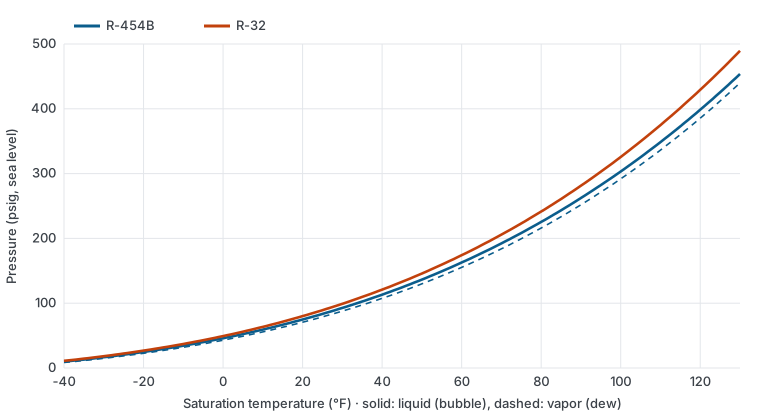
Saturation pressure in psig at sea level. Evaporating rows use the vapor (dew) value, condensing rows the liquid (bubble) value, which is what you compare with suction and liquid-line gauges. The last column is R-32 minus R-454B.
| Saturation | R-454B | R-32 | Difference |
|---|---|---|---|
| Evaporator (vapor, dew) | |||
| -20°F | 22.7 | 26.8 | +4.1 (+18%) |
| 0°F | 42.9 | 49.3 | +6.3 (+15%) |
| 20°F | 70.6 | 80.0 | +9.4 (+13%) |
| 30°F | 87.8 | 99.1 | +11.3 (+13%) |
| 35°F | 97.3 | 109.7 | +12.3 (+13%) |
| 40°F | 107.5 | 121.0 | +13.5 (+13%) |
| 45°F | 118.3 | 133.0 | +14.7 (+12%) |
| 50°F | 129.9 | 145.9 | +16.0 (+12%) |
| Condenser (liquid, bubble) | |||
| 80°F | 225.4 | 241.5 | +16.1 (+7%) |
| 90°F | 262.3 | 281.3 | +19.0 (+7%) |
| 95°F | 282.3 | 302.9 | +20.7 (+7%) |
| 100°F | 303.3 | 325.7 | +22.4 (+7%) |
| 105°F | 325.4 | 349.7 | +24.3 (+7%) |
| 110°F | 348.6 | 374.9 | +26.3 (+8%) |
| 115°F | 373.0 | 401.4 | +28.4 (+8%) |
| 120°F | 398.6 | 429.3 | +30.7 (+8%) |
| 125°F | 425.5 | 458.7 | +33.2 (+8%) |
| 130°F | 453.6 | 489.5 | +35.8 (+8%) |
Properties
| Property | R-454B | R-32 |
|---|---|---|
| Safety class | A2L | A2L |
| Type | HFC/HFO, zeotropic blend | HFC, single-component refrigerant |
| Composition (mass %) | R-32 68.9, R-1234yf 31.1 | Single component |
| GWP (AR4) | 466 | 675 |
| Lubricant | POE (some OEMs PVE) | POE |
| Boiling point (14.7 psia) | -59.3°F | -61.0°F |
| Critical point | 172.9°F, 769 psia | 172.6°F, 839 psia |
| Glide at 40°F evaporating | 2.7°F | 0.0°F |
| Glide at 100°F condensing | 2.7°F | 0.0°F |
| US status | Meets the 700 GWP limit for new US residential and light commercial AC/HP from Jan 1 2025; SNAP-acceptable in new equipment only, not as an R-410A retrofit. | GWP 675 is below the 700 limit for new US residential and light commercial AC/HP from Jan 1 2025; SNAP-acceptable in new equipment subject to use conditions. |
Component compatibility
| Item | R-454B | R-32 |
|---|---|---|
| Composition | R-32 68.9% / R-1234yf 31.1% | Single component |
| Lubricant | POE or PVE as specified by the OEM | POE (Copeland POE-46) |
| PT column | Dew for superheat, bubble for subcooling | One column (zero glide) |
| Charging | Liquid (zeotrope) | No fractionation; Danfoss: initial charge as liquid |
| Equipment listing | Listed for R-454B under UL 60335-2-40 | Listed for R-32 under UL 60335-2-40 |
| Recovery machine | A2L-rated machine (UL 1963 SB / 40 CFR 82.158 App. B4) | A2L-rated machine (UL 1963 SB / 40 CFR 82.158 App. B4) |
| Cylinder | RAL 7044 gray with red band | RAL 7044 gray with red band (legacy light blue-green) |
| GWP (AR4) | 466 (EPA 84.64: 465) | 675 |
What changes in the field
These are the two refrigerants US manufacturers moved to when R-410A left new residential equipment. R-454B is a blend of R-32 and R-1234yf. R-32 is the pure fluid. Both are ASHRAE class A2L, so the handling rules are the same: A2L-rated recovery machines (40 CFR 82.158 Appendix B4, UL 1963 Supplement SB), A2L-rated service equipment as OEMs require, red-banded RAL 7044 cylinders, and often left-hand thread valves. The A2L refrigerants guide covers the site and brazing side.
Pressures differ more than the R-410A heritage suggests. From the PT data, R-32 dew pressure at 40°F is 13.5 psi above R-454B. At 100°F condensing, R-32 bubble is 325.7 psig and R-454B is 303.3 psig, 22.4 psi apart. R-454B sits below R-410A and R-32 sits slightly above it.
Glide is the other field difference. R-454B is a zeotrope with about 2.7°F of glide at 40°F evaporating. Read dew for superheat and bubble for subcooling. R-32 has zero glide, so there is one column. R-454B is charged as liquid. R-32 does not fractionate, though Danfoss still calls for a liquid initial charge.
Oil: Copeland lists POE for both. Carrier says R-454B equipment uses the POE or PVE lubricant the manufacturer specifies.
Retrofit or replacement
Neither one goes into the other’s system. Each piece of equipment is listed under UL 60335-2-40 for a specific refrigerant, with charge limits and, where required, leak detection set around that refrigerant’s properties. Carrier states that “equipment components, controls and safety requirements are designed around the specified refrigerant” and tells technicians to use the manufacturer’s specified pressures, charging procedure and service documentation. The metering device and controls are tuned for one pressure curve, and the gap in the table above is big enough to matter.
When you replace a system, choose by brand and model line rather than by refrigerant. Parts, service cylinders and the OEM’s charging charts follow the brand. For the three-way view including R-410A, see What replaces R-410A.
Capacity, efficiency and cost
Arkema, an R-32 supplier, claims R-32 has “higher capacity and better efficiency over R-410A” and allows a smaller charge. It gives no number and no comparison against R-454B. Carrier’s R-454B page gives no efficiency comparison either. No percentage is quoted here. Compare AHRI ratings of the actual systems.
GWP on the AR4 basis is 466 for R-454B and 675 for R-32 (EPA’s 40 CFR 84.64 calculation gives R-454B 465). Both are under the 700 limit for new residential and light commercial AC and heat pumps. On cost, the only sourced point is that the 2026 final rule preamble (91 FR 31284) discusses R-454B service-cylinder supply shortages.
Common questions
Which is more flammable, R-454B or R-32?
Both carry the same ASHRAE 34 class, 2L, which means low burning velocity (10 cm/s or less) and an LFL above 0.10 kg/m³. Charge limits for each come from UL 60335-2-40 and the equipment listing, not from a field judgment. See flammability safety classes.
R-454B vs R-32: which is better?
Neither is better for a system designed for the other. R-454B has the lower GWP but has glide. R-32 is a single component with no glide, which makes recovery and recharge simpler. The equipment you install decides which one you service.
Can you mix R-454B and R-32?
No. A mixture is neither refrigerant and matches neither PT chart. Recover each into its own cylinder.
PT charts and calculators
Sources
- Carrier: R-454B refrigerant carrier.com
- Arkema: R-32 as a replacement for R-410A forane.arkema.com
- Copeland AE Bulletin 93-11: Refrigerants and Lubricants Approved for Use in Copeland Compressors webapps.copeland.com
- 86 FR 24444 (May 6 2021), SNAP Rule 23: A2L refrigerants in residential and light commercial AC and heat pumps federalregister.gov
- 40 CFR 84.64: Global warming potentials for Technology Transitions ecfr.gov
- 40 CFR 82.158: Standards for recovery and/or recycling equipment ecfr.gov
- 91 FR 31284 (May 26 2026): Reconsideration of Certain Technology Transitions Requirements federalregister.gov
Reviewed . Found an error? Tell us and we will correct it.