R-290 (propane) PT Chart and Refrigerant Profile
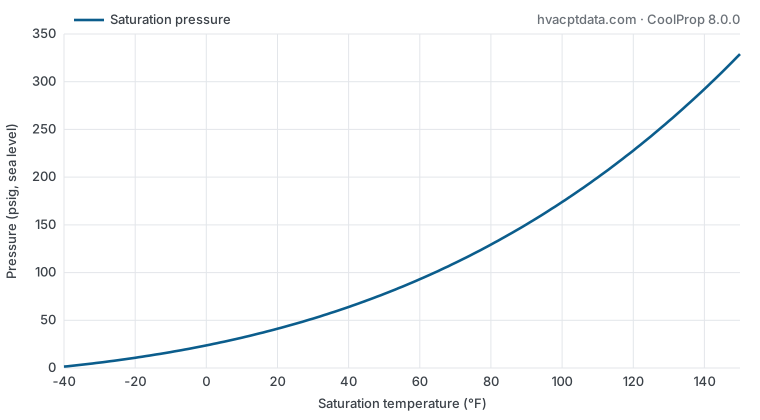
R-290 (propane) is an A3 hydrocarbon single-component refrigerant. It saturates at 63.9 psig at 40°F and 173.9 psig at 100°F.
Reviewed · PT values computed with CoolProp 8.0.0 and checked against NIST reference data (largest difference 0.0 psi)
R-290 at a glance
| Safety class (ASHRAE 34) | A3: lower toxicity, highly flammable |
|---|---|
| Type | HC, single-component refrigerant |
| GWP (100-year, AR4) | Not listed in AR4Not listed in IPCC AR4. EPA uses 3.3 under 40 CFR 84.64; EPA SNAP pages list 3. |
| Ozone depletion potential | 0 |
| Lubricant | POE, PAG or PAO (per compressor maker) |
| Boiling point at 14.7 psia | -43.8°F |
| Critical point | 206.1°F, 617 psia |
| 40°F evaporating | 63.9 psig |
| 100°F condensing | 173.9 psig |
| Charge as | Vapor or liquid |
| Typical use | Stand-alone retail cases and merchandisers; Vending machines; Self-contained room AC (window; portable; PTAC); Ice machines and water coolers; Household refrigerators |
| Trade names | CARE 40 (Linde) |
| US status | Not an ODS or AIM Act regulated HFC; EPA SNAP-acceptable with use conditions in listed self-contained end uses, most recently commercial refrigeration (June 2024). |
| Replaces | R-404A, R-134a, R-22 |
R-290 PT chart (°F and psig)
R-290 is a single-component refrigerant, so one pressure applies at each temperature for both the evaporator and the condenser. Tap a row to load it into the lookup.
-40°F to 150°F · psig at sea level · °C and kPa in the CSV · italic = inches Hg vacuum
| °F | psig |
|---|---|
| -40 | 1.4 |
| -39 | 1.8 |
| -38 | 2.2 |
| -37 | 2.6 |
| -36 | 3.0 |
| -35 | 3.5 |
| -34 | 3.9 |
| -33 | 4.3 |
| -32 | 4.8 |
| -31 | 5.2 |
| -30 | 5.7 |
| -29 | 6.1 |
| -28 | 6.6 |
| -27 | 7.1 |
| -26 | 7.6 |
| -25 | 8.1 |
| -24 | 8.6 |
| -23 | 9.1 |
| -22 | 9.7 |
| -21 | 10.2 |
| -20 | 10.7 |
| -19 | 11.3 |
| -18 | 11.9 |
| -17 | 12.4 |
| -16 | 13.0 |
| -15 | 13.6 |
| -14 | 14.2 |
| -13 | 14.8 |
| -12 | 15.4 |
| -11 | 16.1 |
| -10 | 16.7 |
| -9 | 17.4 |
| -8 | 18.0 |
| -7 | 18.7 |
| -6 | 19.4 |
| -5 | 20.1 |
| -4 | 20.8 |
| -3 | 21.5 |
| -2 | 22.2 |
| -1 | 23.0 |
| 0 | 23.7 |
| 1 | 24.5 |
| 2 | 25.2 |
| 3 | 26.0 |
| 4 | 26.8 |
| 5 | 27.6 |
| 6 | 28.4 |
| 7 | 29.2 |
| 8 | 30.1 |
| 9 | 30.9 |
| 10 | 31.8 |
| 11 | 32.7 |
| 12 | 33.6 |
| 13 | 34.5 |
| 14 | 35.4 |
| 15 | 36.3 |
| 16 | 37.3 |
| 17 | 38.2 |
| 18 | 39.2 |
| 19 | 40.2 |
| 20 | 41.1 |
| 21 | 42.1 |
| 22 | 43.2 |
| 23 | 44.2 |
| 24 | 45.2 |
| 25 | 46.3 |
| 26 | 47.4 |
| 27 | 48.5 |
| 28 | 49.6 |
| 29 | 50.7 |
| 30 | 51.8 |
| 31 | 53.0 |
| 32 | 54.1 |
| 33 | 55.3 |
| 34 | 56.5 |
| 35 | 57.7 |
| 36 | 58.9 |
| 37 | 60.1 |
| 38 | 61.4 |
| 39 | 62.7 |
| 40 | 63.9 |
| 41 | 65.2 |
| 42 | 66.6 |
| 43 | 67.9 |
| 44 | 69.2 |
| 45 | 70.6 |
| 46 | 72.0 |
| 47 | 73.4 |
| 48 | 74.8 |
| 49 | 76.2 |
| 50 | 77.6 |
| 51 | 79.1 |
| 52 | 80.6 |
| 53 | 82.1 |
| 54 | 83.6 |
| 55 | 85.1 |
| 56 | 86.7 |
| 57 | 88.2 |
| 58 | 89.8 |
| 59 | 91.4 |
| 60 | 93.0 |
| 61 | 94.7 |
| 62 | 96.3 |
| 63 | 98.0 |
| 64 | 99.7 |
| 65 | 101.4 |
| 66 | 103.1 |
| 67 | 104.9 |
| 68 | 106.6 |
| 69 | 108.4 |
| 70 | 110.2 |
| 71 | 112.0 |
| 72 | 113.9 |
| 73 | 115.7 |
| 74 | 117.6 |
| 75 | 119.5 |
| 76 | 121.5 |
| 77 | 123.4 |
| 78 | 125.4 |
| 79 | 127.3 |
| 80 | 129.3 |
| 81 | 131.4 |
| 82 | 133.4 |
| 83 | 135.5 |
| 84 | 137.6 |
| 85 | 139.7 |
| 86 | 141.8 |
| 87 | 144.0 |
| 88 | 146.1 |
| 89 | 148.3 |
| 90 | 150.5 |
| 91 | 152.8 |
| 92 | 155.0 |
| 93 | 157.3 |
| 94 | 159.6 |
| 95 | 161.9 |
| 96 | 164.3 |
| 97 | 166.7 |
| 98 | 169.1 |
| 99 | 171.5 |
| 100 | 173.9 |
| 101 | 176.4 |
| 102 | 178.9 |
| 103 | 181.4 |
| 104 | 183.9 |
| 105 | 186.5 |
| 106 | 189.1 |
| 107 | 191.7 |
| 108 | 194.3 |
| 109 | 197.0 |
| 110 | 199.6 |
| 111 | 202.4 |
| 112 | 205.1 |
| 113 | 207.8 |
| 114 | 210.6 |
| 115 | 213.4 |
| 116 | 216.3 |
| 117 | 219.1 |
| 118 | 222.0 |
| 119 | 224.9 |
| 120 | 227.9 |
| 121 | 230.8 |
| 122 | 233.8 |
| 123 | 236.8 |
| 124 | 239.9 |
| 125 | 242.9 |
| 126 | 246.0 |
| 127 | 249.2 |
| 128 | 252.3 |
| 129 | 255.5 |
| 130 | 258.7 |
| 131 | 261.9 |
| 132 | 265.2 |
| 133 | 268.5 |
| 134 | 271.8 |
| 135 | 275.1 |
| 136 | 278.5 |
| 137 | 281.9 |
| 138 | 285.4 |
| 139 | 288.8 |
| 140 | 292.3 |
| 141 | 295.8 |
| 142 | 299.4 |
| 143 | 303.0 |
| 144 | 306.6 |
| 145 | 310.2 |
| 146 | 313.9 |
| 147 | 317.6 |
| 148 | 321.4 |
| 149 | 325.1 |
| 150 | 328.9 |
Where you will find R-290
In the US, R-290 shows up almost entirely in factory-built, self-contained equipment: reach-in coolers and merchandisers, vending machines, ice machines, water coolers, household refrigerators and self-contained room air conditioners (window, portable and PTAC units). EPA lists it as acceptable subject to use conditions in each of those end uses under its SNAP program. Self-contained room AC and household refrigerators were listed April 10, 2015 (80 FR 19454), and the household listing was updated August 8, 2018 to reference UL 60335-2-24. Ice machines and other commercial refrigeration followed in SNAP Rule 26 (89 FR 50410, June 13, 2024), which ties charge limits to UL 60335-2-89. It is not acceptable in motor vehicle AC.
In those cases it took the place of R-404A, R-134a and R-22. You identify it from the nameplate and the compressor label; it is not something you will find in a field-installed split system today. EPA’s pending SNAP Rule 27 (proposed November 10, 2025) would revise the use conditions for residential AC, but it was not final at the time of review.
Propane runs in roughly the same pressure band as R-22, so gauge readings look familiar. At 40°F saturation R-290 reads 63.9 psig against 68.6 psig for R-22; at 100°F it is 173.9 psig against 195.9 psig. Similar pressures do not make it a drop-in: Linde, which sells it as CARE 40, states that R-290 is not a retrofit refrigerant.
Charging R-290
Charge by weight, and weigh accurately. The charge limit is part of the product’s safety listing under the SNAP use conditions, so the nameplate charge is the number to hit, not a pressure. Danfoss notes that the R-290 charge in a hermetic system is roughly 40 to 45% of the mass of the equivalent HFC charge, which is why an ounce of error matters far more than it would on an R-404A box.
Because R-290 is a single-component refrigerant there is no glide and no fractionation: the PT chart above has one column, used for both the evaporator and the condenser. If the unit has access ports and you need to diagnose rather than charge, superheat and subcooling work the same as with any pure fluid: read suction pressure, convert with the chart and use the superheat calculator; read liquid pressure and use the subcooling calculator. The manufacturer’s service data sets the targets.
Evacuate before charging as you would any sealed system; the evacuation microns guide covers targets and decay tests.
Oil and compatibility
There is no single R-290 oil. Copeland approves several POE grades and PAG-68 depending on the compressor model; Danfoss uses POE; BITZER ships PAG (BSG68K) as standard with PAO as an option. Hydrocarbons dissolve readily in oil, so compressor makers often specify a higher viscosity grade than they would for an HFC. Use exactly the oil on the compressor label, and treat the compressor and refrigerant as a matched pair. The refrigerant oil types guide explains the families.
Safety, handling and recovery
A3 means lower toxicity and high flammability under ASHRAE 34: LFL at or below 0.10 kg/m³ or heat of combustion of 19,000 kJ/kg or more. The flammability safety classes page compares A3 with A2L. Keep ignition sources away, ventilate, and do not braze on a circuit that still holds refrigerant.
Section 608: at 104°F R-290 saturates at 183.9 psig (198.6 psia), which puts it in the high-pressure class (170 to 355 psia) under 40 CFR 82.152. Household refrigerators and other factory-sealed units with 5 lb or less are small appliances (Type I); other equipment needs Type II. Universal covers both.
R-290 is one of the hydrocarbons that 40 CFR 82.154(a)(1) exempts from the venting prohibition, but only in the listed end uses: stand-alone retail units, household refrigerators and freezers, self-contained room AC, vending machines, self-contained ice machines, very-low-temperature equipment, water coolers and (from July 15, 2024) refrigerated food processing and dispensing equipment. Outside those uses it is a non-exempt substitute: no venting, required recovery levels apply (small appliances 90% with the compressor running, 80% not running, or 4 in Hg vacuum; high-pressure appliances under 200 lb to 0 in Hg), and since January 1, 2018 sales are restricted to certified technicians. A recovery machine used on it must be certified for flammable refrigerants (40 CFR 82.158 Appendix B4, which adds UL 1963 Supplement SB); see recovery machine compatibility.
Cylinders: new refrigerant containers are light green-gray RAL 7044 under AHRI Guideline N-2017, with a red band on the shoulder or top for flammable refrigerants. EPA’s SNAP use conditions specify red (PMS #185) flammable-refrigerant markings. Details are on the cylinder colors page.
Status and replacements
R-290 is not an ozone-depleting substance and not a regulated HFC, so the AIM Act allowance phasedown and the Technology Transitions GWP limits do not restrict it. Where it can be used is set by SNAP use conditions, end use by end use. Its GWP has no IPCC AR4 value; EPA uses 3.3 in 40 CFR 84.64 and its SNAP pages list 3. For the wider picture of R-404A options in commercial refrigeration, see the R-404A replacement comparison.
Common questions
Is R-290 dangerous?
It is classed A3, highly flammable, which is why EPA allows it only in specific self-contained end uses with charge limits tied to UL 60335-2-24 (household) and UL 60335-2-89 (commercial). Its toxicity class is A, the lower of the two ASHRAE toxicity classes.
Can R-290 replace R-22 in an existing system?
No. Its pressures are close to R-22, but Linde states R-290 is not a retrofit refrigerant, and EPA’s acceptability covers new self-contained equipment designed for it, not field conversion of R-22 systems.
How this chart was computed
Every pressure on this page is calculated, not copied: CoolProp 8.0.0 (HEOS backend), the open-source implementation of the reference equations of state, using the model pure:Propane. Gauge values assume sea-level air pressure (14.696 psia); kPa values in the CSV are absolute.
Spot check against NIST Chemistry WebBook, SRD 69, Thermophysical Properties of Fluid Systems: Propane, saturation properties (temperature increments):
| °F | Column | Published | This chart | Difference |
|---|---|---|---|---|
| 0 | saturation | 38.4 psia | 38.4 psia | 0.0 psi |
| 40 | saturation | 78.6 psia | 78.6 psia | 0.0 psi |
| 120 | saturation | 242.5 psia | 242.5 psia | 0.0 psi |
NIST WebBook implements the same reference equation of state as CoolProp, so near-zero deviation there confirms the implementation and unit handling. No manufacturer chart was checked.
Charts from different publishers can differ by a few tenths of a psi because of the equation of state and blend tolerances. Always charge to the equipment manufacturer's data. Full method and every spot check
Comparisons with R-290
Calculators for R-290
Sources
- EPA SNAP Rule 26 (89 FR 50410, June 13 2024): R-290 and A2Ls in commercial refrigeration federalregister.gov
- EPA SNAP: Substitutes in Household Refrigerators and Freezers epa.gov
- eCFR 40 CFR 82.154: venting prohibition and exempt substitutes ecfr.gov
- eCFR 40 CFR 82.152: Section 608 definitions and pressure classes ecfr.gov
- Danfoss: Practical application of R600a and R290 in small hermetic systems assets.danfoss.com
- Copeland AE Bulletin 93-11: Refrigerants and lubricants approved for Copeland compressors webapps.copeland.com
- Linde CARE 40 (R-290) product data static.prd.echannel.linde.com
- eCFR 40 CFR 84.64: GWPs used for Technology Transitions ecfr.gov
Reviewed . Found an error? Tell us and we will correct it.
More in Natural refrigerants