R-290 vs R-32
Reviewed · pressures computed with CoolProp 8.0 from the same data as the PT charts
Can R-290 replace R-32 in an existing heat pump or air conditioner?
No. R-290 runs at about half the pressure of R-32, is class A3 rather than A2L, and in US residential AC EPA lists it only for new self-contained room air conditioners. Both are new-equipment refrigerants under SNAP, so a system is charged only with the refrigerant it was designed and listed for.
Pressures side by side
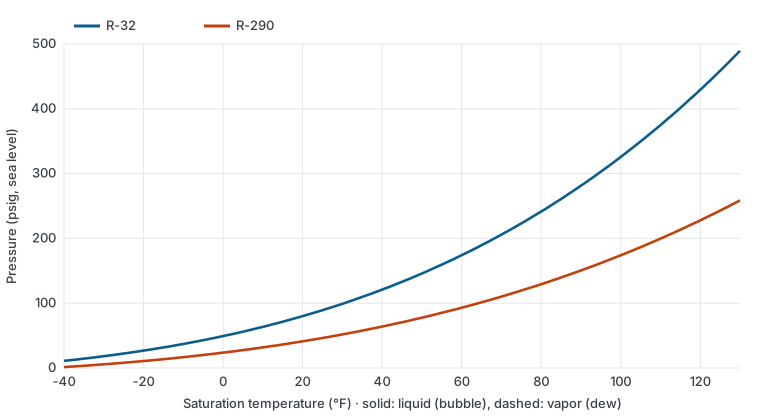
Saturation pressure in psig at sea level. Evaporating rows use the vapor (dew) value, condensing rows the liquid (bubble) value, which is what you compare with suction and liquid-line gauges. The last column is R-290 minus R-32.
| Saturation | R-32 | R-290 | Difference |
|---|---|---|---|
| Evaporator (vapor, dew) | |||
| -20°F | 26.8 | 10.7 | -16.1 (-60%) |
| 0°F | 49.3 | 23.7 | -25.6 (-52%) |
| 20°F | 80.0 | 41.1 | -38.9 (-49%) |
| 30°F | 99.1 | 51.8 | -47.3 (-48%) |
| 35°F | 109.7 | 57.7 | -52.0 (-47%) |
| 40°F | 121.0 | 63.9 | -57.0 (-47%) |
| 45°F | 133.0 | 70.6 | -62.4 (-47%) |
| 50°F | 145.9 | 77.6 | -68.2 (-47%) |
| Condenser (liquid, bubble) | |||
| 80°F | 241.5 | 129.3 | -112.1 (-46%) |
| 90°F | 281.3 | 150.5 | -130.8 (-46%) |
| 95°F | 302.9 | 161.9 | -141.0 (-47%) |
| 100°F | 325.7 | 173.9 | -151.7 (-47%) |
| 105°F | 349.7 | 186.5 | -163.2 (-47%) |
| 110°F | 374.9 | 199.6 | -175.2 (-47%) |
| 115°F | 401.4 | 213.4 | -188.0 (-47%) |
| 120°F | 429.3 | 227.9 | -201.5 (-47%) |
| 125°F | 458.7 | 242.9 | -215.7 (-47%) |
| 130°F | 489.5 | 258.7 | -230.8 (-47%) |
Properties
| Property | R-32 | R-290 |
|---|---|---|
| Safety class | A2L | A3 |
| Type | HFC, single-component refrigerant | HC, single-component refrigerant |
| Composition (mass %) | Single component | Single component |
| GWP (AR4) | 675 | n/a |
| Lubricant | POE | POE, PAG or PAO (per compressor maker) |
| Boiling point (14.7 psia) | -61.0°F | -43.8°F |
| Critical point | 172.6°F, 839 psia | 206.1°F, 617 psia |
| Glide at 40°F evaporating | 0.0°F | 0.0°F |
| Glide at 100°F condensing | 0.0°F | 0.0°F |
| US status | GWP 675 is below the 700 limit for new US residential and light commercial AC/HP from Jan 1 2025; SNAP-acceptable in new equipment subject to use conditions. | Not an ODS or AIM Act regulated HFC; EPA SNAP-acceptable with use conditions in listed self-contained end uses, most recently commercial refrigeration (June 2024). |
Component compatibility
| Item | R-32 | R-290 |
|---|---|---|
| Lubricant | POE (Copeland POE-46; Danfoss POE) | Per compressor label: POE, PAG or PAO |
| US residential AC listing (SNAP) | New residential and light commercial AC and heat pumps | New self-contained room AC only (window, portable, PTAC) |
| Safety standard | UL 60335-2-40 charge limits and detection where required | Room AC use conditions from SNAP Rule 19 (2015) |
| Section 608 class | Very high pressure | High pressure |
| Recovery machine | Flammable-rated (App. B4) | Flammable-rated (App. B4) |
| Gauges and hoses | Rated for R-32 pressures; check A2L listing | Check the tool listing covers A3 use |
| Cylinder | RAL 7044 gray with red band | RAL 7044 gray with red band |
| Charging | Single component; Danfoss: initial charge as liquid | By weight, accurately, to nameplate |
What changes in the field
R-32 runs roughly twice the pressure of R-290. From the PT data, at 40°F evaporating R-32 reads 121.0 psig and R-290 63.9 psig. At 100°F condensing R-32 is 325.7 psig and R-290 173.9 psig. Both are single-component refrigerants with no glide, so each has one PT column.
The Section 608 class follows. At 104°F R-32 saturates at 359.4 psia, just over the 355 psia line, which makes R-32 equipment very high pressure under 40 CFR 82.152. R-290 saturates at 198.6 psia, high pressure. Either way the required recovery level for equipment under 200 lb is 0 in Hg, and Type II (or Universal) certification covers both; Type I covers factory-sealed units of 5 lb or less.
Flammability is the bigger difference. R-32 is A2L (mildly flammable, burning velocity 10 cm/s or less) and R-290 is A3 (highly flammable). Both need a recovery machine certified for flammable refrigerants under Appendix B4 of 40 CFR 82.158, and both come in gray RAL 7044 cylinders with a red band. R-290 is exempt from the venting prohibition only in the end uses listed in 40 CFR 82.154(a)(1), which include self-contained room AC; R-32 is never exempt. See flammability classes and recovery machine compatibility.
Retrofit or replacement
You cannot put R-290 in an R-32 system, or the reverse:
- EPA’s SNAP listings for both are new equipment only. R-32 is acceptable subject to use conditions in new residential and light commercial AC and heat pumps (86 FR 24444, based on UL 60335-2-40). R-290 is acceptable only “for use in self-contained room air conditioning” (listed April 10 2015).
- That means a US split-system heat pump or central AC cannot use R-290 at all under the current listings, retrofit or new.
- The pressures, compressor and charge limits are different. A system built for one refrigerant is evaluated only for that refrigerant.
EPA proposed SNAP Rule 27 on Nov 10 2025, with a supplemental proposal on April 2 2026. It would update the use conditions for R-32, R-290 and six other refrigerants in residential and light commercial AC and heat pumps to the 4th edition of UL 60335-2-40 or to NRTL certification, for equipment made after a final rule. The updated listings would still be “acceptable only for use in new equipment specifically designed for the refrigerant.” It was not final at the time of review.
A failed R-32 system is repaired with R-32 or replaced. Compare with the other R-410A successors on R-410A vs R-32 and R-454B vs R-32.
Capacity, efficiency and cost
None of the manufacturer documents used here gives a capacity or efficiency comparison between R-290 and R-32 systems, so none is quoted. Danfoss gives R-290 roughly 90% of R-22’s volumetric capacity at 45°C (113°F) condensing, but that is a refrigerant property, not a system rating. Compare the AHRI ratings of actual units.
Both clear the Technology Transitions limit of 700 GWP for new residential and light commercial AC and heat pumps under 40 CFR 84.54. R-32 is an HFC with an AR4 GWP of 675, so its supply falls under the AIM Act phasedown. R-290 has no AR4 value (EPA uses 3.3 in 40 CFR 84.64) and is not a regulated HFC.
Charge sizes follow the safety standards rather than a fixed ratio, so use the nameplate. Danfoss puts hydrocarbon charges at about 40 to 45% of an equivalent HFC charge by mass in small hermetic systems.
Common questions
Is R-290 more efficient than R-32?
No source used here gives a verified system-level figure. Efficiency belongs to the matched equipment, so compare AHRI or ENERGY STAR ratings of the units you are choosing between.
Which is safer, R-32 or R-290?
R-32 is A2L and R-290 is A3 under ASHRAE 34; A3 is the more flammable class. In US residential AC, EPA lists R-290 only in self-contained room units, while R-32 is listed in split systems and heat pumps under UL 60335-2-40 use conditions.
PT charts and calculators
Sources
- EPA SNAP: Substitutes in Residential and Light Commercial AC and Heat Pumps epa.gov
- 86 FR 24444 (May 6 2021), SNAP Rule 23: A2L refrigerants in residential and light commercial AC and heat pumps federalregister.gov
- EPA fact sheet: Proposed SNAP Rule 27 and supplemental proposal (April 2026) epa.gov
- 40 CFR 84.54: Technology Transitions restrictions by sector ecfr.gov
- 40 CFR 82.152: Section 608 definitions (pressure classes) ecfr.gov
- 40 CFR 82.154: Venting prohibition, exempt substitutes, sales restriction ecfr.gov
- Copeland AE Bulletin 93-11: Refrigerants and Lubricants Approved for Use in Copeland Compressors webapps.copeland.com
- Danfoss: Practical Application of Refrigerants R600a and R290 in Small Hermetic Systems assets.danfoss.com
Reviewed . Found an error? Tell us and we will correct it.