R-410A PT Chart and Refrigerant Profile
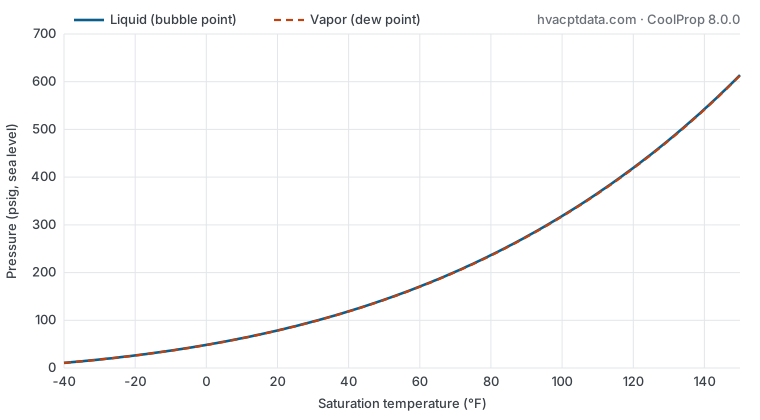
R-410A is an A1 HFC near-azeotropic blend of R-32 and R-125 (50/50 % by mass). At 40°F its vapor (dew) pressure is 118.4 psig; at 100°F its liquid (bubble) pressure is 318.5 psig.
Reviewed · PT values computed with CoolProp 8.0.0 and checked against a published chart (largest difference 0.1 psi)
R-410A at a glance
| Safety class (ASHRAE 34) | A1: lower toxicity, no flame propagation |
|---|---|
| Type | HFC, near-azeotropic blend |
| Composition | R-32 50% · R-125 50% by mass |
| GWP (100-year, AR4) | 2,088 · AR5: 1,924EPA AIM Act exchange value (AR4 basis) is 2,087.5 |
| Ozone depletion potential | 0 |
| Lubricant | POE (PVE in some compressors) |
| Boiling point at 14.7 psia | -60.6°F bubble · -60.5°F dew |
| Critical point | 160.4°F, 711 psia |
| 40°F evaporating | 118.4 psig (dew), glide 0.2°F |
| 100°F condensing | 318.5 psig (bubble), glide 0.2°F |
| Charge as | Liquid only (blend can fractionate as vapor) |
| Typical use | Residential and light commercial split AC and heat pumps; Ductless mini-splits and VRF; Packaged rooftop units; Dehumidifiers and small chillers |
| Trade names | Puron (Carrier), Freon 410A (Chemours), Forane 410A (Arkema) |
| US status | Since Jan 1 2025 no new residential or light commercial AC/HP may be made with it; servicing existing systems remains legal, and split systems built from pre-2025 components may still be installed. |
| Replaces | R-22 |
| Replaced by | R-454B, R-32 |
R-410A PT chart (°F and psig)
R-410A is a blend, so it has two saturation pressures at each temperature. Read the vapor (dew) column against suction pressure for superheat and the liquid (bubble) column against liquid-line pressure for subcooling. Tap a row to load it into the lookup.
-40°F to 150°F · psig at sea level · °C and kPa in the CSV · italic = inches Hg vacuum
| °F | Liquidbubble psig | Vapordew psig |
|---|---|---|
| -40 | 10.8 | 10.7 |
| -39 | 11.4 | 11.3 |
| -38 | 12.1 | 12.0 |
| -37 | 12.7 | 12.6 |
| -36 | 13.4 | 13.3 |
| -35 | 14.1 | 14.0 |
| -34 | 14.8 | 14.7 |
| -33 | 15.6 | 15.5 |
| -32 | 16.3 | 16.2 |
| -31 | 17.1 | 16.9 |
| -30 | 17.8 | 17.7 |
| -29 | 18.6 | 18.5 |
| -28 | 19.4 | 19.3 |
| -27 | 20.2 | 20.1 |
| -26 | 21.0 | 20.9 |
| -25 | 21.9 | 21.8 |
| -24 | 22.7 | 22.6 |
| -23 | 23.6 | 23.5 |
| -22 | 24.5 | 24.4 |
| -21 | 25.4 | 25.3 |
| -20 | 26.3 | 26.2 |
| -19 | 27.3 | 27.1 |
| -18 | 28.2 | 28.1 |
| -17 | 29.2 | 29.0 |
| -16 | 30.2 | 30.0 |
| -15 | 31.2 | 31.0 |
| -14 | 32.2 | 32.1 |
| -13 | 33.3 | 33.1 |
| -12 | 34.3 | 34.1 |
| -11 | 35.4 | 35.2 |
| -10 | 36.5 | 36.3 |
| -9 | 37.6 | 37.4 |
| -8 | 38.7 | 38.5 |
| -7 | 39.9 | 39.7 |
| -6 | 41.0 | 40.8 |
| -5 | 42.2 | 42.0 |
| -4 | 43.4 | 43.2 |
| -3 | 44.6 | 44.4 |
| -2 | 45.9 | 45.7 |
| -1 | 47.2 | 46.9 |
| 0 | 48.4 | 48.2 |
| 1 | 49.7 | 49.5 |
| 2 | 51.1 | 50.8 |
| 3 | 52.4 | 52.2 |
| 4 | 53.8 | 53.5 |
| 5 | 55.2 | 54.9 |
| 6 | 56.6 | 56.3 |
| 7 | 58.0 | 57.8 |
| 8 | 59.5 | 59.2 |
| 9 | 60.9 | 60.7 |
| 10 | 62.4 | 62.2 |
| 11 | 63.9 | 63.7 |
| 12 | 65.5 | 65.2 |
| 13 | 67.1 | 66.8 |
| 14 | 68.6 | 68.4 |
| 15 | 70.3 | 70.0 |
| 16 | 71.9 | 71.6 |
| 17 | 73.5 | 73.3 |
| 18 | 75.2 | 74.9 |
| 19 | 76.9 | 76.6 |
| 20 | 78.7 | 78.4 |
| 21 | 80.4 | 80.1 |
| 22 | 82.2 | 81.9 |
| 23 | 84.0 | 83.7 |
| 24 | 85.8 | 85.5 |
| 25 | 87.7 | 87.4 |
| 26 | 89.6 | 89.2 |
| 27 | 91.5 | 91.1 |
| 28 | 93.4 | 93.1 |
| 29 | 95.4 | 95.0 |
| 30 | 97.4 | 97.0 |
| 31 | 99.4 | 99.0 |
| 32 | 101.4 | 101.1 |
| 33 | 103.5 | 103.1 |
| 34 | 105.6 | 105.2 |
| 35 | 107.7 | 107.3 |
| 36 | 109.9 | 109.5 |
| 37 | 112.1 | 111.7 |
| 38 | 114.3 | 113.9 |
| 39 | 116.5 | 116.1 |
| 40 | 118.8 | 118.4 |
| 41 | 121.1 | 120.7 |
| 42 | 123.4 | 123.0 |
| 43 | 125.8 | 125.3 |
| 44 | 128.2 | 127.7 |
| 45 | 130.6 | 130.1 |
| 46 | 133.0 | 132.6 |
| 47 | 135.5 | 135.0 |
| 48 | 138.0 | 137.5 |
| 49 | 140.6 | 140.1 |
| 50 | 143.2 | 142.6 |
| 51 | 145.8 | 145.2 |
| 52 | 148.4 | 147.9 |
| 53 | 151.1 | 150.5 |
| 54 | 153.8 | 153.2 |
| 55 | 156.5 | 156.0 |
| 56 | 159.3 | 158.7 |
| 57 | 162.1 | 161.5 |
| 58 | 164.9 | 164.4 |
| 59 | 167.8 | 167.2 |
| 60 | 170.7 | 170.1 |
| 61 | 173.7 | 173.1 |
| 62 | 176.7 | 176.0 |
| 63 | 179.7 | 179.0 |
| 64 | 182.7 | 182.1 |
| 65 | 185.8 | 185.2 |
| 66 | 188.9 | 188.3 |
| 67 | 192.1 | 191.4 |
| 68 | 195.3 | 194.6 |
| 69 | 198.5 | 197.8 |
| 70 | 201.8 | 201.1 |
| 71 | 205.1 | 204.4 |
| 72 | 208.4 | 207.7 |
| 73 | 211.8 | 211.1 |
| 74 | 215.2 | 214.5 |
| 75 | 218.7 | 217.9 |
| 76 | 222.2 | 221.4 |
| 77 | 225.7 | 224.9 |
| 78 | 229.3 | 228.5 |
| 79 | 232.9 | 232.1 |
| 80 | 236.5 | 235.8 |
| 81 | 240.2 | 239.4 |
| 82 | 244.0 | 243.2 |
| 83 | 247.8 | 246.9 |
| 84 | 251.6 | 250.7 |
| 85 | 255.4 | 254.6 |
| 86 | 259.3 | 258.5 |
| 87 | 263.3 | 262.4 |
| 88 | 267.3 | 266.4 |
| 89 | 271.3 | 270.4 |
| 90 | 275.4 | 274.5 |
| 91 | 279.5 | 278.6 |
| 92 | 283.6 | 282.7 |
| 93 | 287.8 | 286.9 |
| 94 | 292.1 | 291.2 |
| 95 | 296.4 | 295.5 |
| 96 | 300.7 | 299.8 |
| 97 | 305.1 | 304.2 |
| 98 | 309.5 | 308.6 |
| 99 | 314.0 | 313.1 |
| 100 | 318.5 | 317.6 |
| 101 | 323.1 | 322.1 |
| 102 | 327.7 | 326.7 |
| 103 | 332.4 | 331.4 |
| 104 | 337.1 | 336.1 |
| 105 | 341.9 | 340.9 |
| 106 | 346.7 | 345.7 |
| 107 | 351.6 | 350.5 |
| 108 | 356.5 | 355.4 |
| 109 | 361.4 | 360.4 |
| 110 | 366.4 | 365.4 |
| 111 | 371.5 | 370.4 |
| 112 | 376.6 | 375.5 |
| 113 | 381.8 | 380.7 |
| 114 | 387.0 | 385.9 |
| 115 | 392.3 | 391.2 |
| 116 | 397.6 | 396.5 |
| 117 | 403.0 | 401.9 |
| 118 | 408.4 | 407.3 |
| 119 | 413.9 | 412.8 |
| 120 | 419.4 | 418.3 |
| 121 | 425.0 | 423.9 |
| 122 | 430.7 | 429.5 |
| 123 | 436.4 | 435.2 |
| 124 | 442.1 | 441.0 |
| 125 | 447.9 | 446.8 |
| 126 | 453.8 | 452.7 |
| 127 | 459.8 | 458.6 |
| 128 | 465.8 | 464.6 |
| 129 | 471.8 | 470.7 |
| 130 | 477.9 | 476.8 |
| 131 | 484.1 | 483.0 |
| 132 | 490.3 | 489.2 |
| 133 | 496.6 | 495.5 |
| 134 | 503.0 | 501.9 |
| 135 | 509.4 | 508.3 |
| 136 | 515.9 | 514.8 |
| 137 | 522.5 | 521.4 |
| 138 | 529.1 | 528.0 |
| 139 | 535.8 | 534.7 |
| 140 | 542.5 | 541.4 |
| 141 | 549.3 | 548.3 |
| 142 | 556.2 | 555.2 |
| 143 | 563.2 | 562.1 |
| 144 | 570.2 | 569.2 |
| 145 | 577.3 | 576.3 |
| 146 | 584.5 | 583.5 |
| 147 | 591.7 | 590.7 |
| 148 | 599.0 | 598.1 |
| 149 | 606.4 | 605.5 |
| 150 | 613.9 | 613.0 |
Where you will find R-410A
R-410A is the refrigerant in most US residential and light commercial split systems, heat pumps, ductless mini-splits, VRF and packaged rooftop units built between the R-22 era and the 2025 switch to A2L refrigerants. It also shows up in dehumidifiers and small chillers (Arkema). Carrier sold it under the name Puron, so “Puron” on a nameplate means R-410A.
Confirm it on the outdoor unit nameplate before you connect. The service valves on R-410A equipment are rated for its higher working pressure, and older cylinders were painted rose. Since 2020 new cylinders of every refrigerant are light green-gray (RAL 7044), so read the label, not the paint.
R-410A was the new-equipment replacement for R-22, never a retrofit. It runs at much higher pressure, needs POE oil and needs components rated for it, so an R-22 system cannot be converted to R-410A. See R-22 vs R-410A for what changes.
Charging R-410A
Charge R-410A as liquid. It is a two-component blend, and although its glide is tiny, vapor drawn off the top of a cylinder is not exactly the nominal 50/50 mix. Arkema says it is “better to charge it as liquid” though vapor charging is possible (Arkema), and Chemours accepts topping off after a leak as long as the refrigerant goes in as liquid (Chemours bulletin).
Bubble and dew differ by only about 0.2°F on this chart, so either column gives practically the same saturation temperature. Read dew against suction pressure for superheat and bubble against liquid-line pressure for subcooling, the same habit you need on higher-glide blends.
The charging method depends on the metering device:
- Fixed orifice or piston: charge to target superheat. The California Title 24 procedure (CEC Reference Appendices Table RA3.2-2) looks up the target from return-air wet bulb and outdoor dry bulb, with an installer tolerance of ±5°F. The test is valid only at 55–115°F outdoor, return dry bulb of 70°F or more and return wet bulb of 76°F or less. Use the target superheat calculator, then check actual superheat with the superheat calculator.
- TXV or EEV: charge by subcooling to the target on the nameplate or in the installation manual. Title 24 allows the installer ±3°F of that target. Use the subcooling calculator.
The factory charge typically covers 15 ft of line (25 ft in some manuals); add the manual’s oz/ft rate beyond that with the line-set charge calculator.
Ignore fixed “normal R-410A pressure” ranges: pressures move with outdoor temperature, indoor load and airflow. Convert to saturation temperature with the gauge lookup above.
Oil and compatibility
R-410A uses polyolester (POE) oil. Copeland approves POE-32 in its R-410A compressors and lists PVE-68 for specific variable-speed models (Copeland AE 93-11). Many ductless and VRF units also use PVE. Add only the oil named on the compressor label or in the manual.
Mineral oil is not compatible. POE absorbs moisture fast, so keep oil containers sealed, keep the system closed, replace the filter-drier whenever the system is opened, and pull a deep vacuum. OEMs typically target 350–500 microns; see evacuation to microns and the refrigerant oil guide.
Safety, handling and recovery
R-410A is ASHRAE class A1: lower toxicity and no flame propagation. The hazard in practice is pressure. Use gauges, hoses and recovery cylinders rated for R-410A pressures.
Under Section 608 you need Type II (or Universal) certification, or Type I for factory-sealed small appliances with 5 lb or less. Since 2018 the sales restriction also covers HFCs. By the 40 CFR 82.152 definition R-410A is a high-pressure refrigerant: its computed liquid saturation pressure at 104°F is 351.8 psia (337.1 psig, bubble), just under the 355 psia line for very high pressure. Recover a high-pressure appliance under 200 lb to 0 in Hg, and one of 200 lb or more to 10 in Hg.
The HFC leak-repair rule that took effect Jan 1 2026 (40 CFR 84.106, 15 lb or more) does not apply to residential and light commercial AC and heat pumps. From 2029, the reclaimed-refrigerant servicing requirement covers only supermarket systems, refrigerated transport and automatic commercial ice makers, not residential AC.
Status and replacements
R-410A has a GWP of 2,088 (AR4). Two separate EPA programs affect it:
- Supply: the AIM Act phasedown (40 CFR 84.7) caps HFC allowances at 90% of baseline in 2022–2023, 60% in 2024–2028, 30% in 2029–2033, 20% in 2034–2035 and 15% from 2036. Production did not “start phasing down in 2025”; the cuts began in 2022.
- New equipment: the Technology Transitions rule bans manufacturing or importing residential and light commercial AC and heat pump systems that use refrigerants with GWP of 700 or more from Jan 1 2025 (VRF from Jan 1 2026). The May 26 2026 final rule, effective July 27 2026, removed the installation deadline: a new split system can still be installed if all its specified components were made or imported before Jan 1 2025, with no end date. Pages that still quote a hard Jan 1 2026 installation cutoff are out of date.
Servicing and repairing existing R-410A equipment remains legal, and so does buying R-410A to do it. The new-equipment replacements are R-454B and R-32. Both are A2L, need A2L-rated components and are not drop-ins for an R-410A system. Compare them in R-410A vs R-454B, R-410A vs R-32 and R-410A replacement options, or read the R-410A phase-out guide.
Common questions
Is R-410A being phased out?
Its supply is being cut under the AIM Act, and new residential AC and heat pump systems can no longer be manufactured with it since Jan 1 2025. Existing systems can be serviced indefinitely, and pre-2025 split-system components can still be installed.
Is Puron the same as R-410A?
Yes. Puron is Carrier’s name for R-410A. Puron Advance is Carrier’s name for R-454B, a different refrigerant.
Can I use R-410A in an R-22 system?
No. R-410A runs at much higher pressures and needs POE oil and rated components. See R-22 replacement options for refrigerants meant for R-22 retrofits.
How this chart was computed
Every pressure on this page is calculated, not copied: CoolProp 8.0.0 (HEOS backend), the open-source implementation of the reference equations of state, using the model mix:R410A at the nominal ASHRAE 34 composition. Gauge values assume sea-level air pressure (14.696 psia); kPa values in the CSV are absolute.
Spot check against Chemours "R-22 Replacements" and "R-12 and R-502 Replacements" Pressure-Temperature Guide (C-10914, 3/19):
| °F | Column | Published | This chart | Difference |
|---|---|---|---|---|
| 0 | dew | 48.2 psig | 48.2 psig | +0.0 psi |
| 40 | dew | 118.4 psig | 118.4 psig | -0.0 psi |
| 100 | bubble | 318.5 psig | 318.5 psig | +0.0 psi |
Mix model and NIST pseudo-pure (pure:R410A) agree within 0.02 psi; mix chosen so bubble and dew are distinct (glide about 0.1-0.2 °F).
Charts from different publishers can differ by a few tenths of a psi because of the equation of state and blend tolerances. Always charge to the equipment manufacturer's data. Full method and every spot check
Comparisons with R-410A
Calculators for R-410A
Sources
- 40 CFR 84.54 - Technology Transitions restrictions by sector ecfr.gov
- 91 FR 31284 (May 26 2026): Reconsideration of Certain Technology Transitions Requirements, final rule federalregister.gov
- 40 CFR 84.7 - HFC production and consumption phasedown schedule ecfr.gov
- Copeland AE Bulletin 93-11: Refrigerants and lubricants approved for Copeland compressors webapps.copeland.com
- Chemours Freon 410A technical bulletin pages.chemours.com
- Arkema Forane 410A product page forane.arkema.com
- 40 CFR 82.152 - Section 608 definitions and pressure classes ecfr.gov
- CEC 2025 Reference Appendices, RA3.2 refrigerant charge verification energy.ca.gov
Reviewed . Found an error? Tell us and we will correct it.
More in Air conditioning and heat pumps