R-22 vs R-410A
Reviewed · pressures computed with CoolProp 8.0 from the same data as the PT charts
Can you put R-410A in an R-22 system?
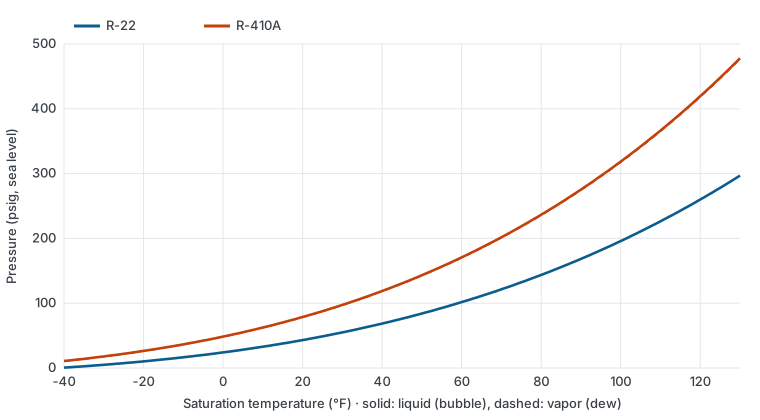
No. R-410A runs 122.6 psi higher than R-22 at 100°F condensing (about 63%), needs POE oil where R-22 systems run mineral or alkylbenzene oil, and was introduced for new equipment only, not as an R-22 retrofit. Moving to R-410A means a new matched system.
Pressures side by side
Saturation pressure in psig at sea level. Evaporating rows use the vapor (dew) value, condensing rows the liquid (bubble) value, which is what you compare with suction and liquid-line gauges. The last column is R-410A minus R-22.
| Saturation | R-22 | R-410A | Difference |
|---|---|---|---|
| Evaporator (vapor, dew) | |||
| -20°F | 10.2 | 26.2 | +16.0 (+157%) |
| 0°F | 24.0 | 48.2 | +24.2 (+101%) |
| 20°F | 43.1 | 78.4 | +35.3 (+82%) |
| 30°F | 55.0 | 97.0 | +42.1 (+77%) |
| 35°F | 61.5 | 107.3 | +45.8 (+74%) |
| 40°F | 68.6 | 118.4 | +49.8 (+73%) |
| 45°F | 76.1 | 130.1 | +54.0 (+71%) |
| 50°F | 84.1 | 142.6 | +58.6 (+70%) |
| Condenser (liquid, bubble) | |||
| 80°F | 143.6 | 236.5 | +92.9 (+65%) |
| 90°F | 168.4 | 275.4 | +107.0 (+64%) |
| 95°F | 181.8 | 296.4 | +114.6 (+63%) |
| 100°F | 195.9 | 318.5 | +122.6 (+63%) |
| 105°F | 210.8 | 341.9 | +131.1 (+62%) |
| 110°F | 226.4 | 366.4 | +140.1 (+62%) |
| 115°F | 242.8 | 392.3 | +149.5 (+62%) |
| 120°F | 260.0 | 419.4 | +159.5 (+61%) |
| 125°F | 278.0 | 447.9 | +170.0 (+61%) |
| 130°F | 296.9 | 477.9 | +181.0 (+61%) |
Properties
| Property | R-22 | R-410A |
|---|---|---|
| Safety class | A1 | A1 |
| Type | HCFC, single-component refrigerant | HFC, near-azeotropic blend |
| Composition (mass %) | Single component | R-32 50, R-125 50 |
| GWP (AR4) | 1,810 | 2,088 |
| Lubricant | Mineral oil (AB alternate) | POE (PVE in some compressors) |
| Boiling point (14.7 psia) | -41.5°F | -60.6°F |
| Critical point | 205.1°F, 724 psia | 160.4°F, 711 psia |
| Glide at 40°F evaporating | 0.0°F | 0.2°F |
| Glide at 100°F condensing | 0.0°F | 0.2°F |
| US status | US production and import ended Jan 1 2020; existing equipment may still be serviced with recovered, recycled, reclaimed or pre-2020 R-22. | Since Jan 1 2025 no new residential or light commercial AC/HP may be made with it; servicing existing systems remains legal, and split systems built from pre-2025 components may still be installed. |
Component compatibility
| Item | R-22 | R-410A |
|---|---|---|
| Lubricant | Mineral oil or AB (Copeland alternate: POE-32) | POE (PVE in some compressors) |
| Type | HCFC, single component | HFC near-azeotrope (R-32/R-125) |
| Charging | Vapor or liquid (single component) | Liquid |
| Recovery machine | AHRI 740 machine (40 CFR 82.158 App. B3) | AHRI 740 machine (40 CFR 82.158 App. B3) |
| Gauges and hoses | R-22 range | Rated for R-410A pressures |
| Cylinder | RAL 7044 gray (legacy light green) | RAL 7044 gray (legacy rose) |
| Supply | Recovered, recycled, reclaimed or pre-2020 stock only | In production under AIM Act allowances |
| Ozone depletion (ODP) | 0.055 | 0 |
What changes in the field
R-410A runs much higher. From the PT data, at 100°F condensing R-22 bubble is 195.9 psig and R-410A is 318.5 psig. At 40°F evaporating R-22 is 68.6 psig and R-410A is 49.8 psi higher. Gauges, hoses and recovery cylinders used on R-410A must be rated for those pressures.
Oil is the second difference. Copeland lists mineral oil as preferred for R-22, with alkylbenzene (AB) or an AB/mineral mix as alternates and POE-32 as a further alternate. R-410A is not compatible with mineral oil. It runs on POE, or PVE in some compressors. See refrigerant oil types.
Both are single-column refrigerants on a PT chart. R-22 is a single component, and R-410A is a near-azeotrope with about 0.2°F glide. R-410A is still charged as liquid to avoid fractionation. For both, charge fixed-orifice systems to target superheat and TXV/EEV systems to subcooling per the nameplate.
Both are A1 and both are high-pressure appliances for Section 608, which means Type II or Universal certification. Recovery to 0 in Hg is required on appliances under 200 lb, and 10 in Hg at 200 lb or more (equipment made on or after Nov 15 1993).
Retrofit or replacement
R-410A is not a retrofit for R-22. It replaced R-22 in new equipment only. An R-22 system was designed around R-22 pressures and a mineral or AB oil, and its compressor, metering device and controls were selected for R-22. Nothing in a conversion makes that system an R-410A system.
Your options for a working R-22 system are:
- Keep servicing it with R-22. This is legal using recovered, recycled, reclaimed or pre-2020 stock (40 CFR 82.15). Production and import ended Jan 1 2020. Recovered R-22 cannot be sold to a new owner unless an EPA-certified reclaimer has reclaimed it (40 CFR 82.154).
- Retrofit to a listed R-22 service blend such as R-407C or MO99, following the blend maker’s procedure.
- Replace the system. New residential AC and heat pumps now use R-454B or R-32. New R-410A split systems may only be installed where all specified components were manufactured or imported before Jan 1 2025 (40 CFR 84.54).
No new R-22 pre-charged equipment or components manufactured on or after Jan 1 2010 may be sold. More detail is on the R-22 phase-out page.
Capacity, efficiency and cost
None of the sources used here gives a capacity or efficiency percentage for R-410A against R-22 in the same system, and the two are never used in the same system. Efficiency differences between an old R-22 unit and a new unit come from the equipment’s rating, not the refrigerant alone.
On GWP (AR4), R-22 is 1,810 and R-410A is 2,088. R-22 also depletes ozone (ODP 0.055). That is why it was phased out under the Clean Air Act, while R-410A falls under the AIM Act HFC phasedown.
Common questions
What happens if you mix R-22 and R-410A?
You get a mixture that is neither refrigerant, matches neither PT chart, and sits in a system whose oil suits only one of them. The fix is to recover the whole charge, evacuate, and recharge with the nameplate refrigerant.
Can you mix R-22 and R-410A in a recovery tank?
Do not. Keep one refrigerant per recovery cylinder (gray body, yellow top under AHRI Guideline K), and label it.
Why is R-410A better than R-22?
For regulation, R-410A has zero ODP, and R-22 can no longer be produced or imported in the US. For performance, compare rated equipment rather than the refrigerants.
PT charts and calculators
Sources
- 40 CFR 82.15: Class II (HCFC) prohibitions ecfr.gov
- 40 CFR 82.16: HCFC allowance phaseout schedule ecfr.gov
- 40 CFR 82.154: Venting prohibition, exempt substitutes, sales restriction ecfr.gov
- Copeland AE Bulletin 93-11: Refrigerants and Lubricants Approved for Use in Copeland Compressors webapps.copeland.com
- Carrier: AC refrigerant (R-22 phase-out) carrier.com
- Carrier HVAC glossary: R-410A (Puron) carrier.com
- 40 CFR 84.54: Technology Transitions restrictions ecfr.gov
Reviewed . Found an error? Tell us and we will correct it.