R-1234yf PT Chart and Refrigerant Profile
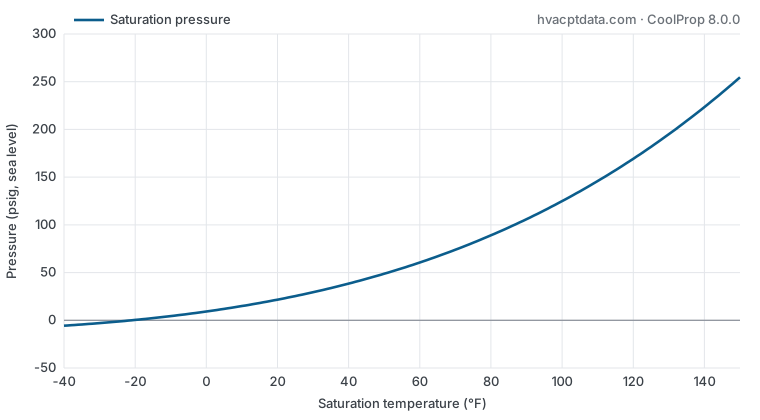
R-1234yf is an A2L HFO single-component refrigerant. It saturates at 38.4 psig at 40°F and 124.9 psig at 100°F.
Reviewed · PT values computed with CoolProp 8.0.0 and checked against a published chart (largest difference 0.0 psi)
R-1234yf at a glance
| Safety class (ASHRAE 34) | A2L: lower toxicity, mildly flammable (burning velocity ≤ 10 cm/s) |
|---|---|
| Type | HFO, single-component refrigerant |
| GWP (100-year, AR4) | Not listed in AR4Not listed in IPCC AR4. EPA's MVAC page lists 4; EPA uses 1 under 40 CFR 84.64; AR5 gives less than 1. |
| Ozone depletion potential | 0 |
| Lubricant | PAG made for R-1234yf, or POE (per compressor maker) |
| Boiling point at 14.7 psia | -21.0°F |
| Critical point | 202.5°F, 491 psia |
| 40°F evaporating | 38.4 psig |
| 100°F condensing | 124.9 psig |
| Charge as | Vapor or liquid |
| Typical use | Automotive A/C (most new US light-duty vehicles); Some stationary chillers and dehumidifiers; Component of blends such as R-454B, R-513A, R-449A and R-452A |
| Trade names | Opteon YF (Chemours), Solstice yf (Solstice Advanced Materials) |
| US status | HFO, not a regulated substance under the AIM Act (40 CFR 84); EPA SNAP-acceptable in vehicle A/C subject to SAE J639 use conditions. |
| Replaces | R-134a |
R-1234yf PT chart (°F and psig)
R-1234yf is a single-component refrigerant, so one pressure applies at each temperature for both the evaporator and the condenser. Tap a row to load it into the lookup.
-40°F to 150°F · psig at sea level · °C and kPa in the CSV · italic = inches Hg vacuum
| °F | psig |
|---|---|
| -40 | 11.5″ |
| -39 | 11.1″ |
| -38 | 10.5″ |
| -37 | 10.0″ |
| -36 | 9.5″ |
| -35 | 8.9″ |
| -34 | 8.4″ |
| -33 | 7.8″ |
| -32 | 7.2″ |
| -31 | 6.6″ |
| -30 | 6.0″ |
| -29 | 5.4″ |
| -28 | 4.8″ |
| -27 | 4.1″ |
| -26 | 3.5″ |
| -25 | 2.8″ |
| -24 | 2.1″ |
| -23 | 1.4″ |
| -22 | 0.7″ |
| -21 | 0.0 |
| -20 | 0.4 |
| -19 | 0.7 |
| -18 | 1.1 |
| -17 | 1.5 |
| -16 | 1.9 |
| -15 | 2.3 |
| -14 | 2.7 |
| -13 | 3.1 |
| -12 | 3.5 |
| -11 | 4.0 |
| -10 | 4.4 |
| -9 | 4.8 |
| -8 | 5.3 |
| -7 | 5.8 |
| -6 | 6.2 |
| -5 | 6.7 |
| -4 | 7.2 |
| -3 | 7.7 |
| -2 | 8.2 |
| -1 | 8.7 |
| 0 | 9.2 |
| 1 | 9.7 |
| 2 | 10.3 |
| 3 | 10.8 |
| 4 | 11.4 |
| 5 | 12.0 |
| 6 | 12.5 |
| 7 | 13.1 |
| 8 | 13.7 |
| 9 | 14.3 |
| 10 | 14.9 |
| 11 | 15.5 |
| 12 | 16.2 |
| 13 | 16.8 |
| 14 | 17.5 |
| 15 | 18.1 |
| 16 | 18.8 |
| 17 | 19.5 |
| 18 | 20.2 |
| 19 | 20.9 |
| 20 | 21.6 |
| 21 | 22.3 |
| 22 | 23.1 |
| 23 | 23.8 |
| 24 | 24.6 |
| 25 | 25.4 |
| 26 | 26.2 |
| 27 | 27.0 |
| 28 | 27.8 |
| 29 | 28.6 |
| 30 | 29.4 |
| 31 | 30.3 |
| 32 | 31.1 |
| 33 | 32.0 |
| 34 | 32.9 |
| 35 | 33.8 |
| 36 | 34.7 |
| 37 | 35.6 |
| 38 | 36.5 |
| 39 | 37.5 |
| 40 | 38.4 |
| 41 | 39.4 |
| 42 | 40.4 |
| 43 | 41.4 |
| 44 | 42.4 |
| 45 | 43.4 |
| 46 | 44.5 |
| 47 | 45.5 |
| 48 | 46.6 |
| 49 | 47.7 |
| 50 | 48.8 |
| 51 | 49.9 |
| 52 | 51.0 |
| 53 | 52.2 |
| 54 | 53.3 |
| 55 | 54.5 |
| 56 | 55.7 |
| 57 | 56.9 |
| 58 | 58.1 |
| 59 | 59.3 |
| 60 | 60.6 |
| 61 | 61.8 |
| 62 | 63.1 |
| 63 | 64.4 |
| 64 | 65.7 |
| 65 | 67.1 |
| 66 | 68.4 |
| 67 | 69.8 |
| 68 | 71.1 |
| 69 | 72.5 |
| 70 | 74.0 |
| 71 | 75.4 |
| 72 | 76.8 |
| 73 | 78.3 |
| 74 | 79.8 |
| 75 | 81.3 |
| 76 | 82.8 |
| 77 | 84.3 |
| 78 | 85.9 |
| 79 | 87.4 |
| 80 | 89.0 |
| 81 | 90.6 |
| 82 | 92.3 |
| 83 | 93.9 |
| 84 | 95.6 |
| 85 | 97.3 |
| 86 | 99.0 |
| 87 | 100.7 |
| 88 | 102.4 |
| 89 | 104.2 |
| 90 | 106.0 |
| 91 | 107.8 |
| 92 | 109.6 |
| 93 | 111.4 |
| 94 | 113.3 |
| 95 | 115.2 |
| 96 | 117.1 |
| 97 | 119.0 |
| 98 | 120.9 |
| 99 | 122.9 |
| 100 | 124.9 |
| 101 | 126.9 |
| 102 | 128.9 |
| 103 | 131.0 |
| 104 | 133.0 |
| 105 | 135.1 |
| 106 | 137.2 |
| 107 | 139.4 |
| 108 | 141.5 |
| 109 | 143.7 |
| 110 | 145.9 |
| 111 | 148.1 |
| 112 | 150.4 |
| 113 | 152.7 |
| 114 | 155.0 |
| 115 | 157.3 |
| 116 | 159.6 |
| 117 | 162.0 |
| 118 | 164.4 |
| 119 | 166.8 |
| 120 | 169.2 |
| 121 | 171.7 |
| 122 | 174.2 |
| 123 | 176.7 |
| 124 | 179.3 |
| 125 | 181.8 |
| 126 | 184.4 |
| 127 | 187.0 |
| 128 | 189.7 |
| 129 | 192.3 |
| 130 | 195.0 |
| 131 | 197.7 |
| 132 | 200.5 |
| 133 | 203.3 |
| 134 | 206.1 |
| 135 | 208.9 |
| 136 | 211.7 |
| 137 | 214.6 |
| 138 | 217.5 |
| 139 | 220.5 |
| 140 | 223.4 |
| 141 | 226.4 |
| 142 | 229.5 |
| 143 | 232.5 |
| 144 | 235.6 |
| 145 | 238.7 |
| 146 | 241.8 |
| 147 | 245.0 |
| 148 | 248.2 |
| 149 | 251.4 |
| 150 | 254.7 |
Where you will find R-1234yf
Mostly under the hood. EPA reports R-1234yf in the majority of light-duty vehicles, where it took over from R-134a. EPA lists it as acceptable in light-duty vehicles since 2011, in heavy-duty vehicles since 2016 and in certain nonroad vehicles since 2022.
Identify the system by the under-hood label and the service ports before connecting. SAE J639, which EPA makes a condition of use, requires a flammable-refrigerant warning label, a high-pressure compressor cutoff switch, pressure relief devices and service fittings unique to R-1234yf. An R-134a coupler will not fit.
Off the road, EPA’s 2023 SNAP rule (88 FR 26382) lists R-1234yf as acceptable, with use conditions, in chillers and residential dehumidifiers. You will also meet it inside blends: it is a component of R-454B, R-513A, R-449A and R-452A.
Charging R-1234yf
R-1234yf is a single-component refrigerant, so there is no glide or fractionation and one PT column covers both the low and high side. It can be charged as vapor or liquid.
On vehicles, charge by weight to the amount on the vehicle label using an R-1234yf machine. Service equipment is set by 40 CFR 82.36. Recover/recycle/recharge machines for R-1234yf must meet SAE J2843. Recovery-only units for contaminated R-134a or R-1234yf must meet SAE J2851. Gauge readings help with diagnosis, not with setting the charge.
On stationary equipment, follow the OEM. Fixed-restriction systems are charged to the manufacturer’s superheat data. TXV or EEV systems are charged by subcooling to the nameplate target with the subcooling calculator.
Oil and compatibility
Chemours says R-1234yf is compatible with POE and with PAG lubricants formulated specifically for R-1234yf. Use the oil the compressor manufacturer designates, and do not assume an R-134a PAG is correct.
Electric (high-voltage) compressors in hybrids and EVs are the special case. They use a dielectric POE. I-CAR, a collision-repair training body rather than an OEM, warns that as little as 1% standard PAG can degrade compressor insulation. On those vehicles use the OEM-specified oil and a machine that will not cross-contaminate. The oil types guide covers PAG and POE in more detail.
Safety, handling and recovery
R-1234yf is ASHRAE class A2L: lower toxicity, mildly flammable. A2L means it can ignite but has a burning velocity of 10 cm/s or less and a lower flammability limit above 0.10 kg/m³. Keep ignition sources away during recovery and charging, and use equipment rated for it. The flammability classes page explains the categories.
In vehicles it falls under Clean Air Act section 609 (40 CFR 82 subpart B), not the Section 608 appliance rules. Anyone servicing an MVAC for consideration must be certified under 82.40 and must use approved equipment. EPA adopted the R-1234yf SAE equipment standards into the 609 program in 2021 (86 FR 15587).
In stationary equipment it is a medium-pressure refrigerant under 40 CFR 82.152, so Type II (or Universal) certification applies. Venting is prohibited. Required recovery for medium-pressure appliances made on or after Nov 15 1993 is 10 in Hg below 200 lb charge and 15 in Hg at 200 lb or more. Recovery machines for flammable refrigerants are certified under 40 CFR 82.158 Appendix B4, which adds UL 1963 Supplement SB. See recovery machine compatibility.
Sales are restricted to certified technicians under 82.154(c), with an exception for MVAC cans of 2 lb or less with a self-sealing valve. Under AHRI Guideline N, new cylinders are light green-gray (RAL 7044) with a red band on the shoulder or top for flammables. Chemours notes R-1234yf-specific left-hand-thread cylinder fittings. No legacy cylinder color is listed for R-1234yf in the sources used here.
Status and replacements
R-1234yf is an HFO. HFOs are not regulated substances under 40 CFR Part 84, so the AIM Act allowance phasedown does not cap its supply. For Technology Transitions sector limits, EPA counts its GWP as 1 (40 CFR 84.64). That keeps it under the 150 limit that applies to new light-duty vehicles from model year 2025 under 40 CFR 84.54. The HFC leak-repair rule (40 CFR 84.106) covers substitutes only above GWP 53, which R-1234yf is not.
There is no listed successor; R-1234yf is the replacement. Converting an older R-134a vehicle is a different question. EPA’s MVAC page does not address it, and Chemours sources disagree, so this page gives no conversion procedure. The R-134a vs R-1234yf comparison covers fittings, pressures and equipment side by side, and the A2L refrigerants guide covers handling.
Common questions
What oil does R-1234yf use?
A PAG formulated for R-1234yf in most belt-driven compressors, or POE where the compressor maker specifies it. Electric compressors use a dielectric POE, and standard PAG contamination can damage their insulation. Always use the oil on the vehicle or compressor label.
Why do R-1234yf and R-134a fittings differ?
SAE J639, an EPA condition of use for R-1234yf, requires service fittings unique to R-1234yf, so R-134a hoses and couplers will not connect. The service machines differ too: R-1234yf recover/recycle/recharge equipment must meet SAE J2843, while R-134a machines meet SAE J2788.
How this chart was computed
Every pressure on this page is calculated, not copied: CoolProp 8.0.0 (HEOS backend), the open-source implementation of the reference equations of state, using the model pure:R1234yf. Gauge values assume sea-level air pressure (14.696 psia); kPa values in the CSV are absolute.
Spot check against Thermodynamic Properties of Opteon YF, Engineering (I/P) Units, C-10256 (5/23):
| °F | Column | Published | This chart | Difference |
|---|---|---|---|---|
| 0 | saturation | 23.9 psia | 23.9 psia | -0.0 psi |
| 40 | saturation | 53.1 psia | 53.1 psia | +0.0 psi |
| 100 | saturation | 139.6 psia | 139.6 psia | +0.0 psi |
Chemours thermodynamic table (psia).
Charts from different publishers can differ by a few tenths of a psi because of the equation of state and blend tolerances. Always charge to the equipment manufacturer's data. Full method and every spot check
Comparisons with R-1234yf
Calculators for R-1234yf
Sources
- EPA: MVAC acceptable refrigerants and their impacts epa.gov
- eCFR 40 CFR Part 82 Subpart B: Servicing of motor vehicle air conditioners ecfr.gov
- Chemours FAQ: Using Opteon YF opteon.com
- Chemours Opteon YF product information bulletin opteon.com
- Federal Register 88 FR 26382: SNAP Rule 25 (A2Ls in chillers and dehumidifiers; red marking) federalregister.gov
- eCFR 40 CFR 84.54: Technology Transitions restrictions by sector ecfr.gov
- eCFR 40 CFR 84.64: GWPs used for Technology Transitions ecfr.gov
- eCFR 40 CFR 82.152: Section 608 definitions (pressure classes) ecfr.gov
Reviewed . Found an error? Tell us and we will correct it.