R-134a Replacement Refrigerants
Reviewed · pressures computed with CoolProp 8.0 from the same data as the PT charts
What replaces R-134a?
It depends. It depends on the equipment. For stationary R-134a refrigeration and chillers, R-513A is the A1 retrofit, keeping the POE and running a few psi higher. New vehicles use R-1234yf, and new centrifugal chillers can use R-1234ze(E). Both of those are A2L and are for equipment designed for them, not retrofits.
Pressures side by side
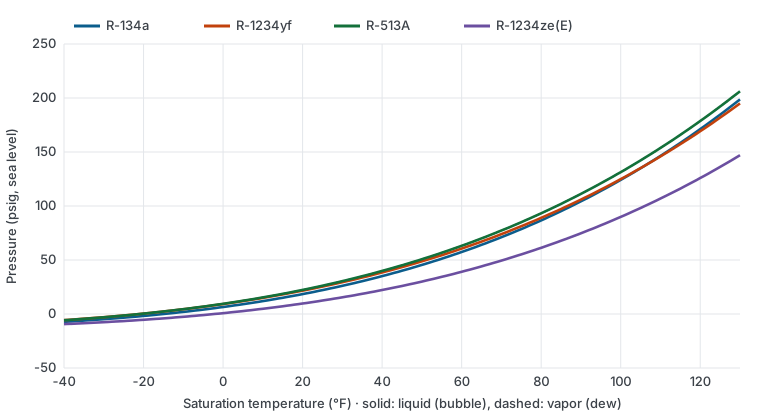
Saturation pressure in psig at sea level. Evaporating rows use the vapor (dew) value, condensing rows the liquid (bubble) value, which is what you compare with suction and liquid-line gauges.
| Saturation | R-134a | R-1234yf | R-513A | R-1234ze(E) |
|---|---|---|---|---|
| Evaporator (vapor, dew) | ||||
| -20°F | 3.7″ Hg | 0.4 | 0.3 | 10.9″ Hg |
| 0°F | 6.5 | 9.2 | 9.4 | 0.8 |
| 20°F | 18.4 | 21.6 | 22.3 | 9.7 |
| 30°F | 26.1 | 29.4 | 30.4 | 15.5 |
| 35°F | 30.4 | 33.8 | 35.0 | 18.7 |
| 40°F | 35.1 | 38.4 | 39.8 | 22.2 |
| 45°F | 40.1 | 43.4 | 45.1 | 26.0 |
| 50°F | 45.4 | 48.8 | 50.7 | 30.0 |
| Condenser (liquid, bubble) | ||||
| 80°F | 86.7 | 89.0 | 93.3 | 61.3 |
| 90°F | 104.3 | 106.0 | 111.2 | 74.8 |
| 95°F | 114.0 | 115.2 | 121.0 | 82.1 |
| 100°F | 124.2 | 124.9 | 131.3 | 89.9 |
| 105°F | 135.0 | 135.1 | 142.3 | 98.2 |
| 110°F | 146.4 | 145.9 | 153.8 | 106.9 |
| 115°F | 158.4 | 157.3 | 165.9 | 116.1 |
| 120°F | 171.2 | 169.2 | 178.7 | 125.9 |
| 125°F | 184.6 | 181.8 | 192.1 | 136.2 |
| 130°F | 198.7 | 195.0 | 206.3 | 147.0 |
Properties
| Property | R-134a | R-1234yf | R-513A | R-1234ze(E) |
|---|---|---|---|---|
| Safety class | A1 | A2L | A1 | A2L |
| Type | HFC, single-component refrigerant | HFO, single-component refrigerant | HFC/HFO, azeotropic blend | HFO, single-component refrigerant |
| Composition (mass %) | Single component | Single component | R-1234yf 56, R-134a 44 | Single component |
| GWP (AR4) | 1,430 | n/a | 631 | n/a |
| Lubricant | PAG (automotive), POE (stationary) | PAG made for R-1234yf, or POE (per compressor maker) | POE (polyolester) | POE (polyolester) |
| Boiling point (14.7 psia) | -14.9°F | -21.0°F | -21.0°F | -2.1°F |
| Critical point | 213.9°F, 589 psia | 202.5°F, 491 psia | 203.7°F, 530 psia | 228.9°F, 527 psia |
| Glide at 40°F evaporating | 0.0°F | 0.0°F | 0.0°F | 0.0°F |
| Glide at 100°F condensing | 0.0°F | 0.0°F | 0.0°F | 0.0°F |
| US status | AIM Act HFC; banned in most new equipment types from 2025 (light-duty vehicles from model year 2025), but servicing existing systems remains legal. | HFO, not a regulated substance under the AIM Act (40 CFR 84); EPA SNAP-acceptable in vehicle A/C subject to SAE J639 use conditions. | AIM Act HFC blend (GWP below 700) allowed in new comfort-cooling chillers since 2025; above the 150/300 limits for new household, stand-alone and vending units. | Not an AIM Act regulated HFC; SNAP-acceptable in new centrifugal chillers since August 10 2012, with more end uses proposed in SNAP Rule 27 (Nov 2025). |
Component compatibility
| Item | R-134a | R-1234yf | R-513A | R-1234ze(E) |
|---|---|---|---|---|
| Main use | Vehicle A/C, chillers, MT refrigeration | New light-duty vehicles | Stationary retrofit and new MT, chillers | New centrifugal chillers |
| Safety class | A1 | A2L | A1 | A2L |
| Lubricant | PAG (vehicles), POE (stationary) | yf-rated PAG or OEM POE | POE, existing oil usually suitable | POE (higher viscosity may be needed) |
| Retrofit into R-134a system | Baseline | No, new vehicles | Yes, per Chemours guide | No, new equipment |
| Charging | Vapor or liquid | By weight per label | Liquid only from cylinder | Per equipment maker, A2L procedures |
| Service equipment | Standard (A1) | yf fittings, A2L-rated tools | Standard (A1) | A2L-rated tools |
| AIM Act HFC status | Regulated HFC, GWP 1,430 | Not a regulated HFC | HFC blend, GWP 631 | Not a regulated HFC |
What changes in the field
Pressures stay close except for R-1234ze(E). From the PT data, at 40°F evaporating (dew) R-134a reads 35.1 psig, R-1234yf 38.4, R-513A 39.8 and R-1234ze(E) 22.2. At 100°F condensing (bubble) the figures are 124.2, 124.9, 131.3 and 89.9 psig. R-513A runs a few psi higher than R-134a on both sides. R-1234ze(E) runs much lower, which is one reason it is a new-chiller refrigerant and not a retrofit.
R-513A is an azeotrope (R-1234yf/R-134a, 56/44 by mass) with negligible glide. Chemours still says it is good practice to use the dew column for superheat and the bubble column for subcooling. The PT calculator has both.
Vehicle and stationary work split here. In vehicles the successor is R-1234yf, with left-hand-thread fittings, yf-rated tools and a refrigerant identifier. In stationary equipment the A1 retrofit is R-513A. For new household refrigerators and stand-alone retail units, the replacements are hydrocarbons such as R-600a and R-290.
Retrofit or replacement
Stationary R-134a to R-513A. The Chemours XP10 retrofit guidelines give these steps:
- Record baseline data on R-134a.
- Check the POE. For most R-134a systems the existing POE is suitable. Change it if it is contaminated or has a high acid number.
- Recover the entire R-134a charge and weigh it.
- Replace the filter-drier and make any other modifications.
- Evacuate below 1,000 microns, pressure test with dry nitrogen, then evacuate again.
- Charge with liquid only from the cylinder. Flash it to vapor before the suction line. Start at about 85% of the R-134a charge, then add in 2–3% steps. The final charge is about 97%.
- Reset superheat, EPRs, pressure cutouts, head pressure controls and controller refrigerant data, then label the system with refrigerant and lubricant.
The mass flow of R-513A is slightly higher, but Chemours says it should be within the usable range of a properly sized R-134a expansion device. Chemours also recommends checking line sizing.
Vehicles. There is no retrofit path to R-1234yf. EPA lists it for new passenger cars and light-duty trucks built to SAE J639. Keep servicing R-134a vehicles with R-134a.
Chillers. EPA lists R-1234ze(E) as acceptable in new centrifugal chillers. Solstice recommends POE and notes that a higher viscosity grade may be needed because the oil is more soluble in R-1234ze(E). Copeland states that A2L refrigerants must not be retrofitted into equipment not designed for them. A2L service also needs A2L-rated recovery machines and tools. See the A2L refrigerants guide.
Never top off R-134a with any of these. Recover the charge first.
Capacity, efficiency and cost
Chemours’ thermodynamic cycle analysis compares R-513A with R-134a at 14°F evaporating and 104°F condensing. It gives R-513A 104% of the capacity and 99% of the EER, with 119% of the mass flow and a lower discharge temperature. Chemours says overall capacity and efficiency “will be similar” and that real systems vary. None of the sources here gives verified R-1234yf or R-1234ze(E) percentages against R-134a.
Regulation drives the choice in new equipment. Under 40 CFR 84.54, R-134a (GWP 1,430) can’t be used in new household refrigerators, stand-alone retail units or vending machines (limit 150, from Jan 1 2025). The same applies to new comfort-cooling chillers (limit 700, from Jan 1 2025) and new light-duty vehicles from model year 2025 (limit 150). R-513A (GWP 631) is under 700, so it fits new comfort chillers, IPR chillers and cold storage, but it exceeds the 150 limits. R-1234yf and R-1234ze(E) are HFOs, not regulated HFCs. Servicing existing R-134a equipment stays legal.
Common questions
What is R-513A?
It is an A1 azeotrope of R-1234yf and R-134a, sold as Opteon XP10 among other names. It is used to retrofit and replace R-134a in medium-temperature refrigeration and chillers.
Is R-1234ze the same as R-1234yf?
No. They are different HFOs. R-1234ze(E) runs at much lower pressure (22.2 vs 38.4 psig at 40°F) and is used in chillers. R-1234yf is used in vehicles.
PT charts and calculators
Sources
- Chemours Opteon XP10 (R-513A) retrofit guidelines to replace R-134a chemours.com
- EPA: MVAC acceptable refrigerants and their impacts epa.gov
- EPA SNAP: Substitutes in Centrifugal Chillers epa.gov
- Solstice ze (R-1234ze) technical data sheet prod-edam.solstice.com
- Chemours FAQ: Using Opteon YF opteon.com
- 40 CFR 84.54: Technology Transitions restrictions by sector ecfr.gov
- Copeland AE Bulletin 93-11: Refrigerants and Lubricants Approved for Use in Copeland Compressors webapps.copeland.com
Reviewed . Found an error? Tell us and we will correct it.