R-1234ze(E) PT Chart and Refrigerant Profile
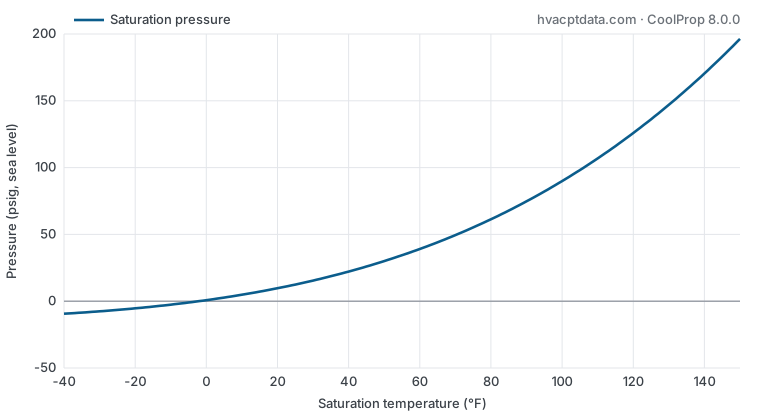
R-1234ze(E) is an A2L HFO single-component refrigerant. It saturates at 22.2 psig at 40°F and 89.9 psig at 100°F.
Reviewed · PT values computed with CoolProp 8.0.0 and checked against a published chart (largest difference 0.1 psi)
R-1234ze(E) at a glance
| Safety class (ASHRAE 34) | A2L: lower toxicity, mildly flammable (burning velocity ≤ 10 cm/s) |
|---|---|
| Type | HFO, single-component refrigerant |
| GWP (100-year, AR4) | Not listed in AR4Not listed in IPCC AR4; AR5 gives less than 1. EPA uses 1 under 40 CFR 84.64; EPA's SNAP chiller page lists 6. |
| Ozone depletion potential | 0 |
| Lubricant | POE (polyolester) |
| Boiling point at 14.7 psia | -2.1°F |
| Critical point | 228.9°F, 527 psia |
| 40°F evaporating | 22.2 psig |
| 100°F condensing | 89.9 psig |
| Charge as | Vapor or liquid |
| Typical use | Air- and water-cooled chillers; Heat pumps; Medium-temperature refrigeration and CO2 cascade high stages |
| Trade names | Solstice ze (Solstice Advanced Materials) |
| US status | Not an AIM Act regulated HFC; SNAP-acceptable in new centrifugal chillers since August 10 2012, with more end uses proposed in SNAP Rule 27 (Nov 2025). |
| Replaces | R-134a |
R-1234ze(E) PT chart (°F and psig)
R-1234ze(E) is a single-component refrigerant, so one pressure applies at each temperature for both the evaporator and the condenser. Tap a row to load it into the lookup.
-40°F to 150°F · psig at sea level · °C and kPa in the CSV · italic = inches Hg vacuum
| °F | psig |
|---|---|
| -40 | 19.1″ |
| -39 | 18.8″ |
| -38 | 18.4″ |
| -37 | 18.1″ |
| -36 | 17.7″ |
| -35 | 17.4″ |
| -34 | 17.0″ |
| -33 | 16.6″ |
| -32 | 16.2″ |
| -31 | 15.8″ |
| -30 | 15.4″ |
| -29 | 15.0″ |
| -28 | 14.6″ |
| -27 | 14.2″ |
| -26 | 13.7″ |
| -25 | 13.3″ |
| -24 | 12.8″ |
| -23 | 12.4″ |
| -22 | 11.9″ |
| -21 | 11.4″ |
| -20 | 10.9″ |
| -19 | 10.4″ |
| -18 | 9.9″ |
| -17 | 9.3″ |
| -16 | 8.8″ |
| -15 | 8.2″ |
| -14 | 7.7″ |
| -13 | 7.1″ |
| -12 | 6.5″ |
| -11 | 5.9″ |
| -10 | 5.3″ |
| -9 | 4.6″ |
| -8 | 4.0″ |
| -7 | 3.4″ |
| -6 | 2.7″ |
| -5 | 2.0″ |
| -4 | 1.3″ |
| -3 | 0.6″ |
| -2 | 0.1 |
| -1 | 0.4 |
| 0 | 0.8 |
| 1 | 1.2 |
| 2 | 1.5 |
| 3 | 1.9 |
| 4 | 2.3 |
| 5 | 2.7 |
| 6 | 3.1 |
| 7 | 3.6 |
| 8 | 4.0 |
| 9 | 4.4 |
| 10 | 4.9 |
| 11 | 5.3 |
| 12 | 5.8 |
| 13 | 6.2 |
| 14 | 6.7 |
| 15 | 7.2 |
| 16 | 7.7 |
| 17 | 8.2 |
| 18 | 8.7 |
| 19 | 9.2 |
| 20 | 9.7 |
| 21 | 10.2 |
| 22 | 10.8 |
| 23 | 11.3 |
| 24 | 11.9 |
| 25 | 12.5 |
| 26 | 13.0 |
| 27 | 13.6 |
| 28 | 14.2 |
| 29 | 14.8 |
| 30 | 15.5 |
| 31 | 16.1 |
| 32 | 16.7 |
| 33 | 17.4 |
| 34 | 18.0 |
| 35 | 18.7 |
| 36 | 19.4 |
| 37 | 20.1 |
| 38 | 20.8 |
| 39 | 21.5 |
| 40 | 22.2 |
| 41 | 22.9 |
| 42 | 23.7 |
| 43 | 24.4 |
| 44 | 25.2 |
| 45 | 26.0 |
| 46 | 26.8 |
| 47 | 27.6 |
| 48 | 28.4 |
| 49 | 29.2 |
| 50 | 30.0 |
| 51 | 30.9 |
| 52 | 31.7 |
| 53 | 32.6 |
| 54 | 33.5 |
| 55 | 34.4 |
| 56 | 35.3 |
| 57 | 36.2 |
| 58 | 37.2 |
| 59 | 38.1 |
| 60 | 39.1 |
| 61 | 40.1 |
| 62 | 41.1 |
| 63 | 42.1 |
| 64 | 43.1 |
| 65 | 44.1 |
| 66 | 45.2 |
| 67 | 46.2 |
| 68 | 47.3 |
| 69 | 48.4 |
| 70 | 49.5 |
| 71 | 50.6 |
| 72 | 51.7 |
| 73 | 52.9 |
| 74 | 54.0 |
| 75 | 55.2 |
| 76 | 56.4 |
| 77 | 57.6 |
| 78 | 58.8 |
| 79 | 60.1 |
| 80 | 61.3 |
| 81 | 62.6 |
| 82 | 63.9 |
| 83 | 65.2 |
| 84 | 66.5 |
| 85 | 67.8 |
| 86 | 69.2 |
| 87 | 70.6 |
| 88 | 71.9 |
| 89 | 73.3 |
| 90 | 74.8 |
| 91 | 76.2 |
| 92 | 77.6 |
| 93 | 79.1 |
| 94 | 80.6 |
| 95 | 82.1 |
| 96 | 83.6 |
| 97 | 85.2 |
| 98 | 86.7 |
| 99 | 88.3 |
| 100 | 89.9 |
| 101 | 91.5 |
| 102 | 93.2 |
| 103 | 94.8 |
| 104 | 96.5 |
| 105 | 98.2 |
| 106 | 99.9 |
| 107 | 101.6 |
| 108 | 103.3 |
| 109 | 105.1 |
| 110 | 106.9 |
| 111 | 108.7 |
| 112 | 110.5 |
| 113 | 112.4 |
| 114 | 114.3 |
| 115 | 116.1 |
| 116 | 118.0 |
| 117 | 120.0 |
| 118 | 121.9 |
| 119 | 123.9 |
| 120 | 125.9 |
| 121 | 127.9 |
| 122 | 129.9 |
| 123 | 132.0 |
| 124 | 134.1 |
| 125 | 136.2 |
| 126 | 138.3 |
| 127 | 140.5 |
| 128 | 142.6 |
| 129 | 144.8 |
| 130 | 147.0 |
| 131 | 149.3 |
| 132 | 151.5 |
| 133 | 153.8 |
| 134 | 156.1 |
| 135 | 158.4 |
| 136 | 160.8 |
| 137 | 163.2 |
| 138 | 165.6 |
| 139 | 168.0 |
| 140 | 170.5 |
| 141 | 172.9 |
| 142 | 175.4 |
| 143 | 178.0 |
| 144 | 180.5 |
| 145 | 183.1 |
| 146 | 185.7 |
| 147 | 188.3 |
| 148 | 191.0 |
| 149 | 193.6 |
| 150 | 196.4 |
Where you will find R-1234ze(E)
R-1234ze(E) is an HFO used mainly in chillers, both air-cooled and water-cooled, and in heat pumps. Solstice, which sells it as Solstice ze, also lists medium-temperature refrigeration and the high stage of CO2 cascade systems. It is a new-equipment alternative to R-134a: EPA lists HFO-1234ze(E) as acceptable in new centrifugal chillers since August 10, 2012. That chiller listing is for new equipment only, not retrofit of existing R-134a systems. The “(E)” designates the trans isomer; check the nameplate for the full name.
This site groups it with chiller refrigerants, but it is not a vacuum-side machine like R-1233zd(E). At normal chiller conditions it runs above atmospheric pressure, just lower than R-134a. At 40°F saturation it reads 22.2 psig against 35.1 psig for R-134a; at 100°F, 89.9 psig against 124.2 psig. It drops into a vacuum below its boiling point of -2.2°F (at -20°F it reads 10.9 in Hg vacuum), which matters only in refrigeration duty.
Charging R-1234ze(E)
R-1234ze(E) is a single-component refrigerant, so there is no glide and no fractionation: one PT column applies to both sides, and it can be charged as vapor or liquid. Charge amount and procedure come from the equipment manufacturer.
For diagnosis, convert suction pressure to saturation temperature and use the superheat calculator, and convert liquid or condenser pressure for the subcooling calculator. Targets come from the equipment manufacturer. Do not read it against an R-134a chart; at the same pressure its saturation temperature is quite different.
Because it is A2L, follow the flammable-refrigerant service procedures in the equipment manual. OEMs require A2L-rated service equipment on A2L systems (Carrier’s R-454B instructions are one example), and the same logic applies here.
Oil and compatibility
Solstice: POE oil is recommended. It notes that R-1234ze(E) is more soluble in oil than HFCs, so a higher-viscosity grade may be needed. BITZER lists POE and PVE. Use the compressor or chiller manufacturer’s specified oil. See the refrigerant oil types guide.
Safety, handling and recovery
A2L under ASHRAE 34: lower toxicity and mildly flammable, meaning LFL above 0.10 kg/m³, heat of combustion below 19,000 kJ/kg and burning velocity of 10 cm/s or less. The 2L class has been separate since Addendum g to ASHRAE 34-2016. The flammability safety classes page explains what that means on the job.
Section 608: at 104°F R-1234ze(E) reads 96.5 psig (111.2 psia), within the 45 to 170 psia medium-pressure band (40 CFR 82.152). That is Type II or Universal certification. Since January 1, 2018 the 608 rules cover HFO substitutes: venting is prohibited and sales are restricted to certified technicians (40 CFR 82.154(c)). Required recovery for medium-pressure appliances made on or after November 15, 1993 is 10 in Hg for charges under 200 lb and 15 in Hg for 200 lb or more (40 CFR 82.156 Table 1).
Recovery machines for flammable refrigerants are certified under Appendix B4 of 40 CFR 82.158, which adds UL 1963 Supplement SB; see recovery machine compatibility.
Cylinders: new containers are light green-gray RAL 7044 under AHRI Guideline N-2017, with a red band on the shoulder or top for flammable classes including 2L. Many A2L cylinders use left-hand thread valves; that is industry practice rather than a Guideline N requirement, so check the valve before connecting. See cylinder colors.
Status and replacements
R-1234ze(E) is an HFO, not an AIM Act regulated substance, so the HFC allowance phasedown does not apply to it. Its GWP depends on the basis: no IPCC AR4 value, less than 1 in AR5, 1 under 40 CFR 84.64 (the value EPA uses for Technology Transitions limits), and 6 on EPA’s SNAP chiller page. Compare on the GWP chart.
EPA’s pending SNAP Rule 27, proposed November 10, 2025, would add HFO-1234ze(E) for additional end uses; it was not final at the time of review. For other R-134a options see the R-134a replacement comparison.
Common questions
What is the difference between R-1234ze(E) and R-134a?
R-1234ze(E) is an A2L HFO with a GWP of about 1 to 6 depending on basis; R-134a is an A1 HFC with an AR4 GWP of 1,430. R-1234ze(E) runs at lower pressure at the same temperature (22.2 psig against 35.1 psig at 40°F), and EPA lists it for new chillers, not as a retrofit for R-134a equipment.
How this chart was computed
Every pressure on this page is calculated, not copied: CoolProp 8.0.0 (HEOS backend), the open-source implementation of the reference equations of state, using the model pure:R1234ze(E). Gauge values assume sea-level air pressure (14.696 psia); kPa values in the CSV are absolute.
Spot check against Honeywell Solstice ze (R-1234ze(E)) brochure BRO-22-40-EN (07/22), PT chart:
| °F | Column | Published | This chart | Difference |
|---|---|---|---|---|
| -2.2 | saturation | 0.00 psig | -0.02 psig | -0.0 psi |
| 39.7 | saturation | 22.0 psig | 22.0 psig | -0.0 psi |
| 100.1 | saturation | 90.0 psig | 90.1 psig | +0.1 psi |
| 108.9 | saturation | 105.0 psig | 104.9 psig | -0.1 psi |
Honeywell chart is pressure-based (psig in, °F out to 0.1 °F); the computed pressure is taken at the printed temperature, so ±0.05 °F printing resolution is about ±0.05-0.15 psi.
Charts from different publishers can differ by a few tenths of a psi because of the equation of state and blend tolerances. Always charge to the equipment manufacturer's data. Full method and every spot check
Comparisons with R-1234ze(E)
Calculators for R-1234ze(E)
Sources
- EPA SNAP: Substitutes in Centrifugal Chillers epa.gov
- Solstice ze (R-1234ze) product page solstice.com
- Solstice ze technical data sheet prod-edam.solstice.com
- BITZER Refrigerant Report: refrigerant data table bitzer.de
- eCFR 40 CFR 84.64: GWPs used for Technology Transitions ecfr.gov
- eCFR 40 CFR 82.152: Section 608 definitions and pressure classes ecfr.gov
- eCFR 40 CFR 82.154: venting prohibition and sales restriction ecfr.gov
Reviewed . Found an error? Tell us and we will correct it.
More in Chiller refrigerants