R-1233zd(E) PT Chart and Refrigerant Profile
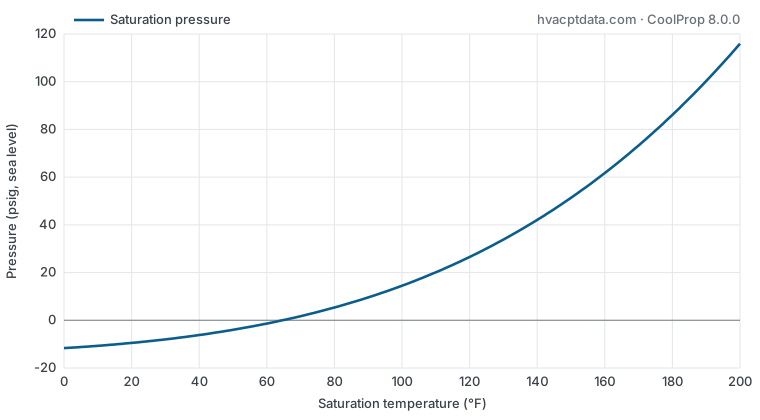
R-1233zd(E) is an A1 HCFO single-component refrigerant. It saturates at 12.6″ Hg vacuum at 40°F and 14.5 psig at 100°F.
Reviewed · PT values computed with CoolProp 8.0.0 and checked against a published chart (largest difference 0.1 psi)
R-1233zd(E) at a glance
| Safety class (ASHRAE 34) | A1: lower toxicity, no flame propagation |
|---|---|
| Type | HCFO, single-component refrigerant |
| GWP (100-year, AR4) | Not listed in AR4 · AR5: 1Not listed in IPCC AR4. EPA uses 4 under 40 CFR 84.64; EPA's SNAP chiller page lists 4.7-7. |
| Ozone depletion potential | 0 |
| Lubricant | Per chiller OEM (mineral oil or POE) |
| Boiling point at 14.7 psia | 64.6°F |
| Critical point | 330.3°F, 520 psia |
| 40°F evaporating | 12.6″ Hg vacuum |
| 100°F condensing | 14.5 psig |
| Charge as | Vapor or liquid |
| Typical use | Low-pressure centrifugal chillers; High-temperature heat pumps; Organic Rankine cycle (ORC) systems |
| Trade names | Solstice zd (Solstice Advanced Materials) |
| US status | Not a controlled ozone-depleting substance or AIM Act regulated HFC; SNAP-acceptable in new centrifugal chillers since August 10 2012. |
| Replaces | R-123, R-11 |
R-1233zd(E) PT chart (°F and psig)
R-1233zd(E) is a single-component refrigerant, so one pressure applies at each temperature for both the evaporator and the condenser. Tap a row to load it into the lookup.
0°F to 200°F · psig at sea level · °C and kPa in the CSV · italic = inches Hg vacuum
| °F | psig |
|---|---|
| 0 | 23.8″ |
| 1 | 23.6″ |
| 2 | 23.4″ |
| 3 | 23.2″ |
| 4 | 23.0″ |
| 5 | 22.8″ |
| 6 | 22.6″ |
| 7 | 22.4″ |
| 8 | 22.2″ |
| 9 | 22.0″ |
| 10 | 21.8″ |
| 11 | 21.6″ |
| 12 | 21.3″ |
| 13 | 21.1″ |
| 14 | 20.9″ |
| 15 | 20.6″ |
| 16 | 20.4″ |
| 17 | 20.1″ |
| 18 | 19.9″ |
| 19 | 19.6″ |
| 20 | 19.3″ |
| 21 | 19.0″ |
| 22 | 18.8″ |
| 23 | 18.5″ |
| 24 | 18.2″ |
| 25 | 17.9″ |
| 26 | 17.6″ |
| 27 | 17.3″ |
| 28 | 16.9″ |
| 29 | 16.6″ |
| 30 | 16.3″ |
| 31 | 15.9″ |
| 32 | 15.6″ |
| 33 | 15.2″ |
| 34 | 14.9″ |
| 35 | 14.5″ |
| 36 | 14.2″ |
| 37 | 13.8″ |
| 38 | 13.4″ |
| 39 | 13.0″ |
| 40 | 12.6″ |
| 41 | 12.2″ |
| 42 | 11.7″ |
| 43 | 11.3″ |
| 44 | 10.9″ |
| 45 | 10.4″ |
| 46 | 10.0″ |
| 47 | 9.5″ |
| 48 | 9.1″ |
| 49 | 8.6″ |
| 50 | 8.1″ |
| 51 | 7.6″ |
| 52 | 7.1″ |
| 53 | 6.6″ |
| 54 | 6.1″ |
| 55 | 5.6″ |
| 56 | 5.0″ |
| 57 | 4.5″ |
| 58 | 3.9″ |
| 59 | 3.4″ |
| 60 | 2.8″ |
| 61 | 2.2″ |
| 62 | 1.6″ |
| 63 | 1.0″ |
| 64 | 0.4″ |
| 65 | 0.1 |
| 66 | 0.4 |
| 67 | 0.7 |
| 68 | 1.1 |
| 69 | 1.4 |
| 70 | 1.7 |
| 71 | 2.1 |
| 72 | 2.4 |
| 73 | 2.8 |
| 74 | 3.1 |
| 75 | 3.5 |
| 76 | 3.8 |
| 77 | 4.2 |
| 78 | 4.6 |
| 79 | 5.0 |
| 80 | 5.4 |
| 81 | 5.8 |
| 82 | 6.2 |
| 83 | 6.6 |
| 84 | 7.0 |
| 85 | 7.4 |
| 86 | 7.8 |
| 87 | 8.3 |
| 88 | 8.7 |
| 89 | 9.1 |
| 90 | 9.6 |
| 91 | 10.1 |
| 92 | 10.5 |
| 93 | 11.0 |
| 94 | 11.5 |
| 95 | 12.0 |
| 96 | 12.5 |
| 97 | 13.0 |
| 98 | 13.5 |
| 99 | 14.0 |
| 100 | 14.5 |
| 101 | 15.0 |
| 102 | 15.6 |
| 103 | 16.1 |
| 104 | 16.7 |
| 105 | 17.2 |
| 106 | 17.8 |
| 107 | 18.4 |
| 108 | 18.9 |
| 109 | 19.5 |
| 110 | 20.1 |
| 111 | 20.7 |
| 112 | 21.3 |
| 113 | 22.0 |
| 114 | 22.6 |
| 115 | 23.2 |
| 116 | 23.9 |
| 117 | 24.5 |
| 118 | 25.2 |
| 119 | 25.9 |
| 120 | 26.5 |
| 121 | 27.2 |
| 122 | 27.9 |
| 123 | 28.6 |
| 124 | 29.4 |
| 125 | 30.1 |
| 126 | 30.8 |
| 127 | 31.6 |
| 128 | 32.3 |
| 129 | 33.1 |
| 130 | 33.8 |
| 131 | 34.6 |
| 132 | 35.4 |
| 133 | 36.2 |
| 134 | 37.0 |
| 135 | 37.8 |
| 136 | 38.7 |
| 137 | 39.5 |
| 138 | 40.4 |
| 139 | 41.2 |
| 140 | 42.1 |
| 141 | 43.0 |
| 142 | 43.9 |
| 143 | 44.8 |
| 144 | 45.7 |
| 145 | 46.6 |
| 146 | 47.5 |
| 147 | 48.5 |
| 148 | 49.4 |
| 149 | 50.4 |
| 150 | 51.4 |
| 151 | 52.3 |
| 152 | 53.3 |
| 153 | 54.3 |
| 154 | 55.4 |
| 155 | 56.4 |
| 156 | 57.4 |
| 157 | 58.5 |
| 158 | 59.6 |
| 159 | 60.6 |
| 160 | 61.7 |
| 161 | 62.8 |
| 162 | 63.9 |
| 163 | 65.1 |
| 164 | 66.2 |
| 165 | 67.4 |
| 166 | 68.5 |
| 167 | 69.7 |
| 168 | 70.9 |
| 169 | 72.1 |
| 170 | 73.3 |
| 171 | 74.5 |
| 172 | 75.7 |
| 173 | 77.0 |
| 174 | 78.3 |
| 175 | 79.5 |
| 176 | 80.8 |
| 177 | 82.1 |
| 178 | 83.4 |
| 179 | 84.8 |
| 180 | 86.1 |
| 181 | 87.5 |
| 182 | 88.8 |
| 183 | 90.2 |
| 184 | 91.6 |
| 185 | 93.0 |
| 186 | 94.5 |
| 187 | 95.9 |
| 188 | 97.3 |
| 189 | 98.8 |
| 190 | 100.3 |
| 191 | 101.8 |
| 192 | 103.3 |
| 193 | 104.8 |
| 194 | 106.4 |
| 195 | 107.9 |
| 196 | 109.5 |
| 197 | 111.1 |
| 198 | 112.7 |
| 199 | 114.3 |
| 200 | 115.9 |
Where you will find R-1233zd(E)
R-1233zd(E) is the low-pressure refrigerant in current centrifugal chillers designed to replace R-123 machines, which in turn replaced R-11. It is an HCFO (hydrochlorofluoroolefin), sold as Solstice zd. Solstice also lists organic Rankine cycle systems and high-temperature heat pumps among its uses. EPA lists it as acceptable in new centrifugal chillers since August 10, 2012. The “(E)” marks the trans isomer; the chiller nameplate shows the full designation.
It is a low-pressure refrigerant: it boils at 64.6°F at sea level, so the evaporator of a running chiller is in a vacuum. At 40°F saturation it reads 12.6 in Hg vacuum. The condenser runs a few psi above atmospheric: 14.5 psig at 100°F.
Do not read an R-1233zd(E) machine against an R-123 chart. At the same temperature R-1233zd(E) runs noticeably higher: at 40°F, 12.6 in Hg vacuum against 18.2 in Hg for R-123; at 100°F, 14.5 psig against 6.1 psig. Use a gauge or transducer that resolves inches of mercury, and the pressure converter when the chiller controls display psia or kPa.
Charging R-1233zd(E)
R-1233zd(E) is a single-component refrigerant and a liquid at room temperature and atmospheric pressure, so it is handled as a liquid. With no glide, one PT column serves the evaporator and condenser, and composition does not shift during leaks or top-offs. Charge amount and procedure come from the chiller manufacturer’s service manual.
The low side runs in a vacuum, so a leak there lets air and moisture into the machine. If condenser pressure sits above the saturation pressure for the measured condensing temperature, suspect non-condensables; check with the PT calculator. The subcooling calculator works for refrigerant-side checks, with targets from the manufacturer.
Oil and compatibility
The sources disagree. Solstice’s product page lists mineral oil as the typical lubricant; BITZER’s refrigerant table lists POE. Chillers are built around a specific lubricant, so use the chiller manufacturer’s specified oil and do not substitute based on either general listing. EPA’s listing covers new chillers only, not retrofits of R-123 machines. See the refrigerant oil types guide.
Safety, handling and recovery
A1 under ASHRAE 34: lower toxicity, no flame propagation. That is a change from R-123, which is B1 (higher toxicity).
Section 608: at 104°F R-1233zd(E) reads 16.7 psig (31.3 psia), under the 45 psia limit, so it is a low-pressure refrigerant (40 CFR 82.152). Work on these chillers needs Type III or Universal certification. Since January 1, 2018 the 608 rules apply to substitutes such as HCFOs: venting is prohibited, sales are restricted to certified technicians (40 CFR 82.154(c)), and recovery from a low-pressure appliance must reach 25 mm Hg absolute (40 CFR 82.156 Table 1), which is close to 29 in Hg vacuum at sea level.
Cylinders: no legacy color applies; new containers are light green-gray RAL 7044 under AHRI Guideline N-2017, with recovery cylinders gray with a yellow top. See cylinder colors.
Status and replacements
R-1233zd(E) is not a listed controlled substance under the ozone rules (40 CFR 82) and is not an AIM Act regulated HFC, so it needs no allowances and the HFC phasedown does not touch it. The ODP field shows 0 because it has no Montreal Protocol value; EPA’s SNAP chiller page gives a very small ODP of 0.00024 to 0.00034.
GWP depends on the basis. IPCC AR4 has no value; AR5 gives 1 (also listed in the ASHRAE/UNEP factsheet); EPA assigns 4 in 40 CFR 84.64 for Technology Transitions; EPA’s SNAP chiller page lists 4.7 to 7. All are low; the GWP chart puts them in context.
For R-123 chiller owners, R-1233zd(E) is the new-equipment route; R-514A is the EPA-listed option for retrofit as well as new chillers (see the R-123 profile).
Common questions
What is the difference between R-1233zd(E) and R-1234ze(E)?
R-1233zd(E) is an A1 low-pressure HCFO for low-pressure centrifugal chillers. R-1234ze(E) is an A2L (mildly flammable) HFO that runs at much higher, above-atmospheric pressures, and falls in the medium-pressure 608 class. At 40°F R-1234ze(E) reads 22.2 psig, where R-1233zd(E) is at 12.6 in Hg vacuum.
How does R-1233zd(E) compare with R-134a?
They serve different chiller designs. R-134a is an A1 HFC that runs above atmospheric pressure (35.1 psig at 40°F) and is a medium-pressure, Type II refrigerant; R-1233zd(E) runs in a vacuum at the same temperature and needs Type III. R-134a has an AR4 GWP of 1,430, so it is under the AIM Act phasedown; R-1233zd(E) is not.
How this chart was computed
Every pressure on this page is calculated, not copied: CoolProp 8.0.0 (HEOS backend), the open-source implementation of the reference equations of state, using the model pure:R1233zd(E). Gauge values assume sea-level air pressure (14.696 psia); kPa values in the CSV are absolute.
Spot check against Honeywell "A Better Environment with Next-Generation Solstice zd" brochure (6846 Ref A4 EU v1, 05/2020), vapor pressure table:
| °F | Column | Published | This chart | Difference |
|---|---|---|---|---|
| 32 | saturation | 48.0 kPa | 48.5 kPa | +0.1 psi |
| 68 | saturation | 108.0 kPa | 108.7 kPa | +0.1 psi |
| 104 | saturation | 216.0 kPa | 216.1 kPa | +0.0 psi |
| 176 | saturation | 658.0 kPa | 658.6 kPa | +0.1 psi |
Only a °C / whole-kPa table was found from the manufacturer; compared at 0, 20, 40, 80 °C. Whole-kPa rounding is ±0.07 psi.
Charts from different publishers can differ by a few tenths of a psi because of the equation of state and blend tolerances. Always charge to the equipment manufacturer's data. Full method and every spot check
Calculators for R-1233zd(E)
Sources
- EPA SNAP: Substitutes in Centrifugal Chillers epa.gov
- Solstice zd (R-1233zd) product page solstice.com
- BITZER Refrigerant Report: R-11 and R-123 alternatives bitzer.de
- BITZER Refrigerant Report: refrigerant data table bitzer.de
- eCFR 40 CFR 84.64: GWPs used for Technology Transitions ecfr.gov
- eCFR 40 CFR 82.152: Section 608 definitions and pressure classes ecfr.gov
- eCFR 40 CFR 82.154: venting prohibition and sales restriction ecfr.gov
Reviewed . Found an error? Tell us and we will correct it.
More in Chiller refrigerants