R-454B PT Chart and Refrigerant Profile
R-454B is an A2L HFC/HFO zeotropic blend of R-32 and R-1234yf (68.9/31.1 % by mass). At 40°F its vapor (dew) pressure is 107.5 psig; at 100°F its liquid (bubble) pressure is 303.3 psig.
Reviewed · PT values computed with CoolProp 8.0.0 and checked against a published chart (largest difference 2.5 psi)
R-454B at a glance
| Safety class (ASHRAE 34) | A2L: lower toxicity, mildly flammable (burning velocity ≤ 10 cm/s) |
|---|---|
| Type | HFC/HFO, zeotropic blend |
| Composition | R-32 68.9% · R-1234yf 31.1% by mass |
| GWP (100-year, AR4) | 466 · AR5: 467466 as commonly published on the AR4 basis; EPA's own 40 CFR 84.64 calculation gives 465 |
| Ozone depletion potential | 0 |
| Lubricant | POE (some OEMs PVE) |
| Boiling point at 14.7 psia | -59.3°F bubble · -57.1°F dew |
| Critical point | 172.9°F, 769 psia |
| 40°F evaporating | 107.5 psig (dew), glide 2.7°F |
| 100°F condensing | 303.3 psig (bubble), glide 2.7°F |
| Charge as | Liquid only (blend can fractionate as vapor) |
| Typical use | New residential and light commercial split AC and heat pumps; Packaged units; Mini-splits and room units; Chillers |
| Trade names | Puron Advance (Carrier), Opteon XL41 (Chemours), Solstice 454B (Solstice Advanced Materials), Forane 454B (Arkema) |
| US status | Meets the 700 GWP limit for new US residential and light commercial AC/HP from Jan 1 2025; SNAP-acceptable in new equipment only, not as an R-410A retrofit. |
| Replaces | R-410A |
R-454B PT chart (°F and psig)
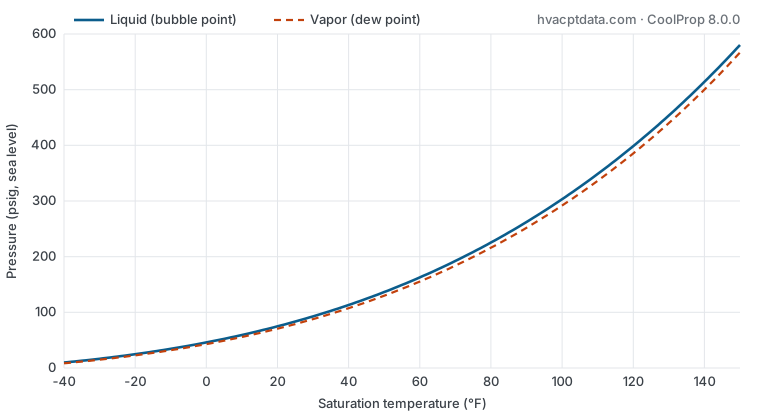
R-454B is a blend, so it has two saturation pressures at each temperature. Read the vapor (dew) column against suction pressure for superheat and the liquid (bubble) column against liquid-line pressure for subcooling. Tap a row to load it into the lookup.
-40°F to 150°F · psig at sea level · °C and kPa in the CSV · italic = inches Hg vacuum
| °F | Liquidbubble psig | Vapordew psig |
|---|---|---|
| -40 | 9.8 | 8.5 |
| -39 | 10.4 | 9.1 |
| -38 | 11.1 | 9.7 |
| -37 | 11.7 | 10.3 |
| -36 | 12.4 | 10.9 |
| -35 | 13.0 | 11.5 |
| -34 | 13.7 | 12.2 |
| -33 | 14.4 | 12.8 |
| -32 | 15.1 | 13.5 |
| -31 | 15.9 | 14.2 |
| -30 | 16.6 | 14.9 |
| -29 | 17.3 | 15.6 |
| -28 | 18.1 | 16.4 |
| -27 | 18.9 | 17.1 |
| -26 | 19.7 | 17.9 |
| -25 | 20.5 | 18.6 |
| -24 | 21.3 | 19.4 |
| -23 | 22.2 | 20.2 |
| -22 | 23.0 | 21.0 |
| -21 | 23.9 | 21.8 |
| -20 | 24.8 | 22.7 |
| -19 | 25.7 | 23.5 |
| -18 | 26.6 | 24.4 |
| -17 | 27.5 | 25.3 |
| -16 | 28.4 | 26.2 |
| -15 | 29.4 | 27.1 |
| -14 | 30.4 | 28.1 |
| -13 | 31.4 | 29.0 |
| -12 | 32.4 | 30.0 |
| -11 | 33.4 | 31.0 |
| -10 | 34.5 | 32.0 |
| -9 | 35.5 | 33.0 |
| -8 | 36.6 | 34.0 |
| -7 | 37.7 | 35.1 |
| -6 | 38.8 | 36.1 |
| -5 | 40.0 | 37.2 |
| -4 | 41.1 | 38.3 |
| -3 | 42.3 | 39.4 |
| -2 | 43.5 | 40.6 |
| -1 | 44.7 | 41.7 |
| 0 | 45.9 | 42.9 |
| 1 | 47.2 | 44.1 |
| 2 | 48.4 | 45.3 |
| 3 | 49.7 | 46.6 |
| 4 | 51.0 | 47.8 |
| 5 | 52.4 | 49.1 |
| 6 | 53.7 | 50.4 |
| 7 | 55.1 | 51.7 |
| 8 | 56.5 | 53.0 |
| 9 | 57.9 | 54.4 |
| 10 | 59.3 | 55.7 |
| 11 | 60.8 | 57.1 |
| 12 | 62.2 | 58.5 |
| 13 | 63.7 | 60.0 |
| 14 | 65.3 | 61.4 |
| 15 | 66.8 | 62.9 |
| 16 | 68.4 | 64.4 |
| 17 | 69.9 | 65.9 |
| 18 | 71.6 | 67.5 |
| 19 | 73.2 | 69.0 |
| 20 | 74.8 | 70.6 |
| 21 | 76.5 | 72.2 |
| 22 | 78.2 | 73.9 |
| 23 | 80.0 | 75.5 |
| 24 | 81.7 | 77.2 |
| 25 | 83.5 | 78.9 |
| 26 | 85.3 | 80.7 |
| 27 | 87.1 | 82.4 |
| 28 | 89.0 | 84.2 |
| 29 | 90.8 | 86.0 |
| 30 | 92.7 | 87.8 |
| 31 | 94.7 | 89.7 |
| 32 | 96.6 | 91.5 |
| 33 | 98.6 | 93.4 |
| 34 | 100.6 | 95.4 |
| 35 | 102.6 | 97.3 |
| 36 | 104.7 | 99.3 |
| 37 | 106.8 | 101.3 |
| 38 | 108.9 | 103.3 |
| 39 | 111.0 | 105.4 |
| 40 | 113.2 | 107.5 |
| 41 | 115.4 | 109.6 |
| 42 | 117.6 | 111.7 |
| 43 | 119.9 | 113.9 |
| 44 | 122.1 | 116.1 |
| 45 | 124.5 | 118.3 |
| 46 | 126.8 | 120.6 |
| 47 | 129.2 | 122.9 |
| 48 | 131.6 | 125.2 |
| 49 | 134.0 | 127.5 |
| 50 | 136.5 | 129.9 |
| 51 | 138.9 | 132.3 |
| 52 | 141.5 | 134.7 |
| 53 | 144.0 | 137.2 |
| 54 | 146.6 | 139.7 |
| 55 | 149.2 | 142.2 |
| 56 | 151.8 | 144.8 |
| 57 | 154.5 | 147.3 |
| 58 | 157.2 | 150.0 |
| 59 | 160.0 | 152.6 |
| 60 | 162.7 | 155.3 |
| 61 | 165.6 | 158.0 |
| 62 | 168.4 | 160.8 |
| 63 | 171.3 | 163.5 |
| 64 | 174.2 | 166.3 |
| 65 | 177.1 | 169.2 |
| 66 | 180.1 | 172.1 |
| 67 | 183.1 | 175.0 |
| 68 | 186.1 | 177.9 |
| 69 | 189.2 | 180.9 |
| 70 | 192.3 | 183.9 |
| 71 | 195.5 | 187.0 |
| 72 | 198.6 | 190.0 |
| 73 | 201.9 | 193.2 |
| 74 | 205.1 | 196.3 |
| 75 | 208.4 | 199.5 |
| 76 | 211.7 | 202.7 |
| 77 | 215.1 | 206.0 |
| 78 | 218.5 | 209.3 |
| 79 | 221.9 | 212.6 |
| 80 | 225.4 | 216.0 |
| 81 | 228.9 | 219.4 |
| 82 | 232.5 | 222.9 |
| 83 | 236.1 | 226.4 |
| 84 | 239.7 | 229.9 |
| 85 | 243.4 | 233.5 |
| 86 | 247.1 | 237.1 |
| 87 | 250.8 | 240.7 |
| 88 | 254.6 | 244.4 |
| 89 | 258.4 | 248.2 |
| 90 | 262.3 | 251.9 |
| 91 | 266.2 | 255.7 |
| 92 | 270.2 | 259.6 |
| 93 | 274.2 | 263.5 |
| 94 | 278.2 | 267.4 |
| 95 | 282.3 | 271.4 |
| 96 | 286.4 | 275.4 |
| 97 | 290.5 | 279.5 |
| 98 | 294.7 | 283.6 |
| 99 | 299.0 | 287.7 |
| 100 | 303.3 | 291.9 |
| 101 | 307.6 | 296.1 |
| 102 | 312.0 | 300.4 |
| 103 | 316.4 | 304.8 |
| 104 | 320.9 | 309.1 |
| 105 | 325.4 | 313.5 |
| 106 | 329.9 | 318.0 |
| 107 | 334.5 | 322.5 |
| 108 | 339.2 | 327.1 |
| 109 | 343.9 | 331.7 |
| 110 | 348.6 | 336.3 |
| 111 | 353.4 | 341.0 |
| 112 | 358.2 | 345.8 |
| 113 | 363.1 | 350.6 |
| 114 | 368.0 | 355.4 |
| 115 | 373.0 | 360.3 |
| 116 | 378.0 | 365.3 |
| 117 | 383.1 | 370.2 |
| 118 | 388.2 | 375.3 |
| 119 | 393.4 | 380.4 |
| 120 | 398.6 | 385.5 |
| 121 | 403.9 | 390.7 |
| 122 | 409.2 | 396.0 |
| 123 | 414.6 | 401.3 |
| 124 | 420.0 | 406.7 |
| 125 | 425.5 | 412.1 |
| 126 | 431.0 | 417.5 |
| 127 | 436.6 | 423.1 |
| 128 | 442.2 | 428.7 |
| 129 | 447.9 | 434.3 |
| 130 | 453.6 | 440.0 |
| 131 | 459.4 | 445.7 |
| 132 | 465.3 | 451.5 |
| 133 | 471.2 | 457.4 |
| 134 | 477.1 | 463.3 |
| 135 | 483.2 | 469.3 |
| 136 | 489.2 | 475.4 |
| 137 | 495.3 | 481.5 |
| 138 | 501.5 | 487.6 |
| 139 | 507.8 | 493.9 |
| 140 | 514.1 | 500.2 |
| 141 | 520.4 | 506.5 |
| 142 | 526.8 | 512.9 |
| 143 | 533.3 | 519.4 |
| 144 | 539.8 | 526.0 |
| 145 | 546.4 | 532.6 |
| 146 | 553.1 | 539.3 |
| 147 | 559.8 | 546.1 |
| 148 | 566.5 | 552.9 |
| 149 | 573.4 | 559.8 |
| 150 | 580.3 | 566.8 |
Where you will find R-454B
R-454B is the refrigerant in most new US residential and light commercial split systems, heat pumps and packaged units built from 2025 on, when new equipment had to drop below a GWP of 700. It is also used in mini-splits, room units and chillers. Carrier brands it Puron Advance; the refrigerant is sold as Opteon XL41 (Chemours), Solstice 454B and Forane 454B (Carrier, Arkema).
Identify it by the nameplate and the A2L flammability labels on the unit. Equipment built for it carries refrigerant detection or other mitigation required by the UL 60335-2-40 based SNAP use conditions; see refrigerant detection systems. Cylinders are the standard light green-gray (RAL 7044) with a red band on the shoulder or top to mark a flammable refrigerant. No legacy paint color applies.
R-454B replaced R-410A in new equipment only. EPA lists it as acceptable in new systems, not as a retrofit, and Copeland says A2L refrigerants must not go into compressors or equipment not designed for them.
Charging R-454B
Charge as liquid. R-454B is a zeotropic blend of R-32 and R-1234yf, and vapor drawn from the cylinder does not match the 68.9/31.1 mix.
The glide is small but real: about 2.7°F at a 40°F dew point. At 40°F this chart gives 107.5 psig dew and 113.2 psig bubble. Some web charts print one pressure per temperature for R-454B, which mixes the columns and can throw superheat or subcooling off by a couple of degrees. Use the right column:
- Superheat: read suction pressure against the dew column. Fixed-orifice systems are charged to target superheat (CEC Title 24 Table RA3.2-2, installer tolerance ±5°F, valid at 55–115°F outdoor, return dry bulb 70°F or higher, return wet bulb 76°F or lower). Use the target superheat calculator.
- Subcooling: read liquid-line pressure against the bubble column. Most R-454B equipment uses a TXV or EEV and is charged by subcooling to the nameplate or manual target, with ±3°F allowed for the installer under Title 24. Use the subcooling calculator.
The temperature glide calculator shows the gap at any pressure. When conditions fall outside the manufacturer’s charging chart, weigh in the charge from the nameplate plus the manual’s line-set adder. Rheem and Ruud R-454B instructions, for example, use 0.6 oz/ft for a 3/8 in liquid line, with the factory charge typically covering 15 ft. Your model’s manual governs.
Oil and compatibility
R-454B equipment uses POE oil. Copeland and Solstice specify POE, and Carrier says R-454B works with certain POE and PVE lubricants (Copeland AE 93-11). Add only the oil named on the compressor or in the manual, keep POE sealed against moisture, and replace the filter-drier with one listed for the refrigerant whenever the system is opened. Evacuate to the OEM target, typically 350–500 microns (evacuation guide).
Do not put R-454B in an R-410A system or top off an R-410A system with it. A mixture no longer matches either PT chart, so charge readings become meaningless.
Safety, handling and recovery
A2L means lower toxicity and mild flammability: it can burn, but with a burning velocity of 10 cm/s or less (flammability classes explained). In practice, keep ignition sources out of the work area and follow the A2L service procedure in the installation manual.
Recovery machines for flammable refrigerants are certified under 40 CFR 82.158 Appendix B4, which adds UL 1963 Supplement SB to AHRI 740. Carrier’s R-454B instructions require A2L-rated service equipment (recovery machine compatibility). Many A2L cylinders use left-hand thread valves, an industry practice that Guideline N-2017 does not specify, so carry the right adapter and never force a fitting.
Section 608 Type II (or Universal) certification covers R-454B systems, and Type I covers factory-sealed units of 5 lb or less. By the 40 CFR 82.152 definition it is a high-pressure refrigerant: its computed liquid saturation pressure at 104°F is 335.6 psia (320.9 psig, bubble). Recover appliances under 200 lb to 0 in Hg, and 200 lb or more to 10 in Hg.
Status and replacements
R-454B has a GWP of 466 on the AR4 basis (EPA’s 40 CFR 84.64 figure is 465), below the 700 limit in the Technology Transitions rule. That makes it compliant for new residential and light commercial AC and heat pumps (from Jan 1 2025), VRF (from Jan 1 2026) and comfort chillers. EPA accepted it subject to use conditions in SNAP Rule 23 (May 6 2021).
R-454B is still an HFC-containing blend, so its R-32 content counts against the AIM Act phasedown. HFOs such as R-1234yf are not regulated substances under Part 84. The preamble of the May 2026 Technology Transitions final rule discusses shortages of R-454B service cylinders, so check supply before a job that needs a full charge.
No replacement for R-454B is set. The other main low-GWP option in new residential equipment is R-32. See R-410A vs R-454B, R-454B vs R-32 and the A2L refrigerants guide.
Common questions
Is Opteon XL41 the same as R-454B?
Yes. Opteon XL41 is Chemours’ name for R-454B. Puron Advance (Carrier), Solstice 454B and Forane 454B are the same refrigerant under other names.
Can you put R-454B in an R-410A system?
No. EPA lists R-454B for new equipment only, and the system needs A2L-rated components and safety measures. See R-410A vs R-454B.
How this chart was computed
Every pressure on this page is calculated, not copied: CoolProp 8.0.0 (HEOS backend), the open-source implementation of the reference equations of state, using the model mix:R454B at the nominal ASHRAE 34 composition. Gauge values assume sea-level air pressure (14.696 psia); kPa values in the CSV are absolute.
Spot check against Opteon XL41 Pressure-Temperature Data (Eng), C-XL41PT-ENG (7/23):
| °F | Column | Published | This chart | Difference |
|---|---|---|---|---|
| 0 | bubble | 45.3 psig | 45.9 psig | +0.6 psi |
| 0 | dew | 42.7 psig | 42.9 psig | +0.2 psi |
| 40 | bubble | 112.0 psig | 113.2 psig | +1.2 psi |
| 40 | dew | 107.0 psig | 107.5 psig | +0.5 psi |
| 100 | bubble | 300.8 psig | 303.3 psig | +2.5 psi |
| 100 | dew | 290.9 psig | 291.9 psig | +1.0 psi |
Bubble side reads up to 2.5 psi high at 100 °F (0.8%); dew within 1 psi.
Charts from different publishers can differ by a few tenths of a psi because of the equation of state and blend tolerances. Always charge to the equipment manufacturer's data. Full method and every spot check
Comparisons with R-454B
Calculators for R-454B
Sources
- Carrier: R-454B refrigerant carrier.com
- 86 FR 24444 (May 6 2021), SNAP Rule 23: A2L refrigerants in residential and light commercial AC and heat pumps federalregister.gov
- EPA SNAP: Substitutes in residential and light commercial AC and heat pumps epa.gov
- 40 CFR 84.64 - GWPs for Technology Transitions ecfr.gov
- 91 FR 31284 (May 26 2026): Reconsideration of Certain Technology Transitions Requirements, final rule federalregister.gov
- Copeland AE Bulletin 93-11: Refrigerants and lubricants approved for Copeland compressors webapps.copeland.com
- Arkema Forane 454B product page forane.arkema.com
- 40 CFR 82.152 - Section 608 definitions and pressure classes ecfr.gov
Reviewed . Found an error? Tell us and we will correct it.
More in Air conditioning and heat pumps