R-454A vs R-454B vs R-454C
Reviewed · pressures computed with CoolProp 8.0 from the same data as the PT charts
Are R-454A, R-454B and R-454C interchangeable?
No. All three are A2L blends of R-32 and R-1234yf, but the R-32 share runs from 68.9% (R-454B) to 35% (R-454A) and 21.5% (R-454C). That changes pressure, glide and GWP so much that each has its own PT chart and its own equipment: R-454B for AC and heat pumps, R-454A and R-454C mainly for new commercial refrigeration.
Pressures side by side
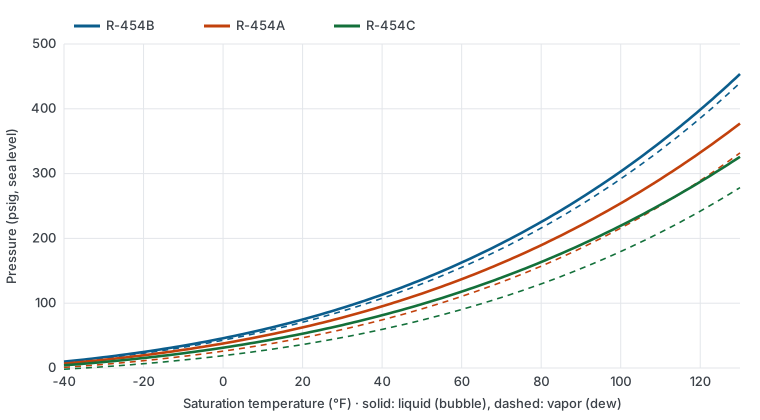
Saturation pressure in psig at sea level. Evaporating rows use the vapor (dew) value, condensing rows the liquid (bubble) value, which is what you compare with suction and liquid-line gauges.
| Saturation | R-454B | R-454A | R-454C |
|---|---|---|---|
| Evaporator (vapor, dew) | |||
| -20°F | 22.7 | 11.2 | 6.7 |
| 0°F | 42.9 | 26.0 | 19.0 |
| 20°F | 70.6 | 46.6 | 36.3 |
| 30°F | 87.8 | 59.4 | 47.1 |
| 35°F | 97.3 | 66.6 | 53.1 |
| 40°F | 107.5 | 74.3 | 59.6 |
| 45°F | 118.3 | 82.5 | 66.5 |
| 50°F | 129.9 | 91.2 | 73.9 |
| Condenser (liquid, bubble) | |||
| 80°F | 225.4 | 189.6 | 163.5 |
| 90°F | 262.3 | 220.3 | 190.2 |
| 95°F | 282.3 | 236.8 | 204.5 |
| 100°F | 303.3 | 254.2 | 219.6 |
| 105°F | 325.4 | 272.5 | 235.4 |
| 110°F | 348.6 | 291.6 | 251.9 |
| 115°F | 373.0 | 311.6 | 269.3 |
| 120°F | 398.6 | 332.5 | 287.4 |
| 125°F | 425.5 | 354.4 | 306.3 |
| 130°F | 453.6 | 377.3 | 326.0 |
Properties
| Property | R-454B | R-454A | R-454C |
|---|---|---|---|
| Safety class | A2L | A2L | A2L |
| Type | HFC/HFO, zeotropic blend | HFC/HFO, zeotropic blend | HFC/HFO, zeotropic blend |
| Composition (mass %) | R-32 68.9, R-1234yf 31.1 | R-32 35, R-1234yf 65 | R-32 21.5, R-1234yf 78.5 |
| GWP (AR4) | 466 | 239 | 148 |
| Lubricant | POE (some OEMs PVE) | POE (polyolester) | POE (polyolester) or PVE |
| Boiling point (14.7 psia) | -59.3°F | -54.6°F | -49.7°F |
| Critical point | 172.9°F, 769 psia | 182.4°F, 685 psia | 189.8°F, 634 psia |
| Glide at 40°F evaporating | 2.7°F | 12.2°F | 14.9°F |
| Glide at 100°F condensing | 2.7°F | 11.0°F | 13.3°F |
| US status | Meets the 700 GWP limit for new US residential and light commercial AC/HP from Jan 1 2025; SNAP-acceptable in new equipment only, not as an R-410A retrofit. | SNAP-acceptable with use conditions in new commercial refrigeration (June 2024); GWP under 300 meets the Jan 1 2032 limits for systems under 200 lb but not the 150 limit for larger systems. | SNAP-acceptable with use conditions in new commercial refrigeration (June 2024); GWP under 150 meets even the Jan 1 2032 limits for remote condensing, supermarket and cold storage systems. |
Component compatibility
| Item | R-454B | R-454A | R-454C |
|---|---|---|---|
| Composition (R-32/R-1234yf) | 68.9 / 31.1 | 35 / 65 | 21.5 / 78.5 |
| Trade names | Opteon XL41, Solstice 454B, Forane 454B; Carrier Puron Advance | Opteon XL40, Solstice 454A | Opteon XL20, Solstice 454C |
| Main use | New residential and light commercial AC and heat pumps, chillers | New low- and medium-temp commercial refrigeration, condensing units, cold storage | New low- and medium-temp refrigeration, plug-in cases, transport; also heat pumps |
| Lubricant | POE or PVE per OEM | POE | POE or PVE (Solstice); POE (Chemours) |
| Charging | Liquid | Liquid | Liquid |
| Recovery machine | Flammable-rated (App. B4) | Flammable-rated (App. B4) | Flammable-rated (App. B4) |
| Cylinder | RAL 7044 gray with red band | RAL 7044 gray with red band | RAL 7044 gray with red band |
| PT chart accuracy on this site | Dew within 1 psi; bubble up to 2.5 psi high at 100°F | Dew 2.6-2.8% low vs Chemours | Dew 2.5-2.7% low vs Chemours and Honeywell |
What changes in the field
More R-32 means higher pressure. From the PT data, at 40°F evaporating (dew) R-454B reads 107.5 psig, R-454A 74.3 psig and R-454C 59.6 psig. At 100°F condensing (bubble) R-454B is 303.3 psig, R-454A 254.2 psig and R-454C 219.6 psig. Reading one blend’s chart for another puts you tens of psi off.
Glide grows as R-32 drops. The computed glide at 40°F evaporating is 2.7°F for R-454B, 12.2°F for R-454A and 14.9°F for R-454C. Read the dew column for superheat and the bubble column for subcooling; on R-454A and R-454C the two columns are about 21 psi apart at 40°F, so the wrong column is a large error. The glide calculator helps.
A note on accuracy. This site computes the PT charts with CoolProp, and its fitted R-32/R-1234yf model reads the R-454A and R-454C dew lines low: 2.6 to 2.8% below Chemours for R-454A and 2.5 to 2.7% below Chemours and Honeywell for R-454C, up to about 6.5 and 5.5 psi. The R-454B chart sits within 1 psi on dew and up to 2.5 psi high on bubble at 100°F. For close superheat readings on R-454A or R-454C, cross-check against the Chemours or Solstice PT data. Each profile’s validation table lists the points.
Handling is the same for all three. They are A2L, so recovery machines must be certified for flammable refrigerants under Appendix B4 of 40 CFR 82.158, and cylinders are gray RAL 7044 with a red band. All are high-pressure refrigerants under Section 608 and are charged as liquid. Keep a separate recovery cylinder for each; see recovery machine compatibility.
Retrofit or replacement
None of the three replaces another in an existing system, and none is a retrofit for an A1 refrigerant:
- EPA’s SNAP listings for R-454A, R-454B and R-454C in residential and light commercial AC and heat pumps (May 6 2021) are all marked new equipment only. The commercial refrigeration listings for R-454A and R-454C in SNAP Rule 26 are also for new equipment with use conditions.
- Equipment is designed, listed and charge-limited for one refrigerant. Carrier states that R-454B is not a drop-in replacement because components, controls and safety requirements are designed around the specified refrigerant.
- The pressure and glide differences above change compressor sizing and metering.
So an R-454B heat pump stays on R-454B, and an R-454A or R-454C condensing unit stays on the refrigerant on its nameplate. Never top off one with another; a mix matches no chart.
In practice: R-454B replaces R-410A in new AC equipment. Chemours positions R-454A as a new-equipment alternative to R-404A and R-507A, and R-454C as an alternative to R-404A, R-507A, R-448A, R-22 and R-407A in new equipment. For existing R-404A racks, see R-404A replacement.
Capacity, efficiency and cost
None of the sources used here gives a capacity or efficiency percentage comparing these three blends, so none is quoted. They are not designed for the same duty.
GWP is the main difference, and it sets where each one can go. On the AR4 basis R-454B is 466, R-454A 239 and R-454C 148; EPA’s own 40 CFR 84.64 calculation gives 465, 236.9 and 145.9. R-454B is under the 700 limit for new residential and light commercial AC and heat pumps. Under 40 CFR 84.54, the Jan 1 2032 limits for remote condensing unit, supermarket and cold storage systems are 300 GWP below 200 lb of charge and 150 at 200 lb or more: R-454A meets the first but not the second, and R-454C meets both.
Common questions
What is the difference between R-454A and R-454B?
The R-32 content: 35% in R-454A against 68.9% in R-454B. R-454A runs lower pressures with about 12°F of glide and is sold for refrigeration; R-454B runs a little below R-410A pressures with under 3°F of glide and is sold for AC and heat pumps.
Is R-454C the same as R-454B?
No. R-454C has the least R-32 of the three, the lowest pressures, the largest glide and a GWP under 150. Solstice and Chemours sell it mainly for refrigeration, with heat pumps also listed; it does not run R-410A pressures.
PT charts and calculators
Sources
- EPA SNAP: Substitutes in Residential and Light Commercial AC and Heat Pumps epa.gov
- 89 FR 50410 (June 13 2024), SNAP Rule 26: A2Ls and R-290 in commercial and industrial refrigeration federalregister.gov
- Chemours General Replacement Guide pages.chemours.com
- Solstice 454A product page solstice.com
- Solstice 454C product page solstice.com
- Carrier: R-454B refrigerant carrier.com
- 40 CFR 84.54: Technology Transitions restrictions by sector ecfr.gov
- 40 CFR 84.64: Global warming potentials for Technology Transitions ecfr.gov
Reviewed . Found an error? Tell us and we will correct it.