R-454A PT Chart and Refrigerant Profile
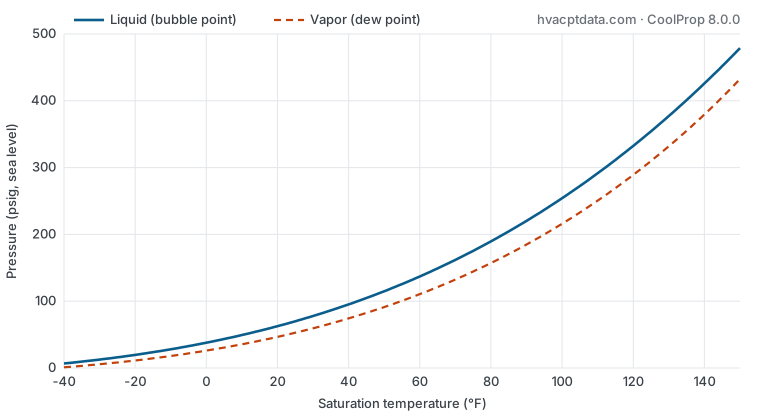
R-454A is an A2L HFC/HFO zeotropic blend of R-32 and R-1234yf (35/65 % by mass). At 40°F its vapor (dew) pressure is 74.3 psig; at 100°F its liquid (bubble) pressure is 254.2 psig.
Reviewed · PT values computed with CoolProp 8.0.0 and checked against a published chart (largest difference 6.5 psi)
Accuracy note. The open mixture model used for R-454A gives vapor (dew) pressures up to 6.5 psi below the manufacturer's published chart (at 100°F). The difference is listed in How this chart was computed. When you set a charge on R-454A, use the manufacturer's chart or the equipment charging chart.
R-454A at a glance
| Safety class (ASHRAE 34) | A2L: lower toxicity, mildly flammable (burning velocity ≤ 10 cm/s) |
|---|---|
| Type | HFC/HFO, zeotropic blend |
| Composition | R-32 35% · R-1234yf 65% by mass |
| GWP (100-year, AR4) | 239 · AR5: 238AR4 sum with R-1234yf at 4 (industry convention); EPA's 40 CFR 84.64 calculation gives 236.9. |
| Ozone depletion potential | 0 |
| Lubricant | POE (polyolester) |
| Boiling point at 14.7 psia | -54.6°F bubble · -42.5°F dew |
| Critical point | 182.4°F, 685 psia |
| 40°F evaporating | 74.3 psig (dew), glide 12.2°F |
| 100°F condensing | 254.2 psig (bubble), glide 11.0°F |
| Charge as | Liquid only (blend can fractionate as vapor) |
| Typical use | New low- and medium-temperature supermarket and commercial refrigeration; Condensing units; Cold storage |
| Trade names | Opteon XL40 (Chemours), Solstice 454A (Solstice Advanced Materials) |
| US status | SNAP-acceptable with use conditions in new commercial refrigeration (June 2024); GWP under 300 meets the Jan 1 2032 limits for systems under 200 lb but not the 150 limit for larger systems. |
| Replaces | R-404A, R-507A |
R-454A PT chart (°F and psig)
R-454A is a blend, so it has two saturation pressures at each temperature. Read the vapor (dew) column against suction pressure for superheat and the liquid (bubble) column against liquid-line pressure for subcooling. Tap a row to load it into the lookup.
-40°F to 150°F · psig at sea level · °C and kPa in the CSV · italic = inches Hg vacuum
| °F | Liquidbubble psig | Vapordew psig |
|---|---|---|
| -40 | 6.7 | 1.0 |
| -39 | 7.3 | 1.4 |
| -38 | 7.8 | 1.9 |
| -37 | 8.4 | 2.3 |
| -36 | 9.0 | 2.8 |
| -35 | 9.5 | 3.2 |
| -34 | 10.1 | 3.7 |
| -33 | 10.7 | 4.2 |
| -32 | 11.3 | 4.6 |
| -31 | 12.0 | 5.1 |
| -30 | 12.6 | 5.6 |
| -29 | 13.3 | 6.2 |
| -28 | 13.9 | 6.7 |
| -27 | 14.6 | 7.2 |
| -26 | 15.3 | 7.8 |
| -25 | 16.0 | 8.3 |
| -24 | 16.7 | 8.9 |
| -23 | 17.4 | 9.5 |
| -22 | 18.1 | 10.0 |
| -21 | 18.9 | 10.6 |
| -20 | 19.7 | 11.2 |
| -19 | 20.4 | 11.9 |
| -18 | 21.2 | 12.5 |
| -17 | 22.0 | 13.1 |
| -16 | 22.8 | 13.8 |
| -15 | 23.7 | 14.5 |
| -14 | 24.5 | 15.1 |
| -13 | 25.4 | 15.8 |
| -12 | 26.2 | 16.5 |
| -11 | 27.1 | 17.3 |
| -10 | 28.0 | 18.0 |
| -9 | 28.9 | 18.7 |
| -8 | 29.9 | 19.5 |
| -7 | 30.8 | 20.3 |
| -6 | 31.8 | 21.0 |
| -5 | 32.7 | 21.8 |
| -4 | 33.7 | 22.6 |
| -3 | 34.7 | 23.5 |
| -2 | 35.8 | 24.3 |
| -1 | 36.8 | 25.2 |
| 0 | 37.9 | 26.0 |
| 1 | 38.9 | 26.9 |
| 2 | 40.0 | 27.8 |
| 3 | 41.1 | 28.7 |
| 4 | 42.2 | 29.6 |
| 5 | 43.4 | 30.6 |
| 6 | 44.5 | 31.5 |
| 7 | 45.7 | 32.5 |
| 8 | 46.9 | 33.5 |
| 9 | 48.1 | 34.5 |
| 10 | 49.3 | 35.5 |
| 11 | 50.6 | 36.5 |
| 12 | 51.8 | 37.6 |
| 13 | 53.1 | 38.6 |
| 14 | 54.4 | 39.7 |
| 15 | 55.7 | 40.8 |
| 16 | 57.1 | 41.9 |
| 17 | 58.4 | 43.1 |
| 18 | 59.8 | 44.2 |
| 19 | 61.2 | 45.4 |
| 20 | 62.6 | 46.6 |
| 21 | 64.0 | 47.8 |
| 22 | 65.5 | 49.0 |
| 23 | 67.0 | 50.2 |
| 24 | 68.5 | 51.5 |
| 25 | 70.0 | 52.8 |
| 26 | 71.5 | 54.1 |
| 27 | 73.1 | 55.4 |
| 28 | 74.6 | 56.7 |
| 29 | 76.2 | 58.1 |
| 30 | 77.8 | 59.4 |
| 31 | 79.5 | 60.8 |
| 32 | 81.1 | 62.2 |
| 33 | 82.8 | 63.7 |
| 34 | 84.5 | 65.1 |
| 35 | 86.2 | 66.6 |
| 36 | 88.0 | 68.1 |
| 37 | 89.8 | 69.6 |
| 38 | 91.6 | 71.1 |
| 39 | 93.4 | 72.7 |
| 40 | 95.2 | 74.3 |
| 41 | 97.1 | 75.9 |
| 42 | 99.0 | 77.5 |
| 43 | 100.9 | 79.1 |
| 44 | 102.8 | 80.8 |
| 45 | 104.7 | 82.5 |
| 46 | 106.7 | 84.2 |
| 47 | 108.7 | 85.9 |
| 48 | 110.8 | 87.7 |
| 49 | 112.8 | 89.4 |
| 50 | 114.9 | 91.2 |
| 51 | 117.0 | 93.1 |
| 52 | 119.1 | 94.9 |
| 53 | 121.3 | 96.8 |
| 54 | 123.4 | 98.7 |
| 55 | 125.6 | 100.6 |
| 56 | 127.9 | 102.5 |
| 57 | 130.1 | 104.5 |
| 58 | 132.4 | 106.5 |
| 59 | 134.7 | 108.5 |
| 60 | 137.1 | 110.6 |
| 61 | 139.4 | 112.6 |
| 62 | 141.8 | 114.7 |
| 63 | 144.2 | 116.9 |
| 64 | 146.7 | 119.0 |
| 65 | 149.1 | 121.2 |
| 66 | 151.6 | 123.4 |
| 67 | 154.1 | 125.6 |
| 68 | 156.7 | 127.9 |
| 69 | 159.3 | 130.2 |
| 70 | 161.9 | 132.5 |
| 71 | 164.5 | 134.8 |
| 72 | 167.2 | 137.2 |
| 73 | 169.9 | 139.6 |
| 74 | 172.6 | 142.0 |
| 75 | 175.4 | 144.5 |
| 76 | 178.1 | 146.9 |
| 77 | 180.9 | 149.5 |
| 78 | 183.8 | 152.0 |
| 79 | 186.7 | 154.6 |
| 80 | 189.6 | 157.2 |
| 81 | 192.5 | 159.8 |
| 82 | 195.5 | 162.5 |
| 83 | 198.4 | 165.2 |
| 84 | 201.5 | 167.9 |
| 85 | 204.5 | 170.6 |
| 86 | 207.6 | 173.4 |
| 87 | 210.7 | 176.3 |
| 88 | 213.9 | 179.1 |
| 89 | 217.1 | 182.0 |
| 90 | 220.3 | 184.9 |
| 91 | 223.5 | 187.9 |
| 92 | 226.8 | 190.8 |
| 93 | 230.1 | 193.9 |
| 94 | 233.5 | 196.9 |
| 95 | 236.8 | 200.0 |
| 96 | 240.2 | 203.1 |
| 97 | 243.7 | 206.3 |
| 98 | 247.2 | 209.5 |
| 99 | 250.7 | 212.7 |
| 100 | 254.2 | 215.9 |
| 101 | 257.8 | 219.2 |
| 102 | 261.4 | 222.6 |
| 103 | 265.1 | 225.9 |
| 104 | 268.7 | 229.3 |
| 105 | 272.5 | 232.8 |
| 106 | 276.2 | 236.3 |
| 107 | 280.0 | 239.8 |
| 108 | 283.8 | 243.3 |
| 109 | 287.7 | 246.9 |
| 110 | 291.6 | 250.6 |
| 111 | 295.5 | 254.3 |
| 112 | 299.5 | 258.0 |
| 113 | 303.5 | 261.7 |
| 114 | 307.5 | 265.5 |
| 115 | 311.6 | 269.3 |
| 116 | 315.7 | 273.2 |
| 117 | 319.8 | 277.1 |
| 118 | 324.0 | 281.1 |
| 119 | 328.3 | 285.1 |
| 120 | 332.5 | 289.1 |
| 121 | 336.8 | 293.2 |
| 122 | 341.2 | 297.3 |
| 123 | 345.5 | 301.5 |
| 124 | 349.9 | 305.7 |
| 125 | 354.4 | 310.0 |
| 126 | 358.9 | 314.3 |
| 127 | 363.4 | 318.7 |
| 128 | 368.0 | 323.0 |
| 129 | 372.6 | 327.5 |
| 130 | 377.3 | 332.0 |
| 131 | 382.0 | 336.5 |
| 132 | 386.7 | 341.1 |
| 133 | 391.5 | 345.7 |
| 134 | 396.3 | 350.4 |
| 135 | 401.1 | 355.2 |
| 136 | 406.0 | 359.9 |
| 137 | 410.9 | 364.8 |
| 138 | 415.9 | 369.7 |
| 139 | 420.9 | 374.6 |
| 140 | 426.0 | 379.6 |
| 141 | 431.1 | 384.6 |
| 142 | 436.2 | 389.7 |
| 143 | 441.4 | 394.9 |
| 144 | 446.6 | 400.1 |
| 145 | 451.9 | 405.4 |
| 146 | 457.2 | 410.7 |
| 147 | 462.5 | 416.1 |
| 148 | 467.9 | 421.5 |
| 149 | 473.4 | 427.0 |
| 150 | 478.8 | 432.5 |
Where you will find R-454A
R-454A is an A2L blend of R-32 and R-1234yf sold as Chemours Opteon XL40 and Solstice 454A. It goes into new low- and medium-temperature supermarket and commercial refrigeration, condensing units and cold storage (Solstice; Chemours replacement guide). It is positioned as an R-404A and R-507A replacement for new equipment, not as a retrofit into existing A1 systems.
Identify it from the unit nameplate, which on A2L equipment should also carry flammable-refrigerant markings, and from the cylinder label. It is easy to confuse with the other R-32/R-1234yf blends: R-454B (68.9/31.1, residential AC) and R-454C (21.5/78.5, refrigeration). Their pressures differ widely, so use the chart for the exact blend on the nameplate.
Charging R-454A
R-454A is zeotropic, with about 12.2°F of glide at 40°F evaporating and 11.0°F at 100°F condensing (computed). Charge it as liquid from the cylinder, as for any zeotropic blend; vapor charging shifts the composition.
At 40°F the computed bubble pressure is 95.2 psig and the dew pressure 74.3 psig. Use the dew column with suction pressure for superheat and the bubble column with liquid-line pressure for subcooling. The glide calculator gives the spread at your pressure.
Know the limits of this chart. The equation-of-state model available for R-32/R-1234yf blends puts the dew line 1.3 to 6.5 psi (2.6–2.8%) below the Chemours XL40 table, while the bubble side agrees within 0.6 psi; the validation section below lists each point. For tight superheat work on R-454A, cross-check the suction-side saturation against the Chemours or Solstice PT data.
Charge new equipment to the manufacturer’s instructions; on TXV and EEV systems that normally means a subcooling target, which you can check with the subcooling calculator. The target superheat calculator is for fixed-metering comfort air conditioners and does not apply to refrigeration.
Oil and compatibility
Solstice states that polyolester (POE) oil is recommended with R-454A, and Chemours also lists POE. Use the oil the compressor maker specifies on the label.
Because R-454A is an A2L and is listed for new equipment, an existing R-404A or R-507A system is not normally converted to it. If you are asked to, the compressor maker’s approval, the equipment’s flammable-refrigerant listing and the SNAP use conditions all have to be satisfied first. The oil types guide covers POE.
Safety, handling and recovery
R-454A is class A2L: lower toxicity and mildly flammable, with a burning velocity of 10 cm/s or less (flammability classes). It is not exempt from the venting prohibition, and EPA’s SNAP listing for commercial refrigeration (89 FR 50410, June 13, 2024) makes it acceptable only subject to use conditions, including red (PMS #185) flammable-refrigerant markings. The A2L refrigerants guide covers what those use conditions mean in the field.
Under Section 608 it is a high-pressure appliance refrigerant (40 CFR 82.152), so Type II or Universal certification is required. Recover to 0 in Hg on systems under 200 lb and 10 in Hg on 200 lb or more (40 CFR 82.156). Use a recovery machine certified under Appendix B4 of 40 CFR 82.158, which adds UL 1963 Supplement SB for flammable refrigerants; see recovery machine compatibility. Equipment makers require A2L-rated service equipment on A2L systems (Carrier’s R-454B instructions are one example), so check the unit’s manual for gauges, vacuum pumps and leak detectors.
The leak repair rules of 40 CFR 84.106 apply from January 1, 2026 to appliances with 15 lb or more of a substitute with GWP above 53, which includes R-454A.
New cylinders are light green-gray (RAL 7044) under AHRI Guideline N-2017 with a red band on the shoulder or top for flammable refrigerants. No legacy color for R-454A was verified. Many A2L cylinders use left-hand thread valves, an industry practice rather than a Guideline N requirement, so check the valve before connecting an adapter. See cylinder colors.
Status and replacements
R-454A’s GWP is 239 on the AR4 basis and 236.9 in EPA’s 40 CFR 84.64 calculation. The May 2026 final rule (91 FR 31284) set interim limits of 1,400 for new remote condensing units (from July 27, 2026) and supermarket systems (from January 1, 2027) and 700 for new cold storage (from July 27, 2026). R-454A is well inside all three.
From January 1, 2032 the lower limits apply under 40 CFR 84.54: 300 for remote condensing unit, supermarket and cold storage systems with a charge under 200 lb and for the high side of cascade systems, and 150 for systems of 200 lb or more. R-454A meets the 300 limit but not the 150 limit, so large systems built from 2032 will need something like R-454C, R-455A or CO2 (R-744).
R-454A contains R-32, an HFC, so its R-32 content counts against the AIM Act allowance phasedown; R-1234yf is an HFO and is not a regulated substance under Part 84. See the R-404A replacement comparison and the AIM Act rules overview.
Common questions
What is the difference between R-454A, R-454B and R-454C?
All three are R-32/R-1234yf blends, class A2L. R-454A is 35/65 (GWP 239), R-454B 68.9/31.1 (GWP 466, residential AC) and R-454C 21.5/78.5 (GWP 148). More R-32 means higher pressure and higher GWP; never charge one into a system built for another.
How this chart was computed
Every pressure on this page is calculated, not copied: CoolProp 8.0.0 (HEOS backend), the open-source implementation of the reference equations of state, using the model mix:R454A at the nominal ASHRAE 34 composition. Gauge values assume sea-level air pressure (14.696 psia); kPa values in the CSV are absolute.
Spot check against Opteon XL40 (R-454A) Pressure-Temperature Data (Eng), C-XL40PT-ENG (5/24):
| °F | Column | Published | This chart | Difference |
|---|---|---|---|---|
| 0 | bubble | 37.4 psig | 37.9 psig | +0.5 psi |
| 0 | dew | 27.3 psig | 26.0 psig | -1.3 psi |
| 40 | bubble | 94.6 psig | 95.2 psig | +0.6 psi |
| 40 | dew | 76.9 psig | 74.3 psig | -2.6 psi |
| 100 | bubble | 253.9 psig | 254.2 psig | +0.3 psi |
| 100 | dew | 222.4 psig | 215.9 psig | -6.5 psi |
Bubble side within 0.6 psi; dew line reads 1.3-6.5 psi (2.6-2.8%) low versus Chemours, from the R-32/R-1234yf interaction parameters (Bell 2023). No better CoolProp model available. Kept with disclosure.
Charts from different publishers can differ by a few tenths of a psi because of the equation of state and blend tolerances. Always charge to the equipment manufacturer's data. Full method and every spot check
Comparisons with R-454A
Calculators for R-454A
Sources
- Solstice 454A product page solstice.com
- Solstice 454A technical data sheet prod-edam.solstice.com
- Chemours General Replacement Guide pages.chemours.com
- EPA SNAP: Substitutes in Cold Storage Warehouses epa.gov
- eCFR 40 CFR 84.54 - Technology Transitions restrictions ecfr.gov
- 91 FR 31284 (May 26 2026): Reconsideration of Technology Transitions requirements, final rule federalregister.gov
- eCFR 40 CFR 82.158 - Recovery and recycling equipment certification ecfr.gov
- eCFR 40 CFR 82.156 - Evacuation requirements for recovery ecfr.gov
Reviewed . Found an error? Tell us and we will correct it.
More in Commercial refrigeration