R-744 (CO2) PT Chart and Refrigerant Profile
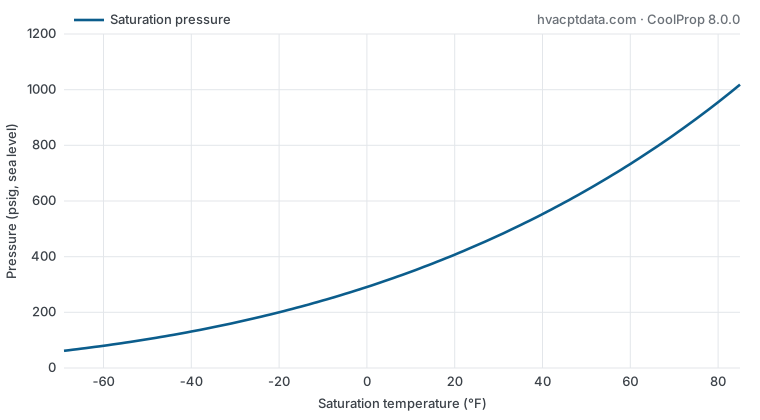
R-744 (CO2) is an A1 natural single-component refrigerant. It saturates at 552.9 psig at 40°F and 1018.4 psig at 85°F.
Reviewed · PT values computed with CoolProp 8.0.0 and checked against NIST reference data (largest difference 0.1 psi)
R-744 at a glance
| Safety class (ASHRAE 34) | A1: lower toxicity, no flame propagation |
|---|---|
| Type | Natural, single-component refrigerant |
| GWP (100-year, AR4) | 1 · AR5: 1Reference gas: GWP 1 by definition. |
| Ozone depletion potential | 0 |
| Lubricant | POE or PAG (per compressor maker) |
| Boiling point at 14.7 psia | -126.5°F |
| Critical point | 87.8°F, 1,070 psia |
| 40°F evaporating | 552.9 psig |
| 85°F condensing | 1018.4 psig |
| Charge as | Vapor or liquid |
| Typical use | Supermarket transcritical booster systems; Low stage of cascades with ammonia or HFC/HFO high side; Industrial refrigeration and cold storage; Vending machines; Heat-pump water heaters; Motor vehicle AC (SNAP use conditions) |
| US status | Not an ODS or regulated HFC; SNAP-acceptable in very-low-temperature, cold storage and other end uses, and exempt from the Section 608 venting prohibition in all applications. |
| Replaces | R-404A, R-507A, R-134a |
R-744 PT chart (°F and psig)
R-744 is a single-component refrigerant, so one pressure applies at each temperature for both the evaporator and the condenser. Tap a row to load it into the lookup.
-69°F to 85°F · psig at sea level · °C and kPa in the CSV · italic = inches Hg vacuum
| °F | psig |
|---|---|
| -69 | 61.9 |
| -68 | 63.8 |
| -67 | 65.7 |
| -66 | 67.6 |
| -65 | 69.5 |
| -64 | 71.5 |
| -63 | 73.6 |
| -62 | 75.6 |
| -61 | 77.7 |
| -60 | 79.9 |
| -59 | 82.1 |
| -58 | 84.3 |
| -57 | 86.5 |
| -56 | 88.8 |
| -55 | 91.1 |
| -54 | 93.5 |
| -53 | 95.9 |
| -52 | 98.4 |
| -51 | 100.9 |
| -50 | 103.4 |
| -49 | 106.0 |
| -48 | 108.6 |
| -47 | 111.2 |
| -46 | 113.9 |
| -45 | 116.7 |
| -44 | 119.4 |
| -43 | 122.3 |
| -42 | 125.1 |
| -41 | 128.0 |
| -40 | 131.0 |
| -39 | 134.0 |
| -38 | 137.1 |
| -37 | 140.1 |
| -36 | 143.3 |
| -35 | 146.5 |
| -34 | 149.7 |
| -33 | 153.0 |
| -32 | 156.3 |
| -31 | 159.7 |
| -30 | 163.1 |
| -29 | 166.6 |
| -28 | 170.1 |
| -27 | 173.7 |
| -26 | 177.4 |
| -25 | 181.0 |
| -24 | 184.8 |
| -23 | 188.6 |
| -22 | 192.4 |
| -21 | 196.3 |
| -20 | 200.2 |
| -19 | 204.2 |
| -18 | 208.3 |
| -17 | 212.4 |
| -16 | 216.5 |
| -15 | 220.8 |
| -14 | 225.0 |
| -13 | 229.4 |
| -12 | 233.8 |
| -11 | 238.2 |
| -10 | 242.7 |
| -9 | 247.3 |
| -8 | 251.9 |
| -7 | 256.6 |
| -6 | 261.3 |
| -5 | 266.1 |
| -4 | 271.0 |
| -3 | 275.9 |
| -2 | 280.9 |
| -1 | 285.9 |
| 0 | 291.0 |
| 1 | 296.2 |
| 2 | 301.5 |
| 3 | 306.8 |
| 4 | 312.1 |
| 5 | 317.6 |
| 6 | 323.1 |
| 7 | 328.6 |
| 8 | 334.3 |
| 9 | 340.0 |
| 10 | 345.7 |
| 11 | 351.6 |
| 12 | 357.5 |
| 13 | 363.4 |
| 14 | 369.5 |
| 15 | 375.6 |
| 16 | 381.8 |
| 17 | 388.0 |
| 18 | 394.3 |
| 19 | 400.7 |
| 20 | 407.2 |
| 21 | 413.8 |
| 22 | 420.4 |
| 23 | 427.1 |
| 24 | 433.8 |
| 25 | 440.7 |
| 26 | 447.6 |
| 27 | 454.6 |
| 28 | 461.7 |
| 29 | 468.8 |
| 30 | 476.1 |
| 31 | 483.4 |
| 32 | 490.8 |
| 33 | 498.3 |
| 34 | 505.8 |
| 35 | 513.5 |
| 36 | 521.2 |
| 37 | 529.0 |
| 38 | 536.9 |
| 39 | 544.8 |
| 40 | 552.9 |
| 41 | 561.0 |
| 42 | 569.3 |
| 43 | 577.6 |
| 44 | 586.0 |
| 45 | 594.5 |
| 46 | 603.1 |
| 47 | 611.7 |
| 48 | 620.5 |
| 49 | 629.3 |
| 50 | 638.3 |
| 51 | 647.3 |
| 52 | 656.5 |
| 53 | 665.7 |
| 54 | 675.0 |
| 55 | 684.5 |
| 56 | 694.0 |
| 57 | 703.6 |
| 58 | 713.3 |
| 59 | 723.1 |
| 60 | 733.1 |
| 61 | 743.1 |
| 62 | 753.2 |
| 63 | 763.4 |
| 64 | 773.8 |
| 65 | 784.2 |
| 66 | 794.8 |
| 67 | 805.5 |
| 68 | 816.2 |
| 69 | 827.1 |
| 70 | 838.1 |
| 71 | 849.3 |
| 72 | 860.5 |
| 73 | 871.9 |
| 74 | 883.3 |
| 75 | 894.9 |
| 76 | 906.7 |
| 77 | 918.5 |
| 78 | 930.5 |
| 79 | 942.6 |
| 80 | 954.9 |
| 81 | 967.3 |
| 82 | 979.8 |
| 83 | 992.5 |
| 84 | 1005.4 |
| 85 | 1018.4 |
Where you will find R-744
Carbon dioxide is used mainly in commercial and industrial refrigeration: supermarket transcritical booster racks, the low-temperature stage of cascade systems (with an ammonia or HFC/HFO high stage), cold storage, vending machines and heat-pump water heaters. In supermarkets it replaced R-404A, R-507A and the R-407 series; in vending it replaced R-134a. EPA lists CO2 as acceptable in very-low-temperature refrigeration (January 13, 1995, and June 16, 2010) and cold storage warehouses (September 30, 2009), and acceptable subject to use conditions in motor vehicle AC (June 6, 2012).
The nameplate will say R-744, but the pressures give it away first: they are several times those of the HFCs it replaced. At 40°F CO2 saturates at 552.9 psig; at 85°F, the last row of the chart, it reaches 1,018.4 psig.
Why the chart stops at 85°F: transcritical operation
The critical point of CO2 is 87.8°F (1,070 psia). Above that temperature there is no boundary between liquid and vapor, so there is no saturation pressure to look up. The PT chart on this page runs from -69°F to 85°F for that reason.
That changes how the high side works. In a subcritical system, such as the CO2 low stage of a cascade, the CO2 is condensed by the high stage below 87.8°F, and the chart applies on both sides like any other refrigerant. In a transcritical system on a warm day, the discharge gas leaves the compressor above the critical point and cannot condense. The outdoor coil is a gas cooler, not a condenser: it lowers the temperature of a dense supercritical gas without a phase change. High-side pressure and gas-cooler outlet temperature are no longer tied together, so you cannot read a high-side gauge against a PT chart, and condensing temperature and subcooling have no meaning there. The system’s controls set that pressure. The low side still boils CO2 below its critical temperature, so suction-side readings and the superheat calculator still apply.
Charging R-744
Copeland’s CO2 guidance: use high-purity CO2 (99.99%), break the vacuum and begin charging with vapor, and charge slowly to avoid lifting relief valves. Do not admit liquid into an evacuated system or one below about 61 psig (4.2 bar g): at that pressure CO2 reaches its triple point and liquid flashes to dry ice. That is also where this chart begins, at -69°F and 61.9 psig. Once the system pressure is above that level, follow the rack or equipment manufacturer’s charging procedure.
As a single-component refrigerant, CO2 has no glide; one PT column serves both sides wherever the system is subcritical. Check the pressure rating of every gauge, hose, charging line and cylinder against these numbers before you connect. The pressure converter helps when manufacturer data is in bar.
Oil and compatibility
Copeland lists POE-68 (for example Emkarate RL68HB) for subcritical and transcritical compressors, with PAG-68 as an alternate or preferred oil for some European-built models. BITZER uses POE (BSE60K, BSE85K) and PAG (BSG68K) for high-pressure applications. The oil depends on the compressor, so use what its label specifies. The refrigerant oil types guide explains POE and PAG.
Safety, handling and recovery
A1 means lower toxicity and no flame propagation under ASHRAE 34. The working hazards with CO2 are pressure and concentration in enclosed spaces. EPA’s use conditions for vehicle AC give an idea of the limits: CO2 in the passenger space must not exceed 30,000 ppm averaged over 15 minutes or 40,000 ppm ceiling in the breathing zone.
Section 608: with its critical temperature below 104°F, CO2 falls in the very-high-pressure class of 40 CFR 82.152. But 40 CFR 82.154(a)(1) exempts carbon dioxide from the venting prohibition in all applications. As an exempt substitute, it is outside the Section 608 recovery levels, technician certification and sales restriction. Vehicle AC is different: EPA states CO2 is not exempt from Section 609 requirements such as certified refrigerant handling equipment.
Cylinders: AHRI Guideline N-2017 assigns light green-gray RAL 7044 to all new refrigerant containers. CO2 is often supplied as an industrial gas, so identify the gas and grade from the label, not the paint. See cylinder colors.
Status and replacements
CO2 is not an ozone-depleting substance and not a regulated HFC. It needs no AIM Act allowances, the Technology Transitions GWP limits do not touch it, and with a GWP of 1 it is the reference gas for every other GWP on the GWP chart. For R-404A system options, including CO2, see the R-404A replacement comparison.
Common questions
What is R-744?
R-744 is the ASHRAE refrigerant number for carbon dioxide. It is an A1 natural refrigerant that runs at far higher pressures than HFCs and above 87.8°F becomes transcritical on the high side.
Can I use regular refrigerant gauges on CO2?
Only if they are rated for the pressures involved. The chart reaches 1,018.4 psig at 85°F, and a transcritical high side runs above the critical pressure of 1,070 psia. Check the rating of the gauges and hoses before connecting.
How this chart was computed
Every pressure on this page is calculated, not copied: CoolProp 8.0.0 (HEOS backend), the open-source implementation of the reference equations of state, using the model pure:CarbonDioxide. Gauge values assume sea-level air pressure (14.696 psia); kPa values in the CSV are absolute.
Spot check against NIST Chemistry WebBook, SRD 69, Thermophysical Properties of Fluid Systems: Carbon dioxide, saturation properties (temperature increments):
| °F | Column | Published | This chart | Difference |
|---|---|---|---|---|
| -40 | saturation | 145.7 psia | 145.7 psia | 0.0 psi |
| 0 | saturation | 305.7 psia | 305.7 psia | 0.0 psi |
| 40 | saturation | 567.6 psia | 567.6 psia | 0.0 psi |
| 80 | saturation | 969.6 psia | 969.6 psia | 0.0 psi |
| -40 | saturation | 131.0 psig | 131.0 psig | -0.0 psi |
| 0 | saturation | 291.0 psig | 291.0 psig | +0.0 psi |
| 40 | saturation | 553.0 psig | 552.9 psig | -0.1 psi |
| 80 | saturation | 955.0 psig | 954.9 psig | -0.1 psi |
NIST WebBook implements the same reference equation of state as CoolProp, so near-zero deviation there confirms the implementation and unit handling; Copeland chart (whole psig) agrees within 0.12 psi. Table stops at 85 °F (critical point 87.8 °F); triple point -69.8 °F.
Charts from different publishers can differ by a few tenths of a psi because of the equation of state and blend tolerances. Always charge to the equipment manufacturer's data. Full method and every spot check
Calculators for R-744
Sources
- Copeland TGE175 CO2 product guide media.copeland.com
- Copeland AE Bulletin 93-11: Refrigerants and lubricants approved for Copeland compressors webapps.copeland.com
- BITZER KT-500: CO2 lubricants bitzer.de
- eCFR 40 CFR 82.154: venting prohibition and exempt substitutes ecfr.gov
- EPA SNAP: Substitutes in Very Low Temperature Refrigeration epa.gov
- EPA SNAP: Substitutes in Cold Storage Warehouses epa.gov
- EPA: MVAC acceptable refrigerants and their impacts epa.gov
Reviewed . Found an error? Tell us and we will correct it.
More in Natural refrigerants