R-134a PT Chart and Refrigerant Profile
R-134a is an A1 HFC single-component refrigerant. It saturates at 35.1 psig at 40°F and 124.2 psig at 100°F.
Reviewed · PT values computed with CoolProp 8.0.0 and checked against NIST reference data (largest difference 0.1 psi)
R-134a at a glance
| Safety class (ASHRAE 34) | A1: lower toxicity, no flame propagation |
|---|---|
| Type | HFC, single-component refrigerant |
| GWP (100-year, AR4) | 1,430 · AR5: 1,300 |
| Ozone depletion potential | 0 |
| Lubricant | PAG (automotive), POE (stationary) |
| Boiling point at 14.7 psia | -14.9°F |
| Critical point | 213.9°F, 589 psia |
| 40°F evaporating | 35.1 psig |
| 100°F condensing | 124.2 psig |
| Charge as | Vapor or liquid |
| Typical use | Automotive A/C (vehicles before R-1234yf); Domestic refrigerators and freezers (legacy); Medium-temperature commercial refrigeration; Centrifugal and screw chillers; Transport refrigeration and dehumidifiers |
| Trade names | Freon 134a (Chemours), Genetron 134a (Solstice Advanced Materials), Forane 134a (Arkema) |
| US status | AIM Act HFC; banned in most new equipment types from 2025 (light-duty vehicles from model year 2025), but servicing existing systems remains legal. |
| Replaces | R-12 |
| Replaced by | R-1234yf, R-513A, R-1234ze(E), R-600a, R-290 |
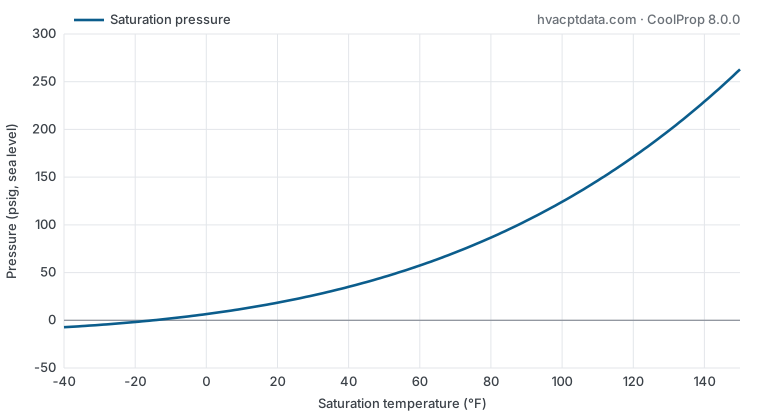
R-134a PT chart (°F and psig)
R-134a is a single-component refrigerant, so one pressure applies at each temperature for both the evaporator and the condenser. Tap a row to load it into the lookup.
-40°F to 150°F · psig at sea level · °C and kPa in the CSV · italic = inches Hg vacuum
| °F | psig |
|---|---|
| -40 | 14.8″ |
| -39 | 14.4″ |
| -38 | 13.9″ |
| -37 | 13.4″ |
| -36 | 12.9″ |
| -35 | 12.5″ |
| -34 | 12.0″ |
| -33 | 11.4″ |
| -32 | 10.9″ |
| -31 | 10.4″ |
| -30 | 9.8″ |
| -29 | 9.3″ |
| -28 | 8.7″ |
| -27 | 8.1″ |
| -26 | 7.5″ |
| -25 | 6.9″ |
| -24 | 6.3″ |
| -23 | 5.7″ |
| -22 | 5.0″ |
| -21 | 4.3″ |
| -20 | 3.7″ |
| -19 | 3.0″ |
| -18 | 2.3″ |
| -17 | 1.5″ |
| -16 | 0.8″ |
| -15 | 0.1″ |
| -14 | 0.4 |
| -13 | 0.7 |
| -12 | 1.1 |
| -11 | 1.5 |
| -10 | 1.9 |
| -9 | 2.4 |
| -8 | 2.8 |
| -7 | 3.2 |
| -6 | 3.7 |
| -5 | 4.1 |
| -4 | 4.6 |
| -3 | 5.0 |
| -2 | 5.5 |
| -1 | 6.0 |
| 0 | 6.5 |
| 1 | 7.0 |
| 2 | 7.5 |
| 3 | 8.0 |
| 4 | 8.5 |
| 5 | 9.1 |
| 6 | 9.6 |
| 7 | 10.2 |
| 8 | 10.8 |
| 9 | 11.3 |
| 10 | 11.9 |
| 11 | 12.5 |
| 12 | 13.1 |
| 13 | 13.8 |
| 14 | 14.4 |
| 15 | 15.0 |
| 16 | 15.7 |
| 17 | 16.4 |
| 18 | 17.0 |
| 19 | 17.7 |
| 20 | 18.4 |
| 21 | 19.1 |
| 22 | 19.9 |
| 23 | 20.6 |
| 24 | 21.4 |
| 25 | 22.1 |
| 26 | 22.9 |
| 27 | 23.7 |
| 28 | 24.5 |
| 29 | 25.3 |
| 30 | 26.1 |
| 31 | 26.9 |
| 32 | 27.8 |
| 33 | 28.6 |
| 34 | 29.5 |
| 35 | 30.4 |
| 36 | 31.3 |
| 37 | 32.2 |
| 38 | 33.1 |
| 39 | 34.1 |
| 40 | 35.1 |
| 41 | 36.0 |
| 42 | 37.0 |
| 43 | 38.0 |
| 44 | 39.0 |
| 45 | 40.1 |
| 46 | 41.1 |
| 47 | 42.2 |
| 48 | 43.2 |
| 49 | 44.3 |
| 50 | 45.4 |
| 51 | 46.6 |
| 52 | 47.7 |
| 53 | 48.9 |
| 54 | 50.0 |
| 55 | 51.2 |
| 56 | 52.4 |
| 57 | 53.6 |
| 58 | 54.9 |
| 59 | 56.1 |
| 60 | 57.4 |
| 61 | 58.7 |
| 62 | 60.0 |
| 63 | 61.3 |
| 64 | 62.7 |
| 65 | 64.0 |
| 66 | 65.4 |
| 67 | 66.8 |
| 68 | 68.2 |
| 69 | 69.7 |
| 70 | 71.1 |
| 71 | 72.6 |
| 72 | 74.1 |
| 73 | 75.6 |
| 74 | 77.1 |
| 75 | 78.7 |
| 76 | 80.2 |
| 77 | 81.8 |
| 78 | 83.4 |
| 79 | 85.0 |
| 80 | 86.7 |
| 81 | 88.4 |
| 82 | 90.1 |
| 83 | 91.8 |
| 84 | 93.5 |
| 85 | 95.2 |
| 86 | 97.0 |
| 87 | 98.8 |
| 88 | 100.6 |
| 89 | 102.5 |
| 90 | 104.3 |
| 91 | 106.2 |
| 92 | 108.1 |
| 93 | 110.0 |
| 94 | 112.0 |
| 95 | 114.0 |
| 96 | 115.9 |
| 97 | 118.0 |
| 98 | 120.0 |
| 99 | 122.1 |
| 100 | 124.2 |
| 101 | 126.3 |
| 102 | 128.4 |
| 103 | 130.6 |
| 104 | 132.8 |
| 105 | 135.0 |
| 106 | 137.2 |
| 107 | 139.5 |
| 108 | 141.7 |
| 109 | 144.0 |
| 110 | 146.4 |
| 111 | 148.7 |
| 112 | 151.1 |
| 113 | 153.5 |
| 114 | 156.0 |
| 115 | 158.4 |
| 116 | 160.9 |
| 117 | 163.5 |
| 118 | 166.0 |
| 119 | 168.6 |
| 120 | 171.2 |
| 121 | 173.8 |
| 122 | 176.5 |
| 123 | 179.1 |
| 124 | 181.8 |
| 125 | 184.6 |
| 126 | 187.4 |
| 127 | 190.2 |
| 128 | 193.0 |
| 129 | 195.8 |
| 130 | 198.7 |
| 131 | 201.6 |
| 132 | 204.6 |
| 133 | 207.6 |
| 134 | 210.6 |
| 135 | 213.6 |
| 136 | 216.7 |
| 137 | 219.8 |
| 138 | 222.9 |
| 139 | 226.0 |
| 140 | 229.2 |
| 141 | 232.5 |
| 142 | 235.7 |
| 143 | 239.0 |
| 144 | 242.3 |
| 145 | 245.7 |
| 146 | 249.1 |
| 147 | 252.5 |
| 148 | 255.9 |
| 149 | 259.4 |
| 150 | 262.9 |
Where you will find R-134a
Two very different worlds use R-134a. In cars and light trucks it is the refrigerant of roughly three decades of vehicles: EPA says automakers began switching from R-12 with the 1992 model year, every new US vehicle with A/C used R-134a by the 1995 model year, and it was the most common MVAC refrigerant from 1994 on. Newer light-duty vehicles have moved to R-1234yf, so check the under-hood label before you connect anything.
On the stationary side you will see it in older domestic refrigerators and freezers, medium-temperature reach-ins and walk-ins, transport units, dehumidifiers and centrifugal and screw chillers. The nameplate or compressor tag is the reliable identifier. Older stock may still be in light blue cylinders.
R-134a replaced R-12 in both automotive and refrigeration service, and EPA still names it as the primary refrigerant for retrofitting R-12 vehicle systems. The R-12 vs R-134a comparison covers that conversion.
Charging R-134a
R-134a is a single-component refrigerant, so it has no glide and cannot fractionate. You can charge it as vapor or liquid; the bubble and dew pressures are the same, so one PT column serves both sides.
On a fixed orifice or cap tube system, charge to the manufacturer’s superheat chart or use the target superheat calculator where the method applies. On a TXV or EEV system, charge by subcooling to the nameplate or installation manual target with the subcooling calculator. Where the nameplate lists a charge weight, weigh it in.
Vehicle systems are charged by weight to the amount on the vehicle label. They use SAE R-134a quick-connect service fittings, which are physically different from R-12 and R-1234yf ports.
Oil and compatibility
The right oil depends on the system, which is where many oil charts go wrong. Stationary compressors run POE; Copeland’s approved lubricant list names POE-32 for R-134a. Automotive compressors run PAG: Chemours notes that almost all mobile OEMs selected PAG lubricants, in the 60 to 135 cSt range. The common advice to “never use PAG with R-134a” is wrong for cars.
R-134a mixes poorly with mineral oil and alkylbenzene. That matters on any R-12 conversion, because R-12 systems ran mineral oil and the old oil has to be dealt with according to the retrofit procedure. Use the exact oil and viscosity the compressor manufacturer specifies. The refrigerant oil types guide explains PAG, POE, PVE, AB and mineral oil.
Safety, handling and recovery
R-134a is ASHRAE class A1: lower toxicity and no flame propagation in the standard test.
For stationary equipment it is a medium-pressure refrigerant under 40 CFR 82.152, which names it as an example. Work on small appliances (factory-sealed, 5 lb or less) needs Type I; other appliances need Type II; Universal covers both. Required recovery levels for medium-pressure equipment made on or after Nov 15 1993 are 10 in Hg vacuum below 200 lb charge and 15 in Hg at 200 lb or more. Small appliances need 90% recovery with the compressor running, 80% with it not running, or a 4 in Hg vacuum.
Motor vehicle A/C is covered by 40 CFR Part 82 subpart B, which implements Clean Air Act section 609, not the Section 608 appliance rules. Anyone servicing an MVAC for consideration must be certified under 82.40 and must use approved equipment: SAE J2788 recover/recycle/recharge machines or SAE J2810 recovery-only units for R-134a.
Since Jan 1 2018, R-134a may be sold only to certified technicians under 82.154(c). The exception is small cans of 2 lb or less for MVAC with a self-sealing valve. Venting is prohibited. Under AHRI Guideline N, new cylinders of every refrigerant have been light green-gray (RAL 7044) since Jan 1 2020; the legacy R-134a color, light blue, now appears only on the label.
Status and replacements
R-134a is a regulated HFC under the AIM Act. Allowances are 90% of baseline in 2022–2023, 60% in 2024–2028, 30% in 2029–2033, 20% in 2034–2035 and 15% from 2036.
The Technology Transitions rule (40 CFR 84.54) bars R-134a, at a GWP of 1,430, from most new equipment. That covers new household refrigerators and freezers, stand-alone retail units and vending machines (150 limit, manufacture or import from Jan 1 2025) and comfort-cooling chillers (700 limit, from Jan 1 2025). New light-duty vehicles face a 150 limit from model year 2025. EPA says R-134a is no longer allowed in new nonroad vehicles from Jan 1 2028. Servicing existing equipment with R-134a stays legal.
Two rules from the Emissions Reduction and Reclamation rule apply. Leak repair covers appliances with 15 lb or more of HFC from Jan 1 2026, excluding residential and light commercial AC and heat pumps. From Jan 1 2029, supermarket systems, refrigerated transport and automatic commercial ice makers must be serviced with reclaimed refrigerant.
Replacements depend on the job:
- Light-duty vehicles: R-1234yf in new production; see R-134a vs R-1234yf.
- Stationary medium temperature and chillers: R-513A or R-450A, and R-1234ze(E) in chillers.
- Domestic and self-contained: R-600a and R-290 in new equipment.
The R-134a replacement guide compares them side by side.
Common questions
Is HFC-134a the same as R-134a?
Yes. HFC-134a is the chemical-family name for 1,1,1,2-tetrafluoroethane and R-134a is its ASHRAE refrigerant number.
Can I put R-134a in an R-1234yf car?
Not with R-134a service gear. EPA requires R-1234yf vehicle systems to meet SAE J639, which includes unique service fittings, and R-1234yf recovery and recharge machines must meet SAE J2843, so R-134a hoses and machines will not connect. EPA’s MVAC refrigerant page does not address converting between the two.
How this chart was computed
Every pressure on this page is calculated, not copied: CoolProp 8.0.0 (HEOS backend), the open-source implementation of the reference equations of state, using the model pure:R134a. Gauge values assume sea-level air pressure (14.696 psia); kPa values in the CSV are absolute.
Spot check against NIST Chemistry WebBook, SRD 69, Thermophysical Properties of Fluid Systems: R134a, saturation properties (temperature increments):
| °F | Column | Published | This chart | Difference |
|---|---|---|---|---|
| 0 | saturation | 21.2 psia | 21.2 psia | 0.0 psi |
| 40 | saturation | 49.7 psia | 49.7 psia | 0.0 psi |
| 120 | saturation | 185.9 psia | 185.9 psia | 0.0 psi |
| 0 | saturation | 6.50 psig | 6.47 psig | -0.0 psi |
| 40 | saturation | 35.0 psig | 35.1 psig | +0.1 psi |
| 100 | saturation | 124.2 psig | 124.2 psig | -0.0 psi |
NIST WebBook implements the same reference equation of state as CoolProp, so near-zero deviation there confirms the implementation and unit handling; the Chemours pocket chart (REFPROP 9.1) agrees within 0.05 psi.
Charts from different publishers can differ by a few tenths of a psi because of the equation of state and blend tolerances. Always charge to the equipment manufacturer's data. Full method and every spot check
Comparisons with R-134a
Calculators for R-134a
Sources
- eCFR 40 CFR 84.54: Technology Transitions restrictions by sector ecfr.gov
- eCFR 40 CFR Part 82 Subpart B: Servicing of motor vehicle air conditioners ecfr.gov
- EPA: MVAC acceptable refrigerants and their impacts epa.gov
- eCFR 40 CFR 82.152: Section 608 definitions (pressure classes) ecfr.gov
- eCFR 40 CFR 82.154: Venting prohibition and sales restriction ecfr.gov
- Copeland AE Bulletin 93-11: Refrigerants and lubricants approved for Copeland compressors webapps.copeland.com
- Chemours: Freon 134a mobile air conditioning freon.com
- Federal Register 89 FR 82682: HFC Emissions Reduction and Reclamation rule federalregister.gov
Reviewed . Found an error? Tell us and we will correct it.