R-22 vs R-134a
Reviewed · pressures computed with CoolProp 8.0 from the same data as the PT charts
Can you use R-134a in an R-22 system?
No. Not as a practical retrofit. EPA's SNAP list does accept HFC-134a as an R-22 substitute in AC, but R-134a runs at about half the suction pressure of R-22 and needs POE oil, so an R-22 compressor and metering device are the wrong size for it. Arkema and Chemours offer other blends for R-22 retrofits.
Pressures side by side
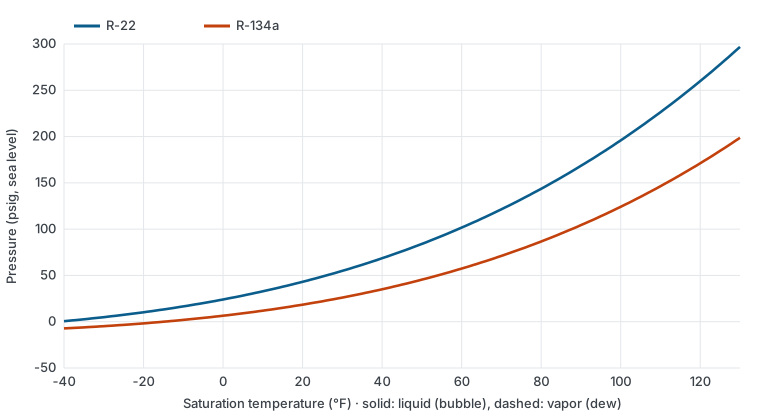
Saturation pressure in psig at sea level. Evaporating rows use the vapor (dew) value, condensing rows the liquid (bubble) value, which is what you compare with suction and liquid-line gauges. The last column is R-134a minus R-22.
| Saturation | R-22 | R-134a | Difference |
|---|---|---|---|
| Evaporator (vapor, dew) | |||
| -20°F | 10.2 | 3.7″ Hg | -12.0 (-118%) |
| 0°F | 24.0 | 6.5 | -17.6 (-73%) |
| 20°F | 43.1 | 18.4 | -24.7 (-57%) |
| 30°F | 55.0 | 26.1 | -28.9 (-53%) |
| 35°F | 61.5 | 30.4 | -31.1 (-51%) |
| 40°F | 68.6 | 35.1 | -33.5 (-49%) |
| 45°F | 76.1 | 40.1 | -36.0 (-47%) |
| 50°F | 84.1 | 45.4 | -38.6 (-46%) |
| Condenser (liquid, bubble) | |||
| 80°F | 143.6 | 86.7 | -56.9 (-40%) |
| 90°F | 168.4 | 104.3 | -64.1 (-38%) |
| 95°F | 181.8 | 114.0 | -67.8 (-37%) |
| 100°F | 195.9 | 124.2 | -71.7 (-37%) |
| 105°F | 210.8 | 135.0 | -75.8 (-36%) |
| 110°F | 226.4 | 146.4 | -80.0 (-35%) |
| 115°F | 242.8 | 158.4 | -84.3 (-35%) |
| 120°F | 260.0 | 171.2 | -88.8 (-34%) |
| 125°F | 278.0 | 184.6 | -93.4 (-34%) |
| 130°F | 296.9 | 198.7 | -98.2 (-33%) |
Properties
| Property | R-22 | R-134a |
|---|---|---|
| Safety class | A1 | A1 |
| Type | HCFC, single-component refrigerant | HFC, single-component refrigerant |
| Composition (mass %) | Single component | Single component |
| GWP (AR4) | 1,810 | 1,430 |
| Lubricant | Mineral oil (AB alternate) | PAG (automotive), POE (stationary) |
| Boiling point (14.7 psia) | -41.5°F | -14.9°F |
| Critical point | 205.1°F, 724 psia | 213.9°F, 589 psia |
| Glide at 40°F evaporating | 0.0°F | 0.0°F |
| Glide at 100°F condensing | 0.0°F | 0.0°F |
| US status | US production and import ended Jan 1 2020; existing equipment may still be serviced with recovered, recycled, reclaimed or pre-2020 R-22. | AIM Act HFC; banned in most new equipment types from 2025 (light-duty vehicles from model year 2025), but servicing existing systems remains legal. |
Component compatibility
| Item | R-22 | R-134a |
|---|---|---|
| Lubricant | Mineral oil or AB | POE (stationary); PAG in automotive AC |
| Typical equipment | Legacy residential and commercial AC, refrigeration, chillers | Chillers, medium-temp refrigeration, automotive AC, legacy domestic |
| Section 608 class | High pressure | Medium pressure |
| Recovery level (under 200 lb) | 0 in Hg | 10 in Hg |
| Recovery level (200 lb or more) | 10 in Hg | 15 in Hg |
| Service fittings | Standard stationary service ports | Stationary ports; SAE R-134a quick-connects on vehicles |
| Cylinder | RAL 7044 gray (legacy light green) | RAL 7044 gray (legacy light blue) |
| Supply | Recovered, reclaimed or pre-2020 stock | In production (HFC, AIM Act phasedown) |
What changes in the field
R-134a runs at about half the pressure of R-22. From the PT data, at 40°F evaporating R-22 reads 68.6 psig and R-134a 35.1 psig, 33.5 psi lower. At 100°F condensing R-22 is 195.9 psig and R-134a 124.2 psig, 71.7 psi lower. Both are single-component refrigerants, so each has one PT column and no glide. At -20°F R-134a is already in a vacuum (3.7 in Hg) while R-22 reads 10.2 psig.
That puts them in different Section 608 classes. At 104°F R-22 saturates at 222.4 psia (high pressure) and R-134a at 147.4 psia (medium pressure) under 40 CFR 82.152, and the rule names both as examples. Recovery levels under 40 CFR 82.156 for equipment made after Nov 15 1993 differ by class: 0 in Hg for a high-pressure appliance under 200 lb against 10 in Hg for medium pressure, and 10 against 15 in Hg at 200 lb or more. Small appliances use 90%/80% recovery or 4 in Hg for either.
Both are A1 and use a standard AHRI 740 recovery machine. Keep separate recovery cylinders; a recovered mix of R-22 and R-134a matches no PT chart.
The two also live in different equipment. R-22 is the legacy refrigerant of residential and commercial AC and much commercial refrigeration. R-134a is found in centrifugal and screw chillers, medium-temperature commercial refrigeration, transport refrigeration, older domestic refrigerators and pre-R-1234yf vehicles. On vehicles it uses SAE R-134a quick-connect service fittings, which do not fit R-22 hoses.
Retrofit or replacement
R-134a is not a practical R-22 retrofit, even though EPA’s SNAP table lists HFC-134a as acceptable for new and retrofit use as an R-22 substitute in residential and light commercial AC. The problems:
- Capacity. Danfoss puts R-290 at roughly 90% of R-22’s volumetric capacity and roughly 150% of R-134a’s at 45°C (113°F) condensing, which places R-134a far below R-22 for the same compressor displacement.
- Oil. R-22 runs mineral oil or alkylbenzene; stationary R-134a systems use POE, so the oil would have to be changed.
- Nobody publishes the procedure. Arkema’s retrofit quick reference lists R-427A, R-407C and R-407A for R-22 equipment and R-134a only for R-12 and R-500 equipment. Chemours’ R-22 retrofit guidance covers its MO99 and NU-22B blends.
If an R-22 system needs a new refrigerant, recover all the R-22 first and use a blend the refrigerant maker publishes an R-22 procedure for. Chemours says topping off an HCFC with any refrigerant is not recommended. The options are compared on R-22 replacement refrigerants, R-22 vs R-407C and R-22 vs MO99. If the equipment is being replaced, new AC uses R-454B or R-32; see R-22 vs R-410A.
R-134a was the replacement for R-12, not R-22, and is now being replaced itself; see R-134a replacement.
Capacity, efficiency and cost
The only capacity figures here are Danfoss’ volumetric comparisons above, which describe the refrigerants, not finished systems. No source used here gives an R-22 versus R-134a system efficiency percentage.
On rules and cost: R-22 production and import ended Jan 1 2020, so service relies on recovered, recycled, reclaimed or pre-2020 stock. R-134a is an HFC with an AR4 GWP of 1,430, in production under the AIM Act phasedown (60% of baseline in 2024–2028). Under 40 CFR 84.54 it is above the limits for new comfort chillers (700) and new household refrigerators (150) from Jan 1 2025, but servicing existing R-134a equipment remains allowed.
Common questions
What is the difference between R-22 and R-134a?
R-22 is an HCFC with mineral oil and about twice R-134a’s pressure; R-134a is an HFC with POE (or PAG in cars) and no ozone depletion. They serve different equipment and are not interchangeable.
Do R-22 and R-134a use the same fittings?
On stationary equipment the service ports are standard; on vehicles R-134a uses SAE quick-connect fittings. Either way, use hoses and a manifold set up for the refrigerant in the system, and never connect a cylinder of one to a system of the other.
PT charts and calculators
Sources
- EPA SNAP: Substitutes in Residential and Light Commercial AC and Heat Pumps epa.gov
- Arkema: Retrofitting with Forane Refrigerants, Quick Reference Guide (2013) forane.arkema.com
- Chemours: Freon MO99 (R-438A) and Freon NU-22B (R-422B) Retrofit Guidelines freon.com
- Danfoss: Practical Application of Refrigerants R600a and R290 in Small Hermetic Systems assets.danfoss.com
- 40 CFR 82.152: Section 608 definitions (pressure classes) ecfr.gov
- 40 CFR 82.156: Required evacuation levels ecfr.gov
- 40 CFR 84.54: Technology Transitions restrictions by sector ecfr.gov
- Copeland AE Bulletin 93-11: Refrigerants and Lubricants Approved for Use in Copeland Compressors webapps.copeland.com
Reviewed . Found an error? Tell us and we will correct it.