R-22 vs R-407C
Reviewed · pressures computed with CoolProp 8.0 from the same data as the PT charts
Can R-407C replace R-22?
Yes. Yes, as a retrofit in DX air conditioning, but not as a top-off. Recover all the R-22, change the oil to POE (Arkema calls for a complete oil change), charge R-407C as liquid, and read its dew and bubble columns separately because glide is about 11°F at 40°F. Arkema does not recommend it for flooded evaporators.
Pressures side by side
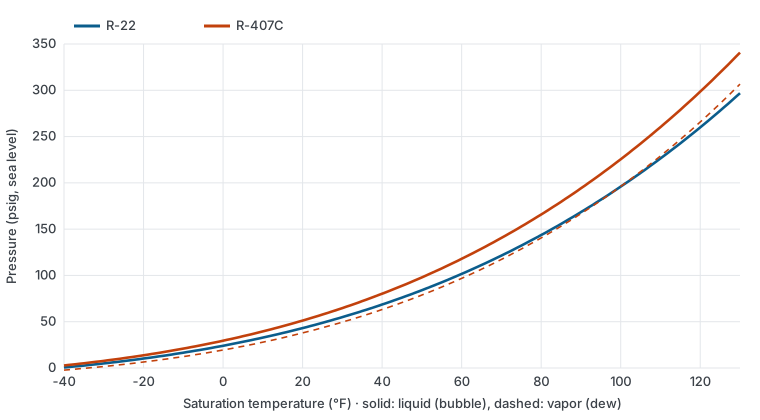
Saturation pressure in psig at sea level. Evaporating rows use the vapor (dew) value, condensing rows the liquid (bubble) value, which is what you compare with suction and liquid-line gauges. The last column is R-407C minus R-22.
| Saturation | R-22 | R-407C | Difference |
|---|---|---|---|
| Evaporator (vapor, dew) | |||
| -20°F | 10.2 | 6.5 | -3.7 (-37%) |
| 0°F | 24.0 | 19.4 | -4.6 (-19%) |
| 20°F | 43.1 | 37.9 | -5.2 (-12%) |
| 30°F | 55.0 | 49.6 | -5.4 (-10%) |
| 35°F | 61.5 | 56.1 | -5.4 (-9%) |
| 40°F | 68.6 | 63.2 | -5.4 (-8%) |
| 45°F | 76.1 | 70.7 | -5.3 (-7%) |
| 50°F | 84.1 | 78.8 | -5.2 (-6%) |
| Condenser (liquid, bubble) | |||
| 80°F | 143.6 | 165.8 | +22.2 (+15%) |
| 90°F | 168.4 | 194.1 | +25.7 (+15%) |
| 95°F | 181.8 | 209.4 | +27.6 (+15%) |
| 100°F | 195.9 | 225.5 | +29.6 (+15%) |
| 105°F | 210.8 | 242.4 | +31.7 (+15%) |
| 110°F | 226.4 | 260.3 | +33.9 (+15%) |
| 115°F | 242.8 | 279.0 | +36.2 (+15%) |
| 120°F | 260.0 | 298.6 | +38.6 (+15%) |
| 125°F | 278.0 | 319.2 | +41.2 (+15%) |
| 130°F | 296.9 | 340.7 | +43.9 (+15%) |
Properties
| Property | R-22 | R-407C |
|---|---|---|
| Safety class | A1 | A1 |
| Type | HCFC, single-component refrigerant | HFC, zeotropic blend |
| Composition (mass %) | Single component | R-32 23, R-125 25, R-134a 52 |
| GWP (AR4) | 1,810 | 1,774 |
| Lubricant | Mineral oil (AB alternate) | POE |
| Boiling point (14.7 psia) | -41.5°F | -46.5°F |
| Critical point | 205.1°F, 724 psia | 187.0°F, 673 psia |
| Glide at 40°F evaporating | 0.0°F | 11.1°F |
| Glide at 100°F condensing | 0.0°F | 9.0°F |
| US status | US production and import ended Jan 1 2020; existing equipment may still be serviced with recovered, recycled, reclaimed or pre-2020 R-22. | GWP 1,774 is above the 700 limit for new US residential and light commercial AC/HP from Jan 1 2025; servicing and R-22 retrofits of existing systems remain allowed. |
Component compatibility
| Item | R-22 | R-407C |
|---|---|---|
| Lubricant | Mineral oil or AB | POE only (complete oil change on retrofit) |
| PT column | One column | Dew for superheat, bubble for subcooling |
| Charging | Vapor or liquid (single component) | Liquid only; initial about 90–95% of R-22 weight (Arkema) |
| Mixing | Do not top off with R-407C | Do not mix with R-22 |
| Flooded evaporators | n/a | Not recommended (Arkema) |
| Recovery machine | AHRI 740 machine (40 CFR 82.158 App. B3) | AHRI 740 machine (40 CFR 82.158 App. B3) |
| Cylinder | RAL 7044 gray (legacy light green) | RAL 7044 gray (legacy medium brown) |
| Supply | Recovered, recycled, reclaimed or pre-2020 stock | In production under AIM Act allowances |
What changes in the field
R-407C runs close to R-22 on the low side and higher on the high side. From the PT data, at 40°F evaporating R-407C dew is 63.2 psig against 68.6 psig for R-22. At 100°F condensing, R-407C bubble is 225.5 psig against 195.9 psig, which is 29.6 psi higher (about 15%).
Glide is the change that trips people up. R-407C is a zeotrope with about 11.1°F of glide at 40°F evaporating and 9.0°F at 100°F condensing. For superheat, use the dew column with the suction pressure. For subcooling, use the bubble column with the liquid pressure. If you read an R-22 chart, or one “average” column, the readings will be wrong by several degrees. The glide calculator shows the spread at any pressure.
Because it is a zeotrope, R-407C must leave the cylinder as liquid. Arkema says liquid phase only, and Chemours says to top off after a leak in the liquid phase.
Retrofit or replacement
R-407C is a listed R-22 retrofit refrigerant for DX air conditioning, but the oil must change. The usual sequence:
- Record the R-22 charge and operating data, then recover all of the R-22 into its own cylinder. Do not mix R-407C with R-22.
- Change the oil to POE. Chemours lists POE only for R-407C, and Arkema calls for a complete oil change when retrofitting an R-22 system. Copeland lists POE-32. Follow the blend maker’s guide on how much residual mineral oil is acceptable. See refrigerant oil types.
- Repair leaks, then pull a deep vacuum. OEM targets are 350–500 microns, and decay criteria vary by manufacturer (evacuation in microns).
- Charge as liquid. Arkema gives an initial charge of about 90–95% of the original R-22 weight, and its documents vary between 90% and 100%. Then adjust to superheat or subcooling using the correct column.
- Label the system with the refrigerant and oil now in it.
Arkema does not recommend R-407C for flooded evaporators. For other R-22 blends, see R-22 vs MO99.
Capacity, efficiency and cost
The sources used here give no capacity or efficiency percentage for R-407C against R-22, so none is quoted, and figures from secondary sites are not used. Check the blend maker’s retrofit guide for the system type.
On cost and supply, the two move in opposite directions. R-22 production and import ended Jan 1 2020, and servicing relies on recovered, recycled, reclaimed or pre-2020 stock (40 CFR 82.15). R-407C is an HFC (GWP 1,774, AR4) still produced under AIM Act allowances, which drop to 30% of baseline in 2029. At GWP 1,774 it cannot be used in new residential AC equipment under 40 CFR 84.54, but retrofitting and servicing existing systems is allowed.
Common questions
Can you mix R-407C and R-22?
No. Arkema says not to mix them. A blend of the two matches neither PT chart and leaves mineral oil and POE in the same system.
Is R-407C a drop-in for R-22?
Not in the strict sense. It needs the POE oil change and liquid charging, and it is not recommended for flooded evaporators. If you want to avoid an oil change, look at R-22 replacement options such as MO99.
Why is my R-407C superheat off after a retrofit?
A likely cause is reading the bubble column, or an R-22 chart, for suction saturation. With about 11°F of glide, use the dew column.
PT charts and calculators
Sources
- Arkema Forane 407C product page forane.arkema.com
- Arkema: Retrofitting with Forane refrigerants forane.arkema.com
- Chemours Freon 407C technical bulletin pages.chemours.com
- Copeland AE Bulletin 93-11: Refrigerants and Lubricants Approved for Use in Copeland Compressors webapps.copeland.com
- 40 CFR 82.15: Class II (HCFC) prohibitions ecfr.gov
- 40 CFR 84.54: Technology Transitions restrictions ecfr.gov
Reviewed . Found an error? Tell us and we will correct it.