R-22 vs MO99 (R-438A)
Reviewed · pressures computed with CoolProp 8.0 from the same data as the PT charts
Can you mix MO99 with R-22?
No. Chemours says not to top off an R-22 system with MO99. Recover all the R-22 first, then charge MO99 as liquid, starting about 10% below the original R-22 weight. Most systems keep their mineral or AB oil, but MO99 is a zeotrope with 7–10°F of glide, so read its own dew and bubble columns.
Pressures side by side
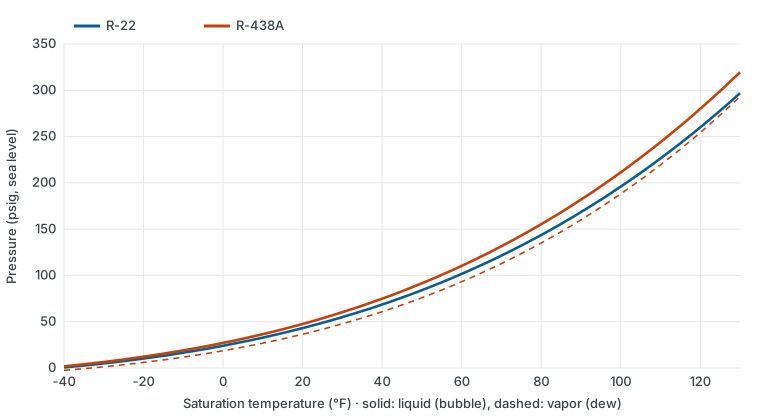
Saturation pressure in psig at sea level. Evaporating rows use the vapor (dew) value, condensing rows the liquid (bubble) value, which is what you compare with suction and liquid-line gauges. The last column is R-438A minus R-22.
| Saturation | R-22 | R-438A | Difference |
|---|---|---|---|
| Evaporator (vapor, dew) | |||
| -20°F | 10.2 | 6.0 | -4.2 (-41%) |
| 0°F | 24.0 | 18.6 | -5.4 (-23%) |
| 20°F | 43.1 | 36.5 | -6.6 (-15%) |
| 30°F | 55.0 | 47.8 | -7.2 (-13%) |
| 35°F | 61.5 | 54.1 | -7.5 (-12%) |
| 40°F | 68.6 | 60.8 | -7.7 (-11%) |
| 45°F | 76.1 | 68.1 | -7.9 (-10%) |
| 50°F | 84.1 | 75.9 | -8.1 (-10%) |
| Condenser (liquid, bubble) | |||
| 80°F | 143.6 | 155.3 | +11.7 (+8%) |
| 90°F | 168.4 | 181.9 | +13.5 (+8%) |
| 95°F | 181.8 | 196.2 | +14.4 (+8%) |
| 100°F | 195.9 | 211.3 | +15.4 (+8%) |
| 105°F | 210.8 | 227.2 | +16.5 (+8%) |
| 110°F | 226.4 | 244.0 | +17.6 (+8%) |
| 115°F | 242.8 | 261.5 | +18.8 (+8%) |
| 120°F | 260.0 | 280.0 | +20.0 (+8%) |
| 125°F | 278.0 | 299.3 | +21.3 (+8%) |
| 130°F | 296.9 | 319.5 | +22.6 (+8%) |
Properties
| Property | R-22 | R-438A |
|---|---|---|
| Safety class | A1 | A1 |
| Type | HCFC, single-component refrigerant | HFC/HC, zeotropic blend |
| Composition (mass %) | Single component | R-32 8.5, R-125 45, R-134a 44.2, R-600 1.7, R-601a 0.6 |
| GWP (AR4) | 1,810 | 2,265 |
| Lubricant | Mineral oil (AB alternate) | Mineral oil, AB or POE (no oil change in most systems) |
| Boiling point (14.7 psia) | -41.5°F | -44.5°F |
| Critical point | 205.1°F, 724 psia | 182.4°F, 605 psia |
| Glide at 40°F evaporating | 0.0°F | 9.6°F |
| Glide at 100°F condensing | 0.0°F | 7.5°F |
| US status | US production and import ended Jan 1 2020; existing equipment may still be serviced with recovered, recycled, reclaimed or pre-2020 R-22. | Legal for retrofitting and servicing existing R-22 equipment; its GWP is above the limits for new AC, heat pumps and most refrigeration under 40 CFR 84.54 (2025 onward). |
Component compatibility
| Item | R-22 | R-438A |
|---|---|---|
| Lubricant | Mineral oil or AB | MO, AB or POE; add POE where oil return is a concern (Chemours) |
| Composition | Single component (HCFC) | R-32/R-125/R-134a/R-600/R-601a 8.5/45/44.2/1.7/0.6 |
| PT column | One column | Dew for superheat, bubble for subcooling |
| Charging | Vapor or liquid (single component) | Liquid from cylinder; start about 10% below R-22 weight |
| Mixing | Do not top off with MO99 | Recover R-22 first |
| Flooded evaporators | n/a | Not for flooded evaporators (Chemours) |
| Recovery machine | AHRI 740 machine (40 CFR 82.158 App. B3) | AHRI 740 machine (40 CFR 82.158 App. B3) |
| Cylinder | RAL 7044 gray (legacy light green) | RAL 7044 gray (legacy blue jay) |
What changes in the field
MO99 (R-438A, sold by Chemours as Freon MO99, formerly ISCEON MO99) is an HFC blend with a small hydrocarbon content that Chemours says “closely matches the performance & operating conditions of R-22.” The PT data shows how close. At 40°F evaporating, MO99 dew is 60.8 psig against 68.6 psig for R-22, which is 7.7 psi lower. At 100°F condensing, MO99 bubble is 211.3 psig against 195.9 psig, which is 15.4 psi higher.
The bigger change is glide. R-22 is a single component. MO99 has about 9.6°F of glide at 40°F evaporating and 7.5°F at 100°F condensing. Use the dew column for superheat and the bubble column for subcooling. An R-22 chart gives the wrong saturation temperature on both sides. The glide calculator shows the spread at any pressure.
Oil is where MO99 differs from R-407C. Chemours lists it as compatible with mineral oil, AB and POE, and says no oil change is needed for most systems. Where oil return is a concern, such as complex piping or risers, Chemours says to add POE. Copeland’s lubricant bulletin lists R-438A for Copeland compressors only in supermarket Discus racks, so check the compressor maker’s approval before a retrofit.
Retrofit or replacement
You cannot mix the two. Chemours says not to top off an R-22 system with MO99: recover the R-22 first. The retrofit sequence, per Chemours:
- Record operating data, then recover all of the R-22 into its own cylinder.
- Leave the existing oil in most systems. Add POE where oil return is a concern.
- Repair leaks and evacuate. OEM targets are 350–500 microns (evacuation in microns).
- Remove MO99 from the cylinder as liquid. Start about 10% below the original R-22 charge weight, then adjust to superheat or subcooling using MO99’s dew and bubble columns.
- Label the system with the new refrigerant.
Chemours also says MO99 is not for flooded evaporators. EPA SNAP lists R-438A as an acceptable R-22 substitute in residential and light commercial AC (listings dated Oct 4 2007 and June 16 2010). For other options, compare R-22 vs R-407C and the R-22 replacement overview.
Capacity, efficiency and cost
Beyond Chemours’ qualitative “closely matches” statement, the sources used here give no capacity or efficiency percentage for MO99 against R-22, so none is quoted.
Supply is the deciding factor. R-22 production and import ended Jan 1 2020. Servicing with recovered, recycled, reclaimed or pre-2020 stock remains legal (40 CFR 82.15). MO99 is an HFC blend with a GWP of 2,265 on the AR4 basis (EPA’s 40 CFR 84.64 calculation gives 2,264.5), so it falls under the AIM Act allowance phasedown and is far above the limits for new equipment in 40 CFR 84.54. Its role is retrofit and service of existing R-22 systems. More on dates is on the R-22 phase-out page.
Common questions
Can you add MO99 to R-22?
No. Chemours says not to top off R-22 with MO99. A mixed charge matches neither PT chart, and the only fix is to recover the whole charge.
Is MO99 a direct replacement for R-22?
It is a retrofit, not a top-off. In most systems it avoids the oil change, but it still requires full R-22 recovery, liquid charging, a reduced starting charge and glide-aware readings, and it is not for flooded evaporators.
How much MO99 do I charge compared to R-22?
Chemours says to start about 10% below the original R-22 charge weight, then trim to the manufacturer’s superheat or subcooling target using the correct MO99 column.
PT charts and calculators
Sources
- Chemours: Freon MO99 (R-438A) and Freon NU-22B (R-422B) Retrofit Guidelines freon.com
- Chemours: About Freon MO99 pages.chemours.com
- Chemours Freon MO99 FAQ (distributor copy) firstsupply.com
- Copeland AE Bulletin 93-11: Refrigerants and Lubricants Approved for Use in Copeland Compressors webapps.copeland.com
- EPA SNAP: Substitutes in Residential and Light Commercial AC and Heat Pumps epa.gov
- 40 CFR 82.15: Class II (HCFC) prohibitions ecfr.gov
- 40 CFR 84.54: Technology Transitions restrictions ecfr.gov
Reviewed . Found an error? Tell us and we will correct it.