R-22 Replacement Refrigerants
Reviewed · pressures computed with CoolProp 8.0 from the same data as the PT charts
What replaces R-22 in an existing system?
It depends. No blend is a true drop-in. MO99, NU-22B and R-421A usually run on the existing mineral or AB oil. R-407C needs a full change to POE. Every retrofit starts with recovering all the R-22. If the system is being replaced, the new equipment uses R-410A, R-454B or R-32, not an R-22 substitute.
Pressures side by side
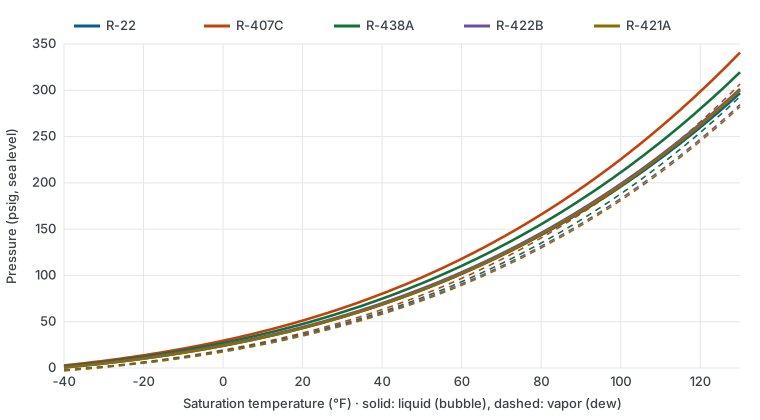
Saturation pressure in psig at sea level. Evaporating rows use the vapor (dew) value, condensing rows the liquid (bubble) value, which is what you compare with suction and liquid-line gauges.
| Saturation | R-22 | R-407C | R-438A | R-422B | R-421A |
|---|---|---|---|---|---|
| Evaporator (vapor, dew) | |||||
| -20°F | 10.2 | 6.5 | 6.0 | 5.7 | 5.2 |
| 0°F | 24.0 | 19.4 | 18.6 | 18.0 | 17.3 |
| 20°F | 43.1 | 37.9 | 36.5 | 35.5 | 34.6 |
| 30°F | 55.0 | 49.6 | 47.8 | 46.6 | 45.5 |
| 35°F | 61.5 | 56.1 | 54.1 | 52.8 | 51.6 |
| 40°F | 68.6 | 63.2 | 60.8 | 59.4 | 58.1 |
| 45°F | 76.1 | 70.7 | 68.1 | 66.5 | 65.2 |
| 50°F | 84.1 | 78.8 | 75.9 | 74.1 | 72.7 |
| Condenser (liquid, bubble) | |||||
| 80°F | 143.6 | 165.8 | 155.3 | 145.9 | 144.4 |
| 90°F | 168.4 | 194.1 | 181.9 | 171.0 | 169.5 |
| 95°F | 181.8 | 209.4 | 196.2 | 184.6 | 183.1 |
| 100°F | 195.9 | 225.5 | 211.3 | 198.9 | 197.4 |
| 105°F | 210.8 | 242.4 | 227.2 | 213.9 | 212.4 |
| 110°F | 226.4 | 260.3 | 244.0 | 229.8 | 228.3 |
| 115°F | 242.8 | 279.0 | 261.5 | 246.4 | 244.9 |
| 120°F | 260.0 | 298.6 | 280.0 | 263.9 | 262.4 |
| 125°F | 278.0 | 319.2 | 299.3 | 282.2 | 280.8 |
| 130°F | 296.9 | 340.7 | 319.5 | 301.5 | 300.1 |
Properties
| Property | R-22 | R-407C | R-438A | R-422B | R-421A |
|---|---|---|---|---|---|
| Safety class | A1 | A1 | A1 | A1 | A1 |
| Type | HCFC, single-component refrigerant | HFC, zeotropic blend | HFC/HC, zeotropic blend | HFC/HC, zeotropic blend | HFC, zeotropic blend |
| Composition (mass %) | Single component | R-32 23, R-125 25, R-134a 52 | R-32 8.5, R-125 45, R-134a 44.2, R-600 1.7, R-601a 0.6 | R-125 55, R-134a 42, R-600a 3 | R-125 58, R-134a 42 |
| GWP (AR4) | 1,810 | 1,774 | 2,265 | 2,526 | 2,631 |
| Lubricant | Mineral oil (AB alternate) | POE | Mineral oil, AB or POE (no oil change in most systems) | Mineral oil, AB or POE (no oil change in most systems) | MO, AB or POE (A-Gas); POE (BITZER) |
| Boiling point (14.7 psia) | -41.5°F | -46.5°F | -44.5°F | -42.6°F | -41.2°F |
| Critical point | 205.1°F, 724 psia | 187.0°F, 673 psia | 182.4°F, 605 psia | 179.5°F, 560 psia | 181.0°F, 568 psia |
| Glide at 40°F evaporating | 0.0°F | 11.1°F | 9.6°F | 7.6°F | 7.6°F |
| Glide at 100°F condensing | 0.0°F | 9.0°F | 7.5°F | 5.3°F | 5.6°F |
| US status | US production and import ended Jan 1 2020; existing equipment may still be serviced with recovered, recycled, reclaimed or pre-2020 R-22. | GWP 1,774 is above the 700 limit for new US residential and light commercial AC/HP from Jan 1 2025; servicing and R-22 retrofits of existing systems remain allowed. | Legal for retrofitting and servicing existing R-22 equipment; its GWP is above the limits for new AC, heat pumps and most refrigeration under 40 CFR 84.54 (2025 onward). | Legal for retrofitting and servicing existing R-22 equipment; its GWP is above the limits for new AC, heat pumps and most refrigeration under 40 CFR 84.54 (2025 onward). | SNAP-acceptable R-22 substitute in residential and light commercial AC (2006); used to service existing systems, too high in GWP for new AC or refrigeration equipment. |
Component compatibility
| Item | R-22 | R-407C | R-438A | R-422B | R-421A |
|---|---|---|---|---|---|
| Lubricant | Mineral oil or AB | POE only | MO, AB or POE | MO, AB or POE | MO, AB or POE (A-Gas) |
| Oil change on retrofit | – | Full change to POE | Usually none; add POE if oil return poor | Usually none; add POE if oil return poor | Works with MO, AB or POE (A-Gas) |
| Charging | Single component | Liquid only | Liquid from cylinder | Liquid from cylinder | Liquid (zeotrope) |
| Starting charge | Baseline | 90–95% of R-22 | About 85%, final about 95% | About 85%, final about 95% | Per A-Gas guide |
| Flooded evaporators | – | Not recommended | Not recommended | Not recommended | Check with supplier |
| Trade name | – | Freon 407C, Forane 407C, Klea 407C | Freon MO99 | Freon NU-22B | Choice R421A |
| Supply | Recovered, reclaimed or pre-2020 stock | In production (HFC) | In production (HFC) | In production (HFC) | In production (HFC) |
What changes in the field
Suction pressure drops for the same evaporator temperature, and the blends glide. From the PT data, at 40°F evaporating (dew) R-22 reads 68.6 psig, R-407C 63.2, MO99 (R-438A) 60.8, NU-22B (R-422B) 59.4 and R-421A 58.1. At 100°F condensing (bubble) R-22 is 195.9 psig. NU-22B (198.9) and R-421A (197.4) stay close, MO99 is 211.3, and R-407C is 225.5, or 29.6 psi above R-22.
R-22 is a single component. All four replacements are zeotropes, with glides at 40°F evaporating of 11.1°F (R-407C), 9.6°F (MO99), 7.6°F (NU-22B) and 7.6°F (R-421A). Read the dew column for superheat and the bubble column for subcooling. Chemours says superheat on MO99 or NU-22B should be the same as it was on R-22. Use the superheat and subcooling calculators with the new refrigerant selected.
All are A1 and high-pressure appliances under Section 608. Chemours says most R-22 recovery equipment can be used for MO99 and NU-22B. Keep separate recovery cylinders per refrigerant.
Retrofit or replacement
Chemours says topping off an HCFC with any refrigerant is not recommended. It also says not to mix MO99 and NU-22B in the same system. Every retrofit starts with removing all the R-22. Chemours’ MO99/NU-22B procedure:
- Record baseline pressures, temperatures, superheat and subcooling on R-22.
- Recover the charge (Chemours cites a recovery device capable of 10–15 in Hg) and weigh it.
- Replace the filter-drier and the critical elastomeric seals. Seals that swelled in R-22 can leak after an HFC retrofit.
- Evacuate to 500 microns, leak check with nitrogen, and evacuate again.
- Charge liquid from the cylinder. Start at about 85% of the R-22 charge, with the final charge usually about 95%.
- Adjust the TXV or charge to the original superheat, and watch the oil level. If oil return is erratic, add POE at about 20% of the oil charge. Chemours recommends a one-time POE change for Trane 3-D and Danfoss SM scrolls.
- Label the system with refrigerant and oil.
R-407C is different: it is POE only. Arkema calls for a complete oil change to POE, and Chemours says R-407C retrofits “will require multiple oil changes.” Arkema gives an initial charge of about 90–95% of the R-22 weight and does not recommend R-407C for flooded evaporators. Chemours says the same about MO99 and NU-22B for flooded and centrifugal systems. Details: R-22 vs R-407C, R-22 vs MO99.
Other listed retrofits:
- R-427A: Arkema recommends POE, usually after one oil change, and liquid charging only.
- R-422D: runs on MO, AB or POE according to Chemours.
- R-453A (RS-70): runs on MO, AB or POE according to Refrigerant Solutions.
- R-417A: runs on MO, AB or POE according to Chemours. BITZER warns of oil migration in systems with high oil circulation.
Replacing the equipment is the other path. A new system is not an R-22 substitute; it is new R-410A, R-454B or R-32 equipment. New R-410A split systems may be installed only where all specified components were manufactured or imported before Jan 1 2025. See R-22 vs R-410A.
Capacity, efficiency and cost
Chemours says MO99 and NU-22B “provide similar cooling capacity and energy efficiency to R-22 in most systems” with a lower compressor discharge temperature, and that actual performance depends on the system. None of the sources here gives a verified capacity percentage for R-407C or R-421A against R-22.
For cost, Chemours points out that its blends avoid the multiple oil changes an R-407C retrofit needs.
On the rules: since Jan 1 2020, R-22 servicing relies on recovered, recycled, reclaimed or pre-2020 stock. Recovered R-22 can’t be sold to a new owner unless an EPA-certified reclaimer has reclaimed it. The four blends compared here are HFCs with AR4 GWPs from 1,774 (R-407C) to 2,631 (R-421A). EPA lists them as acceptable R-22 substitutes in residential and light commercial AC, but they are above the limits for new AC equipment and are used for retrofit and service. See the R-22 phase-out.
Common questions
What is the best R-22 drop-in replacement?
There is no true drop-in. If you want to keep the mineral oil, MO99 and NU-22B are the closest match by Chemours’ account. If you can do the oil change, R-407C is a POE option.
Can you add MO99 to R-22?
No. Chemours’ retrofit guidelines say topping off an HCFC with any refrigerant is not recommended. Recover all the R-22 first, then charge MO99.
PT charts and calculators
Sources
- Chemours: Freon MO99 (R-438A) and Freon NU-22B (R-422B) Retrofit Guidelines (C-10862) freon.com
- Arkema: Retrofitting with Forane refrigerants forane.arkema.com
- A-Gas R-421A product page agas.com
- 40 CFR 82.15: Class II (HCFC) prohibitions ecfr.gov
- 40 CFR 82.154: Venting prohibition, exempt substitutes, sales restriction ecfr.gov
- 40 CFR 84.54: Technology Transitions restrictions by sector ecfr.gov
- EPA SNAP: Substitutes in Residential and Light Commercial AC and Heat Pumps epa.gov
- Copeland AE Bulletin 93-11: Refrigerants and Lubricants Approved for Use in Copeland Compressors webapps.copeland.com
Reviewed . Found an error? Tell us and we will correct it.