R-422D (MO29) PT Chart and Refrigerant Profile
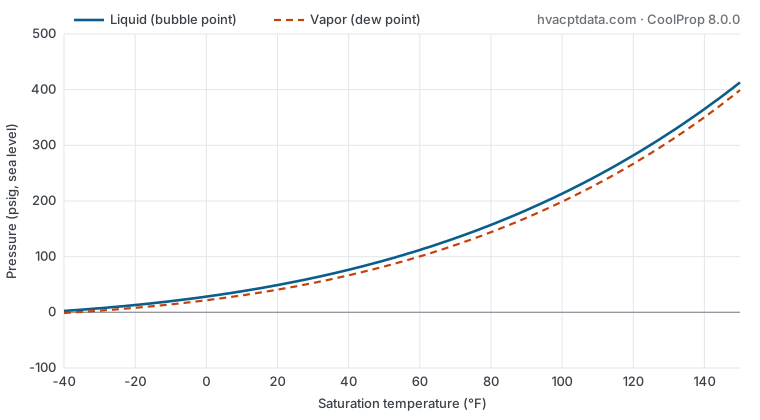
R-422D (MO29) is an A1 HFC/HC zeotropic blend of R-125, R-134a and R-600a (65.1/31.5/3.4 % by mass). At 40°F its vapor (dew) pressure is 66.5 psig; at 100°F its liquid (bubble) pressure is 213.2 psig.
Reviewed · PT values computed with CoolProp 8.0.0 and checked against a published chart (largest difference 1.0 psi)
R-422D at a glance
| Safety class (ASHRAE 34) | A1: lower toxicity, no flame propagation |
|---|---|
| Type | HFC/HC, zeotropic blend |
| Composition | R-125 65.1% · R-134a 31.5% · R-600a 3.4% by mass |
| GWP (100-year, AR4) | 2,729 · AR5: 2,473EPA's 40 CFR 84.64 calculation gives 2,729.0. |
| Ozone depletion potential | 0 |
| Lubricant | Mineral oil, AB or POE (no oil change in most systems) |
| Boiling point at 14.7 psia | -46.1°F bubble · -37.0°F dew |
| Critical point | 172.6°F, 551 psia |
| 40°F evaporating | 66.5 psig (dew), glide 6.6°F |
| 100°F condensing | 213.2 psig (bubble), glide 4.6°F |
| Charge as | Liquid only (blend can fractionate as vapor) |
| Typical use | R-22 retrofit in residential and commercial DX air conditioning; DX chillers; Medium- and low-temperature DX refrigeration including supermarket cases and ice machines |
| Trade names | Freon MO29 (Chemours), ISCEON MO29 (former DuPont name), Genetron 422D (Honeywell) |
| US status | Legal for retrofitting and servicing existing R-22 equipment; its GWP is above the limits for new AC, heat pumps and most refrigeration under 40 CFR 84.54 (2025 onward). |
| Replaces | R-22 |
R-422D PT chart (°F and psig)
R-422D is a blend, so it has two saturation pressures at each temperature. Read the vapor (dew) column against suction pressure for superheat and the liquid (bubble) column against liquid-line pressure for subcooling. Tap a row to load it into the lookup.
-40°F to 150°F · psig at sea level · °C and kPa in the CSV · italic = inches Hg vacuum
| °F | Liquidbubble psig | Vapordew psig |
|---|---|---|
| -40 | 2.5 | 2.3″ |
| -39 | 3.0 | 1.6″ |
| -38 | 3.4 | 0.8″ |
| -37 | 3.9 | 0.0 |
| -36 | 4.3 | 0.4 |
| -35 | 4.8 | 0.8 |
| -34 | 5.3 | 1.3 |
| -33 | 5.8 | 1.7 |
| -32 | 6.3 | 2.1 |
| -31 | 6.8 | 2.6 |
| -30 | 7.3 | 3.0 |
| -29 | 7.9 | 3.5 |
| -28 | 8.4 | 4.0 |
| -27 | 9.0 | 4.4 |
| -26 | 9.5 | 4.9 |
| -25 | 10.1 | 5.4 |
| -24 | 10.7 | 6.0 |
| -23 | 11.3 | 6.5 |
| -22 | 11.9 | 7.0 |
| -21 | 12.5 | 7.6 |
| -20 | 13.1 | 8.1 |
| -19 | 13.8 | 8.7 |
| -18 | 14.4 | 9.3 |
| -17 | 15.1 | 9.9 |
| -16 | 15.8 | 10.5 |
| -15 | 16.5 | 11.1 |
| -14 | 17.2 | 11.7 |
| -13 | 17.9 | 12.3 |
| -12 | 18.6 | 13.0 |
| -11 | 19.3 | 13.6 |
| -10 | 20.1 | 14.3 |
| -9 | 20.8 | 15.0 |
| -8 | 21.6 | 15.7 |
| -7 | 22.4 | 16.4 |
| -6 | 23.2 | 17.1 |
| -5 | 24.0 | 17.8 |
| -4 | 24.8 | 18.6 |
| -3 | 25.7 | 19.3 |
| -2 | 26.5 | 20.1 |
| -1 | 27.4 | 20.9 |
| 0 | 28.2 | 21.7 |
| 1 | 29.1 | 22.5 |
| 2 | 30.0 | 23.3 |
| 3 | 31.0 | 24.2 |
| 4 | 31.9 | 25.0 |
| 5 | 32.9 | 25.9 |
| 6 | 33.8 | 26.8 |
| 7 | 34.8 | 27.7 |
| 8 | 35.8 | 28.6 |
| 9 | 36.8 | 29.5 |
| 10 | 37.8 | 30.5 |
| 11 | 38.9 | 31.4 |
| 12 | 39.9 | 32.4 |
| 13 | 41.0 | 33.4 |
| 14 | 42.1 | 34.4 |
| 15 | 43.2 | 35.4 |
| 16 | 44.3 | 36.4 |
| 17 | 45.4 | 37.5 |
| 18 | 46.6 | 38.5 |
| 19 | 47.8 | 39.6 |
| 20 | 49.0 | 40.7 |
| 21 | 50.2 | 41.8 |
| 22 | 51.4 | 43.0 |
| 23 | 52.6 | 44.1 |
| 24 | 53.9 | 45.3 |
| 25 | 55.1 | 46.5 |
| 26 | 56.4 | 47.7 |
| 27 | 57.7 | 48.9 |
| 28 | 59.1 | 50.2 |
| 29 | 60.4 | 51.4 |
| 30 | 61.8 | 52.7 |
| 31 | 63.2 | 54.0 |
| 32 | 64.6 | 55.3 |
| 33 | 66.0 | 56.6 |
| 34 | 67.4 | 58.0 |
| 35 | 68.9 | 59.4 |
| 36 | 70.4 | 60.8 |
| 37 | 71.8 | 62.2 |
| 38 | 73.4 | 63.6 |
| 39 | 74.9 | 65.0 |
| 40 | 76.5 | 66.5 |
| 41 | 78.0 | 68.0 |
| 42 | 79.6 | 69.5 |
| 43 | 81.2 | 71.0 |
| 44 | 82.9 | 72.6 |
| 45 | 84.5 | 74.2 |
| 46 | 86.2 | 75.8 |
| 47 | 87.9 | 77.4 |
| 48 | 89.6 | 79.0 |
| 49 | 91.4 | 80.7 |
| 50 | 93.2 | 82.4 |
| 51 | 94.9 | 84.1 |
| 52 | 96.8 | 85.8 |
| 53 | 98.6 | 87.5 |
| 54 | 100.4 | 89.3 |
| 55 | 102.3 | 91.1 |
| 56 | 104.2 | 92.9 |
| 57 | 106.1 | 94.8 |
| 58 | 108.1 | 96.6 |
| 59 | 110.1 | 98.5 |
| 60 | 112.0 | 100.4 |
| 61 | 114.1 | 102.4 |
| 62 | 116.1 | 104.3 |
| 63 | 118.2 | 106.3 |
| 64 | 120.3 | 108.3 |
| 65 | 122.4 | 110.3 |
| 66 | 124.5 | 112.4 |
| 67 | 126.7 | 114.5 |
| 68 | 128.9 | 116.6 |
| 69 | 131.1 | 118.7 |
| 70 | 133.3 | 120.9 |
| 71 | 135.6 | 123.1 |
| 72 | 137.9 | 125.3 |
| 73 | 140.2 | 127.5 |
| 74 | 142.5 | 129.8 |
| 75 | 144.9 | 132.1 |
| 76 | 147.3 | 134.4 |
| 77 | 149.7 | 136.8 |
| 78 | 152.1 | 139.1 |
| 79 | 154.6 | 141.5 |
| 80 | 157.1 | 144.0 |
| 81 | 159.6 | 146.4 |
| 82 | 162.2 | 148.9 |
| 83 | 164.8 | 151.4 |
| 84 | 167.4 | 154.0 |
| 85 | 170.0 | 156.6 |
| 86 | 172.7 | 159.2 |
| 87 | 175.4 | 161.8 |
| 88 | 178.1 | 164.5 |
| 89 | 180.9 | 167.1 |
| 90 | 183.7 | 169.9 |
| 91 | 186.5 | 172.6 |
| 92 | 189.3 | 175.4 |
| 93 | 192.2 | 178.2 |
| 94 | 195.1 | 181.1 |
| 95 | 198.0 | 183.9 |
| 96 | 201.0 | 186.9 |
| 97 | 204.0 | 189.8 |
| 98 | 207.0 | 192.8 |
| 99 | 210.1 | 195.8 |
| 100 | 213.2 | 198.8 |
| 101 | 216.3 | 201.9 |
| 102 | 219.4 | 205.0 |
| 103 | 222.6 | 208.1 |
| 104 | 225.8 | 211.3 |
| 105 | 229.1 | 214.5 |
| 106 | 232.4 | 217.7 |
| 107 | 235.7 | 221.0 |
| 108 | 239.0 | 224.3 |
| 109 | 242.4 | 227.7 |
| 110 | 245.8 | 231.1 |
| 111 | 249.3 | 234.5 |
| 112 | 252.8 | 237.9 |
| 113 | 256.3 | 241.4 |
| 114 | 259.8 | 244.9 |
| 115 | 263.4 | 248.5 |
| 116 | 267.0 | 252.1 |
| 117 | 270.7 | 255.7 |
| 118 | 274.4 | 259.4 |
| 119 | 278.1 | 263.1 |
| 120 | 281.9 | 266.9 |
| 121 | 285.7 | 270.6 |
| 122 | 289.5 | 274.5 |
| 123 | 293.4 | 278.3 |
| 124 | 297.3 | 282.3 |
| 125 | 301.2 | 286.2 |
| 126 | 305.2 | 290.2 |
| 127 | 309.3 | 294.2 |
| 128 | 313.3 | 298.3 |
| 129 | 317.4 | 302.4 |
| 130 | 321.6 | 306.5 |
| 131 | 325.7 | 310.7 |
| 132 | 329.9 | 315.0 |
| 133 | 334.2 | 319.3 |
| 134 | 338.5 | 323.6 |
| 135 | 342.8 | 328.0 |
| 136 | 347.2 | 332.4 |
| 137 | 351.6 | 336.8 |
| 138 | 356.1 | 341.3 |
| 139 | 360.6 | 345.9 |
| 140 | 365.1 | 350.5 |
| 141 | 369.7 | 355.1 |
| 142 | 374.4 | 359.8 |
| 143 | 379.0 | 364.6 |
| 144 | 383.8 | 369.4 |
| 145 | 388.5 | 374.2 |
| 146 | 393.3 | 379.1 |
| 147 | 398.2 | 384.1 |
| 148 | 403.1 | 389.0 |
| 149 | 408.0 | 394.1 |
| 150 | 413.0 | 399.2 |
Where you will find R-422D
R-422D is sold as Freon MO29 (formerly ISCEON MO29), and Honeywell sold it as Genetron 422D. The Chemours MO29 bulletin covers R-22 DX equipment in these categories:
- window, split and packaged AC
- air- and water-cooled DX chillers
- medium- and low-temperature commercial refrigeration, including supermarket cases, food refrigeration and ice machines
It shows up in converted R-22 rooftops, condensing units and refrigeration racks. The nameplate still says R-22, so the retrofit label (refrigerant and oil) is what identifies it. The legacy R-422D cylinder color is green-yellow.
R-422D has the same three components as R-422B (NU-22B) but more R-125: 65.1% versus 55%. That makes it the higher-pressure blend of the two. Do not read one blend’s chart for the other.
Charging R-422D
Charge from the liquid side, including top-offs. R-422D is a zeotrope, so the vapor in the cylinder has a different composition from the liquid. The MO29 bulletin allows topping off a leaking system without pulling the whole charge, but only if the system is already on MO29 and the refrigerant goes in as liquid.
For the conversion itself, the MO29 bulletin points to Chemours’ MO29 retrofit guidelines, which we could not obtain. Chemours’ general sequence for its no-oil-change R-22 blends, written for MO99 and NU-22B, goes:
- Record baseline R-22 data.
- Recover and weigh the R-22, holding the system under vacuum to pull R-22 out of the oil.
- Replace the filter-drier and the critical seals.
- Evacuate to 500 microns (evacuation targets).
- Liquid-charge part of the original weight.
- Adjust to the same superheat you had on R-22.
- Watch the oil and label the system.
The 85% starting and 95% final charge figures in that guide are for MO99 and NU-22B. Treat them as a starting point only and follow the equipment manufacturer.
Expect the expansion valve to need attention. The MO29 bulletin says some applications need TXV adjustment or replacement. In Chemours’ calorimeter comparison at AHRI 540 AC conditions, R-422D’s mass flow ran 32% above R-22, against 12% for MO99. On fixed orifices, charge to target superheat. On TXV and EEV systems, charge to subcooling per the nameplate.
Read the dew column for superheat and the bubble column for subcooling. The computed glide is 6.6°F at 40°F dew and 4.6°F at 100°F bubble. Suction pressure sits close to R-22: 66.5 psig dew at 40°F versus 68.6 psig. The head runs higher: 213.2 psig bubble at 100°F versus 195.9 psig. The same Chemours table shows discharge pressure 12 psi above R-22 and discharge temperature 39°F lower.
Oil and compatibility
Chemours says MO29 works with mineral oil, alkylbenzene and POE, and most retrofits keep the existing oil. In systems with complex piping, POE may need to be added for oil return. BITZER’s data table lists POE or PVE, with AB only in limited cases. Check the compressor maker’s approval before you leave mineral oil in a semi-hermetic.
Where oil return is in doubt, the Chemours practice for its other no-oil-change blends is to add POE at about 20% of the oil charge. Typical cases:
- the oil level falls or swings during a cycle
- the system has a receiver but no oil separator
- the evaporator sits well below the condensing unit
That guide also calls for a one-time sump change to POE on Trane 3-D and Danfoss SM scrolls. See the refrigerant oil guide.
The MO29 bulletin lists seal replacement among the possible retrofit changes. R-22 swells elastomers more than HFCs, so seals that held on R-22 can leak after conversion. Replace Schrader cores and any seal that needs the charge pulled to change.
Safety, handling and recovery
R-422D is A1 (lower toxicity, no flame propagation), and Chemours describes it as nonflammable and nontoxic. It is a Section 608 high-pressure refrigerant: Type II or Universal certification. Sales have been restricted to certified technicians since Jan 1 2018, and venting is prohibited.
Required recovery levels for high-pressure appliances made after Nov 15 1993:
- under 200 lb charge: 0 in Hg
- 200 lb or more: 10 in Hg
Use an electronic HFC leak detector, and never leak-test with air and refrigerant mixtures.
Its legacy color, green-yellow, now appears only on labels. New cylinders made since Jan 1 2020 are light green-gray (RAL 7044) under AHRI Guideline N (cylinder colors).
Status and replacements
EPA SNAP lists R-422D as acceptable for replacing R-22 in residential and light commercial AC (Sept 28 2006). Its AR4 GWP of about 2,729 is above the 700 limit that has applied to new residential and light commercial AC and heat pumps since Jan 1 2025 under 40 CFR 84.54, so it is a retrofit and service refrigerant only. AIM Act HFC allowances are 60% of baseline in 2024–2028, 30% in 2029–2033, 20% in 2034–2035 and 15% from 2036.
From Jan 1 2026, leak repair rules apply to appliances holding 15 lb or more, excluding residential and light commercial AC. That can include converted supermarket and commercial systems. From 2029, supermarket systems and ice makers must be serviced with reclaimed HFC.
Compare it with MO99, R-407C and other options in R-22 replacement options.
Common questions
Is R-422D a replacement for R-22?
Yes, in existing DX equipment. EPA lists it as acceptable, and Chemours says it gives capacity and efficiency similar to R-22 in most systems. In refrigeration tests, the bulletin shows capacity 8% above R-22 at low temperature and 5% below at medium temperature.
What oil does R-422D use?
It uses the existing mineral oil or AB in most retrofits. Add POE where oil return is poor, and follow the compressor manufacturer’s approval list.
How this chart was computed
Every pressure on this page is calculated, not copied: CoolProp 8.0.0 (HEOS backend), the open-source implementation of the reference equations of state, using the model mix:R422D at the nominal ASHRAE 34 composition. Gauge values assume sea-level air pressure (14.696 psia); kPa values in the CSV are absolute.
Spot check against Chemours "R-22 Replacements" and "R-12 and R-502 Replacements" Pressure-Temperature Guide (C-10914, 3/19):
| °F | Column | Published | This chart | Difference |
|---|---|---|---|---|
| 0 | dew | 21.7 psig | 21.7 psig | -0.0 psi |
| 40 | dew | 66.4 psig | 66.5 psig | +0.1 psi |
| 100 | bubble | 212.2 psig | 213.2 psig | +1.0 psi |
Charts from different publishers can differ by a few tenths of a psi because of the equation of state and blend tolerances. Always charge to the equipment manufacturer's data. Full method and every spot check
Comparisons with R-422D
Calculators for R-422D
Sources
- Chemours: Freon MO29 product information (Portuguese, 2021) pages.chemours.com
- Chemours: Freon MO99 FAQ with calorimeter comparison including R-422D (C-10846, 11/16) firstsupply.com
- Chemours: Freon MO99 and NU-22B Retrofit Guidelines (general R-22 DX procedure, C-10862) freon.com
- ASHRAE Refrigerant Designations ashrae.org
- BITZER Refrigerant Report: refrigerant data table bitzer.de
- EPA SNAP: Substitutes in Residential and Light Commercial AC and Heat Pumps epa.gov
- 40 CFR 84.54: Technology Transitions restrictions by sector ecfr.gov
Reviewed . Found an error? Tell us and we will correct it.
More in R-22 service blends