R-422B vs R-422D
Reviewed · pressures computed with CoolProp 8.0 from the same data as the PT charts
Are R-422B and R-422D interchangeable?
No. Both are A1 R-22 retrofit blends of R-125, R-134a and isobutane, but R-422D carries more R-125 and runs higher pressures and mass flow. Each has its own PT chart and charge behavior, so a system gets one or the other, never a mix of both.
Pressures side by side
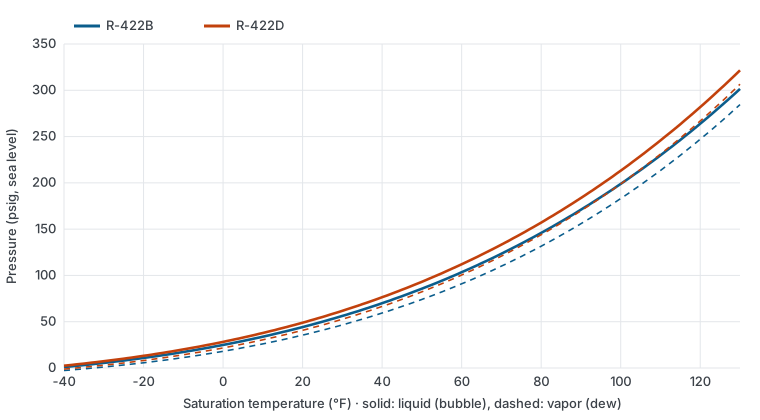
Saturation pressure in psig at sea level. Evaporating rows use the vapor (dew) value, condensing rows the liquid (bubble) value, which is what you compare with suction and liquid-line gauges. The last column is R-422D minus R-422B.
| Saturation | R-422B | R-422D | Difference |
|---|---|---|---|
| Evaporator (vapor, dew) | |||
| -20°F | 5.7 | 8.1 | +2.5 (+43%) |
| 0°F | 18.0 | 21.7 | +3.7 (+20%) |
| 20°F | 35.5 | 40.7 | +5.2 (+15%) |
| 30°F | 46.6 | 52.7 | +6.1 (+13%) |
| 35°F | 52.8 | 59.4 | +6.6 (+13%) |
| 40°F | 59.4 | 66.5 | +7.1 (+12%) |
| 45°F | 66.5 | 74.2 | +7.7 (+12%) |
| 50°F | 74.1 | 82.4 | +8.3 (+11%) |
| Condenser (liquid, bubble) | |||
| 80°F | 145.9 | 157.1 | +11.2 (+8%) |
| 90°F | 171.0 | 183.7 | +12.7 (+7%) |
| 95°F | 184.6 | 198.0 | +13.5 (+7%) |
| 100°F | 198.9 | 213.2 | +14.3 (+7%) |
| 105°F | 213.9 | 229.1 | +15.2 (+7%) |
| 110°F | 229.8 | 245.8 | +16.1 (+7%) |
| 115°F | 246.4 | 263.4 | +17.0 (+7%) |
| 120°F | 263.9 | 281.9 | +18.0 (+7%) |
| 125°F | 282.2 | 301.2 | +19.0 (+7%) |
| 130°F | 301.5 | 321.6 | +20.1 (+7%) |
Properties
| Property | R-422B | R-422D |
|---|---|---|
| Safety class | A1 | A1 |
| Type | HFC/HC, zeotropic blend | HFC/HC, zeotropic blend |
| Composition (mass %) | R-125 55, R-134a 42, R-600a 3 | R-125 65.1, R-134a 31.5, R-600a 3.4 |
| GWP (AR4) | 2,526 | 2,729 |
| Lubricant | Mineral oil, AB or POE (no oil change in most systems) | Mineral oil, AB or POE (no oil change in most systems) |
| Boiling point (14.7 psia) | -42.6°F | -46.1°F |
| Critical point | 179.5°F, 560 psia | 172.6°F, 551 psia |
| Glide at 40°F evaporating | 7.6°F | 6.6°F |
| Glide at 100°F condensing | 5.3°F | 4.6°F |
| US status | Legal for retrofitting and servicing existing R-22 equipment; its GWP is above the limits for new AC, heat pumps and most refrigeration under 40 CFR 84.54 (2025 onward). | Legal for retrofitting and servicing existing R-22 equipment; its GWP is above the limits for new AC, heat pumps and most refrigeration under 40 CFR 84.54 (2025 onward). |
Component compatibility
| Item | R-422B | R-422D |
|---|---|---|
| Composition (R-125/R-134a/R-600a) | 55 / 42 / 3 | 65.1 / 31.5 / 3.4 |
| Trade name | Freon NU-22B (Chemours, originally ICOR) | Freon MO29 (formerly ISCEON MO29); Genetron 422D |
| Lubricant | MO, AB or POE (Chemours); BITZER lists POE | MO, AB or POE (Chemours); BITZER lists POE/PVE, AB limited |
| Capacity vs R-22 (Chemours AC calorimeter) | -12% | -8% |
| Mass flow vs R-22 (same test) | +20% | +32% |
| Charging | Liquid only; start about 85% of R-22 weight (Chemours) | Liquid only |
| Recovery machine | AHRI 740 (40 CFR 82.158 App. B3) | AHRI 740 (40 CFR 82.158 App. B3) |
| Cylinder | RAL 7044 gray; read the label | RAL 7044 gray (legacy green-yellow) |
What changes in the field
R-422D runs higher on both sides. From the PT data, at 40°F evaporating (dew) R-422B reads 59.4 psig and R-422D 66.5 psig, against 68.6 psig for R-22. At 100°F condensing (bubble) R-422B is 198.9 psig, R-422D 213.2 psig and R-22 195.9 psig. So R-422D stays closer to R-22 on suction, while R-422B stays closer on the high side.
Both blends glide. The computed glide is 7.6°F (R-422B) and 6.6°F (R-422D) at 40°F evaporating, and 5.3°F and 4.6°F at 100°F condensing. Read the dew column for superheat and the bubble column for subcooling, and make sure the manifold is set to the blend on the retrofit label. The nameplate on a converted unit still says R-22.
The bigger practical difference is mass flow. In Chemours’ calorimeter comparison at AHRI 540 air-conditioning conditions, R-422D moved 32% more mass than R-22 and R-422B 20% more. Chemours argues that the closest mass flow to R-22 gives the best fit with existing cap tubes and fixed metering devices. The Chemours MO29 bulletin says some applications need expansion valve adjustment or replacement.
Both are A1, both are high-pressure refrigerants under Section 608, and both use a standard AHRI 740 recovery machine. Keep a separate recovery cylinder for each; a recovered mix of the two is neither refrigerant.
Retrofit or replacement
These are not swaps for each other. If a system is already on NU-22B, it stays on NU-22B; an MO29 system stays on MO29. Changing from one blend to the other means recovering the whole charge, treating it as a new retrofit and relabeling the system.
For an R-22 conversion to either blend, Chemours’ procedure for NU-22B is the reference:
- Record baseline R-22 pressures, temperatures, superheat and subcooling.
- Recover and weigh the R-22, holding the system under vacuum to pull R-22 out of the oil.
- Replace the filter-drier and critical elastomeric seals.
- Evacuate to 500 microns (evacuation targets), leak check with nitrogen, evacuate again.
- Charge liquid from the cylinder. For NU-22B, Chemours starts at about 85% of the R-22 weight with a final charge usually about 95%.
- Adjust to the original superheat, watch the oil level, and label refrigerant and oil.
The MO29 bulletin refers to separate MO29 retrofit guidelines that we could not obtain, so the 85%/95% figures should not be assumed for R-422D. Follow the equipment manufacturer.
Oil is the same story for both: Chemours says most systems keep the existing mineral oil or alkylbenzene, and POE may need to be added where oil return is poor. BITZER warns that blends of this type can see oil migration in systems with high oil circulation or large receivers, and its data table lists POE for R-422B and POE or PVE for R-422D. Check the compressor maker’s approval on semi-hermetics.
Chemours does not recommend NU-22B for centrifugal compressors or chillers with flooded evaporators. The MO29 bulletin lists DX applications only: window, split and packaged AC, DX chillers, and medium- and low-temperature DX refrigeration.
See R-22 replacement refrigerants for the wider field of options.
Capacity, efficiency and cost
Chemours’ 2016 calorimeter table (45°F average evaporator, 115°F average condenser) gives, relative to R-22:
| R-422B | R-422D | |
|---|---|---|
| Capacity | -12% | -8% |
| COP | -3% | -4% |
| Discharge pressure | -5 psi | +12 psi |
| Discharge temperature | -37°F | -39°F |
Chemours’ NU-22B guide adds that capacity and efficiency are similar to R-22 in most retrofitted systems and that real results depend on the system. The MO29 bulletin says the same about MO29.
Both are HFC blends. AR4 GWP is 2,526 for R-422B and 2,729 for R-422D, well above the limits for new AC and commercial refrigeration under 40 CFR 84.54, so they are retrofit and service refrigerants only. EPA SNAP lists both as acceptable R-22 substitutes in residential and light commercial AC. Freon MO29 does not appear in Chemours’ 2024 US retrofit guide; we could not confirm whether it has been discontinued, so check supply before planning a job around it.
Common questions
Is R-422B compatible with R-22?
It is a replacement for R-22, not something to add to it. Chemours says topping off an HCFC with any refrigerant is not recommended. Recover all the R-22 first, then charge R-422B as liquid.
What is the difference between 422B and 422D?
The ratio of the same three components. R-422D has 65.1% R-125 against 55% in R-422B, which gives it higher pressures, more mass flow and slightly more capacity in Chemours’ test, at a higher GWP.
PT charts and calculators
Sources
- Chemours: Freon MO99 (R-438A) and Freon NU-22B (R-422B) Retrofit Guidelines freon.com
- Chemours: Comparison of No Oil Change R-22 Replacement Products for Air Conditioning (C-10259, 4/16) crescentparts.com
- Chemours Freon MO29 technical bulletin (Portuguese) pages.chemours.com
- BITZER Refrigerant Report: R-22 service blends bitzer.de
- BITZER Refrigerant Report (A-500/501) refrigerant data table bitzer.de
- EPA SNAP: Substitutes in Residential and Light Commercial AC and Heat Pumps epa.gov
- 40 CFR 84.54: Technology Transitions restrictions by sector ecfr.gov
Reviewed . Found an error? Tell us and we will correct it.