R-453A (RS-70) PT Chart and Refrigerant Profile
R-453A (RS-70) is an A1 HFC/HC zeotropic blend of R-32, R-125, R-134a, R-227ea, R-600 and R-601a (20/20/53.8/5/0.6/0.6 % by mass). At 40°F its vapor (dew) pressure is 57.9 psig; at 100°F its liquid (bubble) pressure is 212.7 psig.
Reviewed · PT values computed with CoolProp 8.0.0 and checked against a published chart (largest difference 0.9 psi)
R-453A at a glance
| Safety class (ASHRAE 34) | A1: lower toxicity, no flame propagation |
|---|---|
| Type | HFC/HC, zeotropic blend |
| Composition | R-32 20% · R-125 20% · R-134a 53.8% · R-227ea 5% · R-600 0.6% · R-601a 0.6% by mass |
| GWP (100-year, AR4) | 1,765 · AR5: 1,636EPA's 40 CFR 84.64 calculation gives 1,765.4. |
| Ozone depletion potential | 0 |
| Lubricant | Mineral oil, AB or POE (no oil change in most systems) |
| Boiling point at 14.7 psia | -44.3°F bubble · -31.0°F dew |
| Critical point | 190.1°F, 657 psia |
| 40°F evaporating | 57.9 psig (dew), glide 11.8°F |
| 100°F condensing | 212.7 psig (bubble), glide 9.6°F |
| Charge as | Liquid only (blend can fractionate as vapor) |
| Typical use | R-22 retrofit in commercial air conditioning; Cold stores and supermarket refrigeration; Refrigerated transport and dairy chillers |
| Trade names | RS-70 (Refrigerant Solutions Ltd), RS-44b (ComStar; US distributor listing) |
| US status | Legal for retrofitting and servicing existing R-22 equipment; its GWP is above the limits for new AC, heat pumps, cold storage and supermarket systems under 40 CFR 84.54. |
| Replaces | R-22 |
R-453A PT chart (°F and psig)
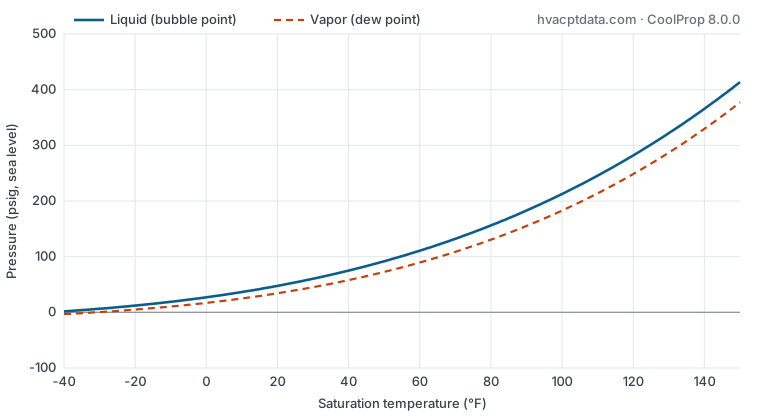
R-453A is a blend, so it has two saturation pressures at each temperature. Read the vapor (dew) column against suction pressure for superheat and the liquid (bubble) column against liquid-line pressure for subcooling. Tap a row to load it into the lookup.
-40°F to 150°F · psig at sea level · °C and kPa in the CSV · italic = inches Hg vacuum
| °F | Liquidbubble psig | Vapordew psig |
|---|---|---|
| -40 | 1.8 | 6.5″ |
| -39 | 2.2 | 5.9″ |
| -38 | 2.6 | 5.2″ |
| -37 | 3.1 | 4.5″ |
| -36 | 3.5 | 3.8″ |
| -35 | 4.0 | 3.1″ |
| -34 | 4.5 | 2.3″ |
| -33 | 4.9 | 1.5″ |
| -32 | 5.4 | 0.8″ |
| -31 | 5.9 | 0.0 |
| -30 | 6.4 | 0.4 |
| -29 | 7.0 | 0.8 |
| -28 | 7.5 | 1.3 |
| -27 | 8.0 | 1.7 |
| -26 | 8.6 | 2.1 |
| -25 | 9.2 | 2.6 |
| -24 | 9.7 | 3.0 |
| -23 | 10.3 | 3.5 |
| -22 | 10.9 | 3.9 |
| -21 | 11.5 | 4.4 |
| -20 | 12.1 | 4.9 |
| -19 | 12.8 | 5.4 |
| -18 | 13.4 | 5.9 |
| -17 | 14.0 | 6.5 |
| -16 | 14.7 | 7.0 |
| -15 | 15.4 | 7.5 |
| -14 | 16.1 | 8.1 |
| -13 | 16.8 | 8.6 |
| -12 | 17.5 | 9.2 |
| -11 | 18.2 | 9.8 |
| -10 | 18.9 | 10.4 |
| -9 | 19.7 | 11.0 |
| -8 | 20.4 | 11.6 |
| -7 | 21.2 | 12.3 |
| -6 | 22.0 | 12.9 |
| -5 | 22.8 | 13.6 |
| -4 | 23.6 | 14.2 |
| -3 | 24.5 | 14.9 |
| -2 | 25.3 | 15.6 |
| -1 | 26.1 | 16.3 |
| 0 | 27.0 | 17.0 |
| 1 | 27.9 | 17.7 |
| 2 | 28.8 | 18.5 |
| 3 | 29.7 | 19.2 |
| 4 | 30.6 | 20.0 |
| 5 | 31.6 | 20.8 |
| 6 | 32.5 | 21.6 |
| 7 | 33.5 | 22.4 |
| 8 | 34.5 | 23.2 |
| 9 | 35.5 | 24.1 |
| 10 | 36.5 | 24.9 |
| 11 | 37.5 | 25.8 |
| 12 | 38.6 | 26.7 |
| 13 | 39.7 | 27.6 |
| 14 | 40.7 | 28.5 |
| 15 | 41.8 | 29.4 |
| 16 | 42.9 | 30.3 |
| 17 | 44.1 | 31.3 |
| 18 | 45.2 | 32.3 |
| 19 | 46.4 | 33.2 |
| 20 | 47.6 | 34.2 |
| 21 | 48.8 | 35.3 |
| 22 | 50.0 | 36.3 |
| 23 | 51.2 | 37.4 |
| 24 | 52.5 | 38.4 |
| 25 | 53.7 | 39.5 |
| 26 | 55.0 | 40.6 |
| 27 | 56.3 | 41.7 |
| 28 | 57.6 | 42.9 |
| 29 | 59.0 | 44.0 |
| 30 | 60.4 | 45.2 |
| 31 | 61.7 | 46.4 |
| 32 | 63.1 | 47.6 |
| 33 | 64.5 | 48.8 |
| 34 | 66.0 | 50.1 |
| 35 | 67.4 | 51.3 |
| 36 | 68.9 | 52.6 |
| 37 | 70.4 | 53.9 |
| 38 | 71.9 | 55.2 |
| 39 | 73.5 | 56.6 |
| 40 | 75.0 | 57.9 |
| 41 | 76.6 | 59.3 |
| 42 | 78.2 | 60.7 |
| 43 | 79.8 | 62.1 |
| 44 | 81.5 | 63.6 |
| 45 | 83.1 | 65.0 |
| 46 | 84.8 | 66.5 |
| 47 | 86.5 | 68.0 |
| 48 | 88.2 | 69.5 |
| 49 | 90.0 | 71.1 |
| 50 | 91.8 | 72.6 |
| 51 | 93.6 | 74.2 |
| 52 | 95.4 | 75.8 |
| 53 | 97.2 | 77.5 |
| 54 | 99.1 | 79.1 |
| 55 | 101.0 | 80.8 |
| 56 | 102.9 | 82.5 |
| 57 | 104.8 | 84.2 |
| 58 | 106.8 | 86.0 |
| 59 | 108.7 | 87.7 |
| 60 | 110.7 | 89.5 |
| 61 | 112.8 | 91.3 |
| 62 | 114.8 | 93.2 |
| 63 | 116.9 | 95.0 |
| 64 | 119.0 | 96.9 |
| 65 | 121.1 | 98.8 |
| 66 | 123.3 | 100.8 |
| 67 | 125.5 | 102.7 |
| 68 | 127.7 | 104.7 |
| 69 | 129.9 | 106.7 |
| 70 | 132.1 | 108.7 |
| 71 | 134.4 | 110.8 |
| 72 | 136.7 | 112.9 |
| 73 | 139.1 | 115.0 |
| 74 | 141.4 | 117.1 |
| 75 | 143.8 | 119.3 |
| 76 | 146.2 | 121.5 |
| 77 | 148.6 | 123.7 |
| 78 | 151.1 | 126.0 |
| 79 | 153.6 | 128.3 |
| 80 | 156.1 | 130.6 |
| 81 | 158.7 | 132.9 |
| 82 | 161.3 | 135.3 |
| 83 | 163.9 | 137.6 |
| 84 | 166.5 | 140.1 |
| 85 | 169.2 | 142.5 |
| 86 | 171.8 | 145.0 |
| 87 | 174.6 | 147.5 |
| 88 | 177.3 | 150.0 |
| 89 | 180.1 | 152.6 |
| 90 | 182.9 | 155.2 |
| 91 | 185.7 | 157.8 |
| 92 | 188.6 | 160.5 |
| 93 | 191.5 | 163.2 |
| 94 | 194.4 | 165.9 |
| 95 | 197.4 | 168.6 |
| 96 | 200.4 | 171.4 |
| 97 | 203.4 | 174.2 |
| 98 | 206.5 | 177.1 |
| 99 | 209.6 | 180.0 |
| 100 | 212.7 | 182.9 |
| 101 | 215.8 | 185.8 |
| 102 | 219.0 | 188.8 |
| 103 | 222.2 | 191.8 |
| 104 | 225.5 | 194.9 |
| 105 | 228.7 | 197.9 |
| 106 | 232.0 | 201.0 |
| 107 | 235.4 | 204.2 |
| 108 | 238.8 | 207.4 |
| 109 | 242.2 | 210.6 |
| 110 | 245.6 | 213.9 |
| 111 | 249.1 | 217.2 |
| 112 | 252.6 | 220.5 |
| 113 | 256.1 | 223.8 |
| 114 | 259.7 | 227.2 |
| 115 | 263.3 | 230.7 |
| 116 | 267.0 | 234.2 |
| 117 | 270.7 | 237.7 |
| 118 | 274.4 | 241.2 |
| 119 | 278.2 | 244.8 |
| 120 | 281.9 | 248.4 |
| 121 | 285.8 | 252.1 |
| 122 | 289.6 | 255.8 |
| 123 | 293.5 | 259.6 |
| 124 | 297.5 | 263.4 |
| 125 | 301.5 | 267.2 |
| 126 | 305.5 | 271.1 |
| 127 | 309.5 | 275.0 |
| 128 | 313.6 | 278.9 |
| 129 | 317.7 | 282.9 |
| 130 | 321.9 | 286.9 |
| 131 | 326.1 | 291.0 |
| 132 | 330.3 | 295.1 |
| 133 | 334.6 | 299.3 |
| 134 | 338.9 | 303.5 |
| 135 | 343.3 | 307.8 |
| 136 | 347.7 | 312.1 |
| 137 | 352.1 | 316.4 |
| 138 | 356.6 | 320.8 |
| 139 | 361.1 | 325.2 |
| 140 | 365.7 | 329.7 |
| 141 | 370.3 | 334.3 |
| 142 | 374.9 | 338.8 |
| 143 | 379.6 | 343.5 |
| 144 | 384.3 | 348.1 |
| 145 | 389.1 | 352.9 |
| 146 | 393.9 | 357.6 |
| 147 | 398.7 | 362.5 |
| 148 | 403.6 | 367.3 |
| 149 | 408.6 | 372.3 |
| 150 | 413.5 | 377.2 |
Where you will find R-453A
R-453A is RS-70, an R-22 replacement made by Refrigerant Solutions Ltd (RSL) in the UK. RSL markets it as a drop-in for R-22 in:
- commercial air conditioning
- cold stores, supermarkets and dairy chillers
- refrigerated transport and cellar cooling
RSL lists it for both low- and high-temperature duty, with either fixed orifices or expansion valves.
In the US you will also see the name RS-44b. The distributor ChemPoint lists ComStar RS-44b with ASHRAE number R-453A, as an R-22 replacement compatible with MO, AB and POE. We have not seen that name in an RSL or ASHRAE document, so confirm the R-number on the cylinder label. Do not confuse it with RS-44 (no “b”). In Chemours’ comparison table, RS-44 is R-424A, a different blend with its own PT chart.
It is the only R-22 service blend on this site with R-227ea, and its AR4 GWP of about 1,765 is the lowest of the seven R-22 retrofit blends profiled here (R-421A, R-427A, R-417A, R-438A, R-422B, R-422D, R-453A). Identify it by the retrofit label, since the nameplate will still say R-22.
Charging R-453A
The RSL retrofit procedure, in order:
- Record baseline operating data on R-22.
- Recover the R-22 and weigh it; that weight sets the RS-70 charge.
- Record how much oil came out of the compressor, and put the same amount back.
- Replace the filter-drier.
- Replace critical seals, such as shaft seals, and any seals near the end of their life.
- Pull a full vacuum (evacuation targets).
- Liquid-charge an amount equal to the original R-22 charge.
- Start the system and adjust the expansion device as needed. Avoid overcharging.
- Monitor the oil, leak-check and label the system RS-70.
Charge as liquid. RSL’s Q&A allows vapor charging only when the entire cylinder goes into the system. The disposable cylinder has no dip tube, so invert it.
Where the manufacturer charged R-22 by superheat or subcooling, RSL says to use the same values for RS-70. Use target superheat on fixed orifices and subcooling on TXV systems. If a sight glass is fitted, RSL charges to a full glass but notes that some bubbles are normal with blends.
Glide is the number to watch. RSL’s data sheet gives about 4.2°C (7.6°F). This chart, which matches RSL’s own PT table within 0.9 psi, shows a wider gap: 11.8°F at 40°F dew and 9.6°F at 100°F bubble. Always read dew for superheat and bubble for subcooling, never a single column.
Suction runs lower than R-22: 57.9 psig dew at 40°F versus 68.6 psig. The high side runs higher: 212.7 psig bubble at 100°F versus 195.9. RSL describes discharge pressure as about half a bar above R-22, with lower discharge temperatures.
Oil and compatibility
RSL says RS-70 works with mineral oil, alkylbenzene and POE, and the lubricant does not need to change. The compressor manufacturer’s lubricity recommendations still apply. More on lubricants in the refrigerant oil guide.
Watch the oil level after start-up. If it is erratic and will not settle, RSL says to drain some oil and replace it with POE. Where oil return is a known risk, RSL recommends replacing up to 25% of the oil charge with POE: start at 10%, then add 5% steps until the level holds. Examples of those systems:
- evaporating at -13°F (-25°C) or below with a liquid receiver
- long or complex pipe runs
- unusually long suction lines
On materials, RSL says RS-70 is compatible with what is normally used in R-22 systems, and that magnesium and zinc alloys should be avoided, as with R-22. Its retrofit sheet still calls for replacing critical seals, because some elastomers are affected by any change from R-22 to an HFC.
Safety, handling and recovery
R-453A is A1. RSL states the ASHRAE classification holds “under all conditions of fractionation”. It is a Section 608 high-pressure refrigerant, so you need Type II or Universal certification. Sales have been restricted to certified technicians since Jan 1 2018, and venting is prohibited.
Required recovery levels for high-pressure appliances made after Nov 15 1993:
- under 200 lb charge: 0 in Hg
- 200 lb or more: 10 in Hg
RSL says recovered RS-70 can be reused after reclamation. Leak detectors used for HFCs work. After a large release, ventilate low areas before entering, because the vapor collects at floor level.
New cylinders made since Jan 1 2020 are light green-gray (RAL 7044) under AHRI Guideline N, with no red band. We have not verified a legacy paint color for R-453A, so rely on the label (cylinder colors).
Status and replacements
EPA’s SNAP page for cold storage warehouses lists it as RS-70. RSL states that RS-70 is on the SNAP list. Under 40 CFR 84.54, its GWP of about 1,765 exceeds the 1,400 limit for new supermarket and remote condensing systems and the 700 limit for new cold storage and AC/heat pump systems. Its US role is retrofit and service of existing R-22 equipment. AIM Act HFC allowances are 60% of baseline in 2024–2028, 30% in 2029–2033, 20% in 2034–2035 and 15% from 2036.
For other R-22 options, see R-22 replacement options, and see R-22 vs MO99 for the closest Chemours alternative.
Common questions
Is RS-44b the same as R-453A?
The US distributor ChemPoint lists ComStar RS-44b as R-453A. RS-44 without the “b” is R-424A. Check the R-number on the cylinder before charging.
Can RS-70 be added to an R-22 system?
RSL does not recommend mixing it with R-22. Recover the R-22, then charge RS-70 as liquid.
How this chart was computed
Every pressure on this page is calculated, not copied: CoolProp 8.0.0 (HEOS backend), the open-source implementation of the reference equations of state, using the model custom:R32&R125&R134a&R227EA&n-Butane&Isopentane:0.20,0.20,0.538,0.05,0.006,0.006 at the nominal ASHRAE 34 composition. Gauge values assume sea-level air pressure (14.696 psia); kPa values in the CSV are absolute.
Spot check against RS-70 (R453A) Pressure & Temperature Table, Refrigerant Solutions Ltd (undated):
| °F | Column | Published | This chart | Difference |
|---|---|---|---|---|
| -0.4 | bubble | 41.1 psia | 41.4 psia | +0.2 psi |
| -0.4 | dew | 31.3 psia | 31.4 psia | +0.1 psi |
| 39.2 | bubble | 88.1 psia | 88.5 psia | +0.4 psi |
| 39.2 | dew | 71.3 psia | 71.5 psia | +0.3 psi |
| 100.4 | bubble | 227.8 psia | 228.6 psia | +0.9 psi |
| 100.4 | dew | 198.0 psia | 198.7 psia | +0.8 psi |
Custom model with surrogate HFC/isopentane parameters; within 0.9 psi of the RSL table (RS-70 is RSL's current name for R-453A, formerly RS-44b). Compared at the printed °C points.
Charts from different publishers can differ by a few tenths of a psi because of the equation of state and blend tolerances. Always charge to the equipment manufacturer's data. Full method and every spot check
Calculators for R-453A
Sources
- Refrigerant Solutions Ltd: RS-70 (R453A) physical data and retrofit procedure (Nov 2013) refsols.com
- Refrigerant Solutions Ltd: RS-70 (R453A) Q&A (Aug 2016) refsols.com
- ChemPoint: ComStar RS-44b product page chempoint.com
- ASHRAE Refrigerant Designations ashrae.org
- EPA SNAP: Substitutes in Cold Storage Warehouses epa.gov
- 40 CFR 84.54: Technology Transitions restrictions by sector ecfr.gov
- Chemours: Freon MO99 FAQ (lists RS-44 as R-424A) firstsupply.com
Reviewed . Found an error? Tell us and we will correct it.
More in R-22 service blends