R-417A PT Chart and Refrigerant Profile
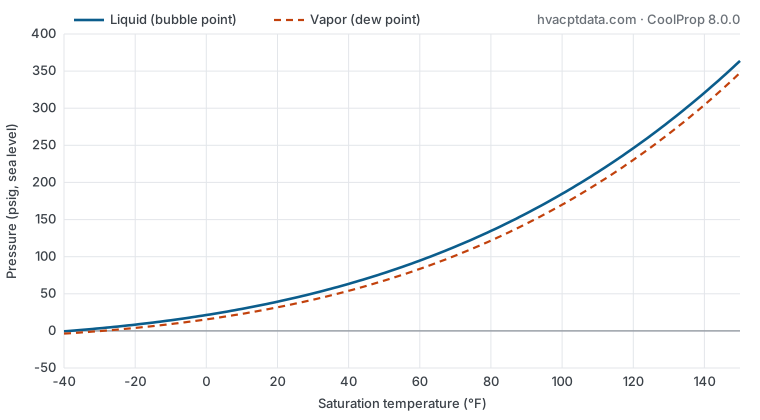
R-417A is an A1 HFC/HC zeotropic blend of R-125, R-134a and R-600 (46.6/50/3.4 % by mass). At 40°F its vapor (dew) pressure is 54.0 psig; at 100°F its liquid (bubble) pressure is 184.6 psig.
Reviewed · PT values computed with CoolProp 8.0.0 and checked against a published chart (largest difference 0.4 psi)
R-417A at a glance
| Safety class (ASHRAE 34) | A1: lower toxicity, no flame propagation |
|---|---|
| Type | HFC/HC, zeotropic blend |
| Composition | R-125 46.6% · R-134a 50% · R-600 3.4% by mass |
| GWP (100-year, AR4) | 2,346 · AR5: 2,127EPA AIM Act exchange value (HFC components, AR4 basis) is 2,346.0 |
| Ozone depletion potential | 0 |
| Lubricant | POE or PVE (BITZER); AB limited |
| Boiling point at 14.7 psia | -38.4°F bubble · -29.3°F dew |
| Critical point | 185.8°F, 565 psia |
| 40°F evaporating | 54.0 psig (dew), glide 7.1°F |
| 100°F condensing | 184.6 psig (bubble), glide 5.2°F |
| Charge as | Liquid only (blend can fractionate as vapor) |
| Typical use | R-22 retrofit in DX air conditioning; R-22 retrofit in medium-temperature refrigeration |
| Trade names | Freon ISCEON MO59 (Chemours) |
| US status | SNAP-acceptable R-22 substitute in residential and light commercial AC (1999, 2010); used to service existing systems, too high in GWP for new AC or refrigeration equipment. |
| Replaces | R-22 |
R-417A PT chart (°F and psig)
R-417A is a blend, so it has two saturation pressures at each temperature. Read the vapor (dew) column against suction pressure for superheat and the liquid (bubble) column against liquid-line pressure for subcooling. Tap a row to load it into the lookup.
-40°F to 150°F · psig at sea level · °C and kPa in the CSV · italic = inches Hg vacuum
| °F | Liquidbubble psig | Vapordew psig |
|---|---|---|
| -40 | 1.2″ | 7.6″ |
| -39 | 0.5″ | 6.9″ |
| -38 | 0.1 | 6.3″ |
| -37 | 0.5 | 5.6″ |
| -36 | 0.9 | 4.9″ |
| -35 | 1.3 | 4.2″ |
| -34 | 1.7 | 3.5″ |
| -33 | 2.2 | 2.8″ |
| -32 | 2.6 | 2.1″ |
| -31 | 3.0 | 1.3″ |
| -30 | 3.5 | 0.5″ |
| -29 | 3.9 | 0.1 |
| -28 | 4.4 | 0.5 |
| -27 | 4.9 | 0.9 |
| -26 | 5.3 | 1.4 |
| -25 | 5.8 | 1.8 |
| -24 | 6.3 | 2.2 |
| -23 | 6.8 | 2.6 |
| -22 | 7.3 | 3.1 |
| -21 | 7.9 | 3.6 |
| -20 | 8.4 | 4.0 |
| -19 | 9.0 | 4.5 |
| -18 | 9.5 | 5.0 |
| -17 | 10.1 | 5.5 |
| -16 | 10.6 | 6.0 |
| -15 | 11.2 | 6.5 |
| -14 | 11.8 | 7.0 |
| -13 | 12.4 | 7.6 |
| -12 | 13.1 | 8.1 |
| -11 | 13.7 | 8.7 |
| -10 | 14.3 | 9.2 |
| -9 | 15.0 | 9.8 |
| -8 | 15.6 | 10.4 |
| -7 | 16.3 | 11.0 |
| -6 | 17.0 | 11.6 |
| -5 | 17.7 | 12.2 |
| -4 | 18.4 | 12.8 |
| -3 | 19.1 | 13.5 |
| -2 | 19.9 | 14.1 |
| -1 | 20.6 | 14.8 |
| 0 | 21.4 | 15.5 |
| 1 | 22.1 | 16.2 |
| 2 | 22.9 | 16.9 |
| 3 | 23.7 | 17.6 |
| 4 | 24.5 | 18.3 |
| 5 | 25.3 | 19.1 |
| 6 | 26.2 | 19.8 |
| 7 | 27.0 | 20.6 |
| 8 | 27.9 | 21.4 |
| 9 | 28.8 | 22.1 |
| 10 | 29.6 | 22.9 |
| 11 | 30.6 | 23.8 |
| 12 | 31.5 | 24.6 |
| 13 | 32.4 | 25.4 |
| 14 | 33.3 | 26.3 |
| 15 | 34.3 | 27.2 |
| 16 | 35.3 | 28.1 |
| 17 | 36.3 | 29.0 |
| 18 | 37.3 | 29.9 |
| 19 | 38.3 | 30.8 |
| 20 | 39.3 | 31.8 |
| 21 | 40.4 | 32.7 |
| 22 | 41.4 | 33.7 |
| 23 | 42.5 | 34.7 |
| 24 | 43.6 | 35.7 |
| 25 | 44.7 | 36.7 |
| 26 | 45.8 | 37.7 |
| 27 | 47.0 | 38.8 |
| 28 | 48.1 | 39.9 |
| 29 | 49.3 | 40.9 |
| 30 | 50.5 | 42.1 |
| 31 | 51.7 | 43.2 |
| 32 | 52.9 | 44.3 |
| 33 | 54.2 | 45.5 |
| 34 | 55.4 | 46.6 |
| 35 | 56.7 | 47.8 |
| 36 | 58.0 | 49.0 |
| 37 | 59.3 | 50.2 |
| 38 | 60.6 | 51.5 |
| 39 | 62.0 | 52.7 |
| 40 | 63.4 | 54.0 |
| 41 | 64.7 | 55.3 |
| 42 | 66.1 | 56.6 |
| 43 | 67.6 | 57.9 |
| 44 | 69.0 | 59.3 |
| 45 | 70.5 | 60.6 |
| 46 | 71.9 | 62.0 |
| 47 | 73.4 | 63.4 |
| 48 | 75.0 | 64.9 |
| 49 | 76.5 | 66.3 |
| 50 | 78.0 | 67.8 |
| 51 | 79.6 | 69.3 |
| 52 | 81.2 | 70.8 |
| 53 | 82.8 | 72.3 |
| 54 | 84.5 | 73.8 |
| 55 | 86.1 | 75.4 |
| 56 | 87.8 | 77.0 |
| 57 | 89.5 | 78.6 |
| 58 | 91.2 | 80.2 |
| 59 | 93.0 | 81.8 |
| 60 | 94.7 | 83.5 |
| 61 | 96.5 | 85.2 |
| 62 | 98.3 | 86.9 |
| 63 | 100.1 | 88.7 |
| 64 | 102.0 | 90.4 |
| 65 | 103.8 | 92.2 |
| 66 | 105.7 | 94.0 |
| 67 | 107.7 | 95.8 |
| 68 | 109.6 | 97.7 |
| 69 | 111.6 | 99.5 |
| 70 | 113.5 | 101.4 |
| 71 | 115.5 | 103.3 |
| 72 | 117.6 | 105.3 |
| 73 | 119.6 | 107.3 |
| 74 | 121.7 | 109.2 |
| 75 | 123.8 | 111.3 |
| 76 | 125.9 | 113.3 |
| 77 | 128.1 | 115.4 |
| 78 | 130.3 | 117.4 |
| 79 | 132.5 | 119.6 |
| 80 | 134.7 | 121.7 |
| 81 | 136.9 | 123.9 |
| 82 | 139.2 | 126.0 |
| 83 | 141.5 | 128.3 |
| 84 | 143.8 | 130.5 |
| 85 | 146.2 | 132.8 |
| 86 | 148.6 | 135.1 |
| 87 | 151.0 | 137.4 |
| 88 | 153.4 | 139.7 |
| 89 | 155.8 | 142.1 |
| 90 | 158.3 | 144.5 |
| 91 | 160.8 | 146.9 |
| 92 | 163.4 | 149.4 |
| 93 | 165.9 | 151.9 |
| 94 | 168.5 | 154.4 |
| 95 | 171.1 | 156.9 |
| 96 | 173.8 | 159.5 |
| 97 | 176.5 | 162.1 |
| 98 | 179.2 | 164.7 |
| 99 | 181.9 | 167.4 |
| 100 | 184.6 | 170.1 |
| 101 | 187.4 | 172.8 |
| 102 | 190.2 | 175.5 |
| 103 | 193.1 | 178.3 |
| 104 | 196.0 | 181.1 |
| 105 | 198.9 | 183.9 |
| 106 | 201.8 | 186.8 |
| 107 | 204.8 | 189.7 |
| 108 | 207.8 | 192.6 |
| 109 | 210.8 | 195.6 |
| 110 | 213.8 | 198.6 |
| 111 | 216.9 | 201.6 |
| 112 | 220.0 | 204.7 |
| 113 | 223.2 | 207.8 |
| 114 | 226.4 | 210.9 |
| 115 | 229.6 | 214.0 |
| 116 | 232.8 | 217.2 |
| 117 | 236.1 | 220.5 |
| 118 | 239.4 | 223.7 |
| 119 | 242.8 | 227.0 |
| 120 | 246.1 | 230.3 |
| 121 | 249.5 | 233.7 |
| 122 | 253.0 | 237.1 |
| 123 | 256.4 | 240.5 |
| 124 | 259.9 | 244.0 |
| 125 | 263.5 | 247.5 |
| 126 | 267.1 | 251.0 |
| 127 | 270.7 | 254.6 |
| 128 | 274.3 | 258.2 |
| 129 | 278.0 | 261.9 |
| 130 | 281.7 | 265.5 |
| 131 | 285.5 | 269.3 |
| 132 | 289.2 | 273.0 |
| 133 | 293.1 | 276.8 |
| 134 | 296.9 | 280.7 |
| 135 | 300.8 | 284.6 |
| 136 | 304.7 | 288.5 |
| 137 | 308.7 | 292.4 |
| 138 | 312.7 | 296.4 |
| 139 | 316.8 | 300.5 |
| 140 | 320.8 | 304.5 |
| 141 | 324.9 | 308.7 |
| 142 | 329.1 | 312.8 |
| 143 | 333.3 | 317.0 |
| 144 | 337.5 | 321.3 |
| 145 | 341.8 | 325.6 |
| 146 | 346.1 | 329.9 |
| 147 | 350.5 | 334.3 |
| 148 | 354.9 | 338.7 |
| 149 | 359.3 | 343.2 |
| 150 | 363.8 | 347.7 |
Where you will find R-417A
R-417A is an R-22 service blend, first listed by EPA as an R-22 substitute in 1999. It went into existing R-22 DX air conditioners and medium-temperature refrigeration as a replacement charge. It was sold by Chemours as Freon ISCEON MO59 (Linde data sheet). You find it in systems that were retrofitted, not in equipment designed for it.
A converted system still has an R-22 nameplate, so look for the retrofit label naming R-417A and the oil. If there is no label and pressures do not fit R-22, treat the charge as unknown and recover it. New cylinders are light green-gray (RAL 7044), so read the label.
The blend is mostly HFC: R-125 and R-134a (46.6% and 50% by mass) plus 3.4% n-butane (R-600). The Linde sheet lists the hydrocarbon as isobutane (R-600a); ASHRAE’s designation is n-butane. Even with butane in it, R-417A as formulated is class A1.
Charging R-417A
Charge liquid only. R-417A is a zeotropic blend; vapor drawn from the cylinder does not match the blend, and the Linde product data calls for liquid charging. Recover all R-22 first and do not mix the two.
R-417A runs at lower pressures than R-22. At 40°F, R-22 saturates at 68.6 psig, while R-417A shows 54.0 psig on the dew column and 63.4 psig on the bubble column, a glide of about 7.1°F. At 100°F, its bubble pressure is 184.6 psig against 195.9 psig for R-22. On an R-22 scale, suction saturation reads several degrees low and superheat reads high, which can tempt you to overcharge. Set your gauges to R-417A or use the gauge lookup on this page.
- Superheat: convert suction pressure with the dew column. Fixed-orifice systems are charged to target superheat from CEC Title 24 Table RA3.2-2 (installer tolerance ±5°F, valid at 55–115°F outdoor, return dry bulb of 70°F or more, return wet bulb of 76°F or less). Use the target superheat calculator.
- Subcooling: convert liquid-line pressure with the bubble column and compare it with the manufacturer’s target on TXV systems, using the subcooling calculator.
The temperature glide calculator shows the glide at any pressure. Charge by weight in small steps and finish to superheat or subcooling. For the starting charge weight, follow the blend supplier’s retrofit instructions.
Oil and compatibility
Do not assume the existing mineral oil can stay. BITZER lists POE or PVE for R-417A, with AB only in limited cases (BITZER). It also warns of oil migration in systems with high oil circulation or large receivers, where mineral oil may not come back to the compressor.
Before a retrofit, check the compressor maker’s approval for R-417A with the oil in the system. Systems with high oil circulation or large receivers are where BITZER’s warning applies. Replace the filter-drier, label the system with the refrigerant and oil, and evacuate to the OEM target, typically 350–500 microns (evacuation guide). See the refrigerant oil guide.
Safety, handling and recovery
R-417A is ASHRAE class A1: lower toxicity and no flame propagation as formulated. Its pressures are below R-22’s, so R-22-rated gauges, hoses and recovery cylinders are suitable.
Section 608 Type II (or Universal) certification covers R-417A systems, and only certified technicians may buy it. It is not on the list of venting-exempt substitutes. By the 40 CFR 82.152 definition it is a high-pressure refrigerant: its computed liquid saturation pressure at 104°F is 210.7 psia (196.0 psig, bubble). Recover appliances under 200 lb to 0 in Hg, and those of 200 lb or more to 10 in Hg.
Recover R-417A into its own labeled recovery cylinder (gray with a yellow top), never into one holding R-22 or another blend. Commercial refrigeration with 15 lb or more is subject to the HFC leak-repair rule (40 CFR 84.106) from Jan 1 2026; residential and light commercial AC and heat pumps are not.
Status and replacements
EPA’s SNAP program lists R-417A as an acceptable R-22 substitute in residential and light commercial AC, with listings dated Dec 6 1999 and June 16 2010 (EPA SNAP). Servicing and retrofitting existing systems with it remains legal.
Its GWP of 2,346 (AR4) is above the Technology Transitions limits for new AC, heat pumps and commercial refrigeration (40 CFR 84.54). R-417A is also named as restricted in new road and marine transport refrigeration from Jan 1 2025, and in large ice machines and food processing and dispensing equipment from 2027. Its HFC content counts against the AIM Act phasedown: 60% of baseline in 2024–2028, 30% in 2029–2033, 20% in 2034–2035 and 15% from 2036.
Other R-22 retrofit options are R-422D, R-438A, R-422B, R-427A, R-421A and R-407C. Compare them in R-22 replacement refrigerants or replace the system; see the R-22 phase-out guide.
Common questions
What oil does R-417A use?
BITZER lists POE or PVE, with AB only in limited cases, and warns about oil return in systems with high oil circulation or large receivers. Confirm with the compressor maker before keeping mineral oil.
R-417A vs R-22: what changes?
R-417A runs at lower pressures than R-22, has about 7°F of glide at evaporator conditions and must be charged as liquid. Read it on an R-417A scale, never an R-22 scale.
How this chart was computed
Every pressure on this page is calculated, not copied: CoolProp 8.0.0 (HEOS backend), the open-source implementation of the reference equations of state, using the model mix:R417A at the nominal ASHRAE 34 composition. Gauge values assume sea-level air pressure (14.696 psia); kPa values in the CSV are absolute.
Spot check against Thermodynamic Properties of Freon MO59 (R-417A), Eng Units, C-11111 (2/17):
| °F | Column | Published | This chart | Difference |
|---|---|---|---|---|
| 0 | bubble | 36.1 psia | 36.1 psia | -0.0 psi |
| 0 | dew | 30.3 psia | 30.2 psia | -0.1 psi |
| 40 | bubble | 78.1 psia | 78.1 psia | -0.1 psi |
| 40 | dew | 68.9 psia | 68.7 psia | -0.2 psi |
| 100 | bubble | 199.5 psia | 199.3 psia | -0.2 psi |
| 100 | dew | 185.2 psia | 184.8 psia | -0.4 psi |
Charts from different publishers can differ by a few tenths of a psi because of the equation of state and blend tolerances. Always charge to the equipment manufacturer's data. Full method and every spot check
Calculators for R-417A
Sources
- Linde: R-417A Freon ISCEON MO59 product data static.prd.echannel.linde.com
- BITZER: R-22 service blends (R-417A, R-422D) bitzer.de
- BITZER Refrigerant Report (A-500/501) refrigerant data table bitzer.de
- ASHRAE Refrigerant Designations ashrae.org
- EPA SNAP: Substitutes in residential and light commercial AC and heat pumps epa.gov
- 40 CFR 84.54 - Technology Transitions restrictions by sector ecfr.gov
- 40 CFR 82.152 - Section 608 definitions and pressure classes ecfr.gov
Reviewed . Found an error? Tell us and we will correct it.
More in R-22 service blends