R-12 vs R-134a
Reviewed · pressures computed with CoolProp 8.0 from the same data as the PT charts
Can you put R-134a in an R-12 system?
It depends. Only as a full retrofit, never added to the R-12. EPA names R-134a as the main retrofit refrigerant for R-12 vehicle A/C. Chemours says it is not a drop-in: the mineral oil, desiccant and service fittings have to change, and R-134a runs higher on the high side.
Pressures side by side
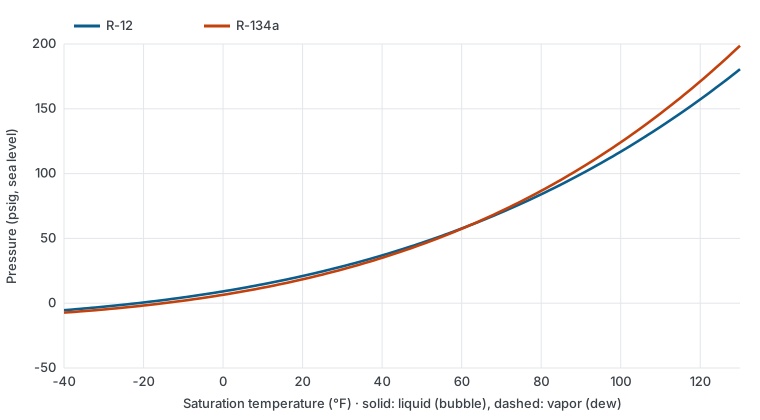
Saturation pressure in psig at sea level. Evaporating rows use the vapor (dew) value, condensing rows the liquid (bubble) value, which is what you compare with suction and liquid-line gauges. The last column is R-134a minus R-12.
| Saturation | R-12 | R-134a | Difference |
|---|---|---|---|
| Evaporator (vapor, dew) | |||
| -20°F | 0.6 | 3.7″ Hg | -2.3 |
| 0°F | 9.1 | 6.5 | -2.6 (-29%) |
| 20°F | 21.0 | 18.4 | -2.6 (-12%) |
| 30°F | 28.4 | 26.1 | -2.3 (-8%) |
| 35°F | 32.5 | 30.4 | -2.1 (-6%) |
| 40°F | 36.9 | 35.1 | -1.8 (-5%) |
| 45°F | 41.6 | 40.1 | -1.5 (-4%) |
| 50°F | 46.6 | 45.4 | -1.2 (-3%) |
| Condenser (liquid, bubble) | |||
| 80°F | 84.0 | 86.7 | +2.7 (+3%) |
| 90°F | 99.6 | 104.3 | +4.7 (+5%) |
| 95°F | 108.0 | 114.0 | +5.9 (+5%) |
| 100°F | 116.9 | 124.2 | +7.2 (+6%) |
| 105°F | 126.3 | 135.0 | +8.7 (+7%) |
| 110°F | 136.1 | 146.4 | +10.3 (+8%) |
| 115°F | 146.4 | 158.4 | +12.0 (+8%) |
| 120°F | 157.3 | 171.2 | +13.9 (+9%) |
| 125°F | 168.6 | 184.6 | +15.9 (+9%) |
| 130°F | 180.5 | 198.7 | +18.2 (+10%) |
Properties
| Property | R-12 | R-134a |
|---|---|---|
| Safety class | A1 | A1 |
| Type | CFC, single-component refrigerant | HFC, single-component refrigerant |
| Composition (mass %) | Single component | Single component |
| GWP (AR4) | 10,900 | 1,430 |
| Lubricant | Mineral oil (alkylbenzene as alternate) | PAG (automotive), POE (stationary) |
| Boiling point (14.7 psia) | -21.5°F | -14.9°F |
| Critical point | 233.5°F, 600 psia | 213.9°F, 589 psia |
| Glide at 40°F evaporating | 0.0°F | 0.0°F |
| Glide at 100°F condensing | 0.0°F | 0.0°F |
| US status | Class I CFC; US production and import banned since Jan 1 1996, so servicing uses only recovered, recycled, reclaimed or pre-1996 stock. | AIM Act HFC; banned in most new equipment types from 2025 (light-duty vehicles from model year 2025), but servicing existing systems remains legal. |
Component compatibility
| Item | R-12 | R-134a |
|---|---|---|
| Lubricant | Mineral oil (AB alternate) | PAG (vehicle A/C), POE (stationary) |
| Vehicle low-side port | 7/16 in-20 thread (1/4 in flare) | SAE quick-connect |
| Vehicle high-side port | 3/8 in-24 thread | SAE quick-connect |
| Cylinder outlet | 7/16 in-20 (1/4 in flare) | 1/2 in ACME |
| Drier desiccant | R-12 type | Desiccant compatible with R-134a |
| Section 608 class | Medium-pressure (Type I if small appliance) | Medium-pressure (Type I if small appliance) |
| Cylinder | Legacy white | RAL 7044 gray (legacy light blue) |
| Supply | Recovered, recycled, reclaimed or pre-1996 stock | In production under AIM Act allowances |
What changes in the field
On the low side the two read almost the same. From the PT data, at 40°F evaporating R-12 is 36.9 psig and R-134a is 35.1 psig. The gap opens on the high side. At 100°F condensing R-134a is 7.2 psi higher (124.2 vs 116.9 psig), and at 130°F it is 18.2 psi higher (198.7 vs 180.5 psig). Both are single-component, so there is no glide and one PT column.
Chemours explains how new R-134a vehicle systems handled this. Their condensers or condenser airflow were enlarged, and discharge pressure ended up the same as R-12 or up to 10% higher. An old R-12 condenser was never sized for that, which is why retrofitted systems often run hotter heads.
Oil is the main hardware change. Chemours says “CFC-12 systems use mineral oils,” and mineral oil does not mix well enough with R-134a to circulate. That leads to poor oil return and early compressor failure. R-134a vehicle systems use PAG, with almost all vehicle makers choosing PAG in about the 60–135 cSt range. Stationary R-134a equipment uses POE. Copeland lists mineral oil as preferred for R-12, with AB as an alternate. The refrigerant oil types guide covers the families.
Vehicle service fittings are deliberately different to prevent cross-contamination. R-12 uses threaded ports: 7/16 in-20 (“1/4 in flare”) low side and 3/8 in-24 high side. R-134a uses SAE quick-connect couplers, and its cylinders use a 1/2 in ACME outlet. Chemours also notes R-134a needs a different desiccant and that low-permeation (nylon barrier) hoses were adopted.
Retrofit or replacement
Never add R-134a to an R-12 system. Chemours says the two form a high-pressure azeotrope: the mix runs at a higher pressure than either refrigerant alone. A recovery or recycle machine can’t separate the mix, and it usually has to be incinerated. EPA requires unique fittings, labels and recovery/recycle equipment for each vehicle A/C refrigerant.
A vehicle conversion in outline:
- Recover all R-12 with R-12 recovery equipment. Chemours cites SAE: 2% residual R-12 should not cause problems, but residual should be kept as low as possible.
- Replace the drier or accumulator with an R-134a-compatible desiccant, and replace the oil with the lubricant the compressor or retrofit kit maker specifies.
- Fit R-134a service ports and a retrofit label, evacuate and charge.
Chemours says vehicle and component makers “are the best source of retrofit information.” Follow their procedure for the specific vehicle.
For stationary R-12 equipment, change the mineral oil to the POE the compressor maker approves. Service blends such as R-401A and R-409A are alternatives, and R-513A is also used as an R-12 alternative with similar pressures. Stationary R-12 and R-134a are medium-pressure refrigerants for Section 608. Recovery is to 10 in Hg under 200 lb and 15 in Hg at 200 lb or more. Small appliances need 90% recovery with the compressor running, 80% without, or 4 in Hg.
Capacity, efficiency and cost
Chemours calls R-134a “not a ‘drop-in’ replacement” for vehicle A/C and says OEM design changes were needed for acceptable cooling. None of the sources here gives a capacity percentage for a retrofitted R-12 system. Expect results to depend on condenser size and airflow.
R-12 is a Class I CFC. US production and import ended Jan 1 1996 (40 CFR 82.4), and service now relies on recovered, recycled, reclaimed or pre-1996 stock. R-134a (GWP 1,430) is itself being phased out of new vehicles. Under 40 CFR 84.54, new light-duty vehicles from model year 2025 must use refrigerant with GWP below 150. Most now use R-1234yf. See also R-134a replacement.
Common questions
Which is colder, R-12 or R-134a?
Neither refrigerant is “colder.” Both can evaporate at the same temperature, and R-12 reads 1.8 psi higher than R-134a at 40°F. Cooling performance depends on whether the system was designed for the refrigerant.
What oil do you use when converting R-12 to R-134a?
In vehicles, use the PAG the compressor or retrofit maker specifies. Chemours notes that OEMs each recommend specific lubricants. In stationary equipment, use the POE approved by the compressor maker. Mineral oil does not suit R-134a in either case.
PT charts and calculators
Sources
- Chemours: Freon 134a for Mobile Air Conditioning (C-11172) freon.com
- EPA: MVAC acceptable refrigerants and their impacts epa.gov
- 40 CFR 82.4: Class I production and import prohibitions ecfr.gov
- 40 CFR 82.152: Section 608 definitions (pressure classes) ecfr.gov
- 40 CFR 84.54: Technology Transitions restrictions by sector ecfr.gov
- Copeland AE Bulletin 93-11: Refrigerants and Lubricants Approved for Use in Copeland Compressors webapps.copeland.com
Reviewed . Found an error? Tell us and we will correct it.