R-401A PT Chart and Refrigerant Profile
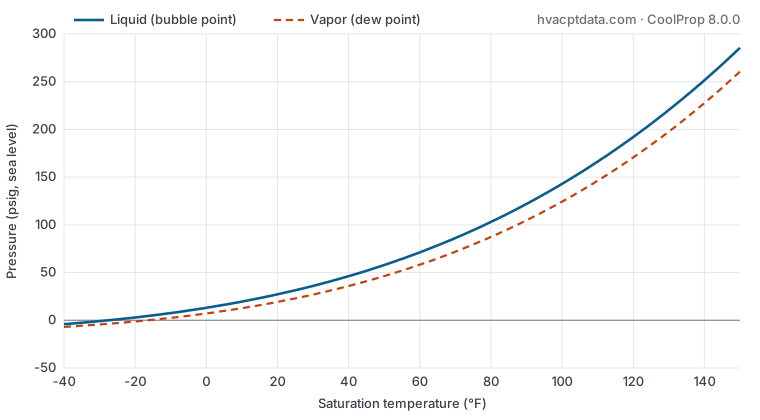
R-401A is an A1 HCFC blend zeotropic blend of R-22, R-152a and R-124 (53/13/34 % by mass). At 40°F its vapor (dew) pressure is 35.9 psig; at 100°F its liquid (bubble) pressure is 143.0 psig.
Reviewed · PT values computed with CoolProp 8.0.0 and checked against a published chart (largest difference 1.4 psi)
R-401A at a glance
| Safety class (ASHRAE 34) | A1: lower toxicity, no flame propagation |
|---|---|
| Type | HCFC blend, zeotropic blend |
| Composition | R-22 53% · R-152a 13% · R-124 34% by mass |
| GWP (100-year, AR4) | 1,182 · AR5: 1,130Counts all three components. EPA's 40 CFR 84.64 value is about 16 because only the HFC-152a share is counted. |
| Ozone depletion potential | 0.037 |
| Lubricant | Mineral oil or alkylbenzene (AB) |
| Boiling point at 14.7 psia | -27.5°F bubble · -16.4°F dew |
| Critical point | 227.1°F, 675 psia |
| 40°F evaporating | 35.9 psig (dew), glide 10.1°F |
| 100°F condensing | 143.0 psig (bubble), glide 8.6°F |
| Charge as | Liquid only (blend can fractionate as vapor) |
| Typical use | R-12 retrofit service in walk-ins, vending, display cases and domestic refrigeration |
| Trade names | MP39 (Suva MP39, now Chemours) |
| US status | HCFC service blend; no new HCFC-22 has been produced or imported since 2020 and HCFC-124 phases out by 2030, so supply is recovered or remaining stock. |
| Replaces | R-12 |
| Replaced by | R-134a, R-513A |
R-401A PT chart (°F and psig)
R-401A is a blend, so it has two saturation pressures at each temperature. Read the vapor (dew) column against suction pressure for superheat and the liquid (bubble) column against liquid-line pressure for subcooling. Tap a row to load it into the lookup.
-40°F to 150°F · psig at sea level · °C and kPa in the CSV · italic = inches Hg vacuum
| °F | Liquidbubble psig | Vapordew psig |
|---|---|---|
| -40 | 8.2″ | 14.0″ |
| -39 | 7.6″ | 13.6″ |
| -38 | 7.0″ | 13.1″ |
| -37 | 6.4″ | 12.6″ |
| -36 | 5.8″ | 12.1″ |
| -35 | 5.2″ | 11.6″ |
| -34 | 4.5″ | 11.1″ |
| -33 | 3.8″ | 10.6″ |
| -32 | 3.2″ | 10.0″ |
| -31 | 2.5″ | 9.5″ |
| -30 | 1.8″ | 8.9″ |
| -29 | 1.1″ | 8.3″ |
| -28 | 0.3″ | 7.8″ |
| -27 | 0.2 | 7.2″ |
| -26 | 0.6 | 6.5″ |
| -25 | 0.9 | 5.9″ |
| -24 | 1.3 | 5.3″ |
| -23 | 1.7 | 4.6″ |
| -22 | 2.1 | 3.9″ |
| -21 | 2.5 | 3.3″ |
| -20 | 3.0 | 2.6″ |
| -19 | 3.4 | 1.9″ |
| -18 | 3.8 | 1.1″ |
| -17 | 4.3 | 0.4″ |
| -16 | 4.7 | 0.2 |
| -15 | 5.2 | 0.6 |
| -14 | 5.6 | 0.9 |
| -13 | 6.1 | 1.3 |
| -12 | 6.6 | 1.7 |
| -11 | 7.1 | 2.1 |
| -10 | 7.6 | 2.6 |
| -9 | 8.1 | 3.0 |
| -8 | 8.6 | 3.4 |
| -7 | 9.1 | 3.8 |
| -6 | 9.7 | 4.3 |
| -5 | 10.2 | 4.8 |
| -4 | 10.8 | 5.2 |
| -3 | 11.3 | 5.7 |
| -2 | 11.9 | 6.2 |
| -1 | 12.5 | 6.7 |
| 0 | 13.1 | 7.2 |
| 1 | 13.7 | 7.7 |
| 2 | 14.3 | 8.2 |
| 3 | 14.9 | 8.7 |
| 4 | 15.6 | 9.3 |
| 5 | 16.2 | 9.8 |
| 6 | 16.9 | 10.4 |
| 7 | 17.5 | 10.9 |
| 8 | 18.2 | 11.5 |
| 9 | 18.9 | 12.1 |
| 10 | 19.6 | 12.7 |
| 11 | 20.3 | 13.3 |
| 12 | 21.0 | 13.9 |
| 13 | 21.7 | 14.6 |
| 14 | 22.5 | 15.2 |
| 15 | 23.2 | 15.8 |
| 16 | 24.0 | 16.5 |
| 17 | 24.8 | 17.2 |
| 18 | 25.6 | 17.9 |
| 19 | 26.4 | 18.6 |
| 20 | 27.2 | 19.3 |
| 21 | 28.0 | 20.0 |
| 22 | 28.9 | 20.7 |
| 23 | 29.7 | 21.4 |
| 24 | 30.6 | 22.2 |
| 25 | 31.5 | 23.0 |
| 26 | 32.4 | 23.7 |
| 27 | 33.3 | 24.5 |
| 28 | 34.2 | 25.3 |
| 29 | 35.1 | 26.1 |
| 30 | 36.0 | 27.0 |
| 31 | 37.0 | 27.8 |
| 32 | 38.0 | 28.7 |
| 33 | 39.0 | 29.5 |
| 34 | 40.0 | 30.4 |
| 35 | 41.0 | 31.3 |
| 36 | 42.0 | 32.2 |
| 37 | 43.0 | 33.1 |
| 38 | 44.1 | 34.0 |
| 39 | 45.2 | 35.0 |
| 40 | 46.2 | 35.9 |
| 41 | 47.3 | 36.9 |
| 42 | 48.5 | 37.9 |
| 43 | 49.6 | 38.9 |
| 44 | 50.7 | 39.9 |
| 45 | 51.9 | 41.0 |
| 46 | 53.1 | 42.0 |
| 47 | 54.2 | 43.1 |
| 48 | 55.5 | 44.1 |
| 49 | 56.7 | 45.2 |
| 50 | 57.9 | 46.3 |
| 51 | 59.2 | 47.5 |
| 52 | 60.4 | 48.6 |
| 53 | 61.7 | 49.8 |
| 54 | 63.0 | 50.9 |
| 55 | 64.3 | 52.1 |
| 56 | 65.7 | 53.3 |
| 57 | 67.0 | 54.5 |
| 58 | 68.4 | 55.8 |
| 59 | 69.8 | 57.0 |
| 60 | 71.2 | 58.3 |
| 61 | 72.6 | 59.6 |
| 62 | 74.0 | 60.9 |
| 63 | 75.5 | 62.2 |
| 64 | 77.0 | 63.5 |
| 65 | 78.5 | 64.9 |
| 66 | 80.0 | 66.2 |
| 67 | 81.5 | 67.6 |
| 68 | 83.0 | 69.0 |
| 69 | 84.6 | 70.5 |
| 70 | 86.2 | 71.9 |
| 71 | 87.8 | 73.4 |
| 72 | 89.4 | 74.8 |
| 73 | 91.1 | 76.3 |
| 74 | 92.7 | 77.9 |
| 75 | 94.4 | 79.4 |
| 76 | 96.1 | 80.9 |
| 77 | 97.8 | 82.5 |
| 78 | 99.5 | 84.1 |
| 79 | 101.3 | 85.7 |
| 80 | 103.1 | 87.4 |
| 81 | 104.9 | 89.0 |
| 82 | 106.7 | 90.7 |
| 83 | 108.5 | 92.4 |
| 84 | 110.4 | 94.1 |
| 85 | 112.2 | 95.8 |
| 86 | 114.1 | 97.6 |
| 87 | 116.1 | 99.3 |
| 88 | 118.0 | 101.1 |
| 89 | 120.0 | 103.0 |
| 90 | 122.0 | 104.8 |
| 91 | 124.0 | 106.7 |
| 92 | 126.0 | 108.5 |
| 93 | 128.0 | 110.4 |
| 94 | 130.1 | 112.4 |
| 95 | 132.2 | 114.3 |
| 96 | 134.3 | 116.3 |
| 97 | 136.4 | 118.3 |
| 98 | 138.6 | 120.3 |
| 99 | 140.8 | 122.3 |
| 100 | 143.0 | 124.4 |
| 101 | 145.2 | 126.5 |
| 102 | 147.5 | 128.6 |
| 103 | 149.7 | 130.7 |
| 104 | 152.0 | 132.9 |
| 105 | 154.3 | 135.0 |
| 106 | 156.7 | 137.2 |
| 107 | 159.1 | 139.5 |
| 108 | 161.4 | 141.7 |
| 109 | 163.9 | 144.0 |
| 110 | 166.3 | 146.3 |
| 111 | 168.8 | 148.6 |
| 112 | 171.3 | 151.0 |
| 113 | 173.8 | 153.3 |
| 114 | 176.3 | 155.7 |
| 115 | 178.9 | 158.2 |
| 116 | 181.5 | 160.6 |
| 117 | 184.1 | 163.1 |
| 118 | 186.7 | 165.6 |
| 119 | 189.4 | 168.1 |
| 120 | 192.1 | 170.7 |
| 121 | 194.8 | 173.3 |
| 122 | 197.5 | 175.9 |
| 123 | 200.3 | 178.5 |
| 124 | 203.1 | 181.2 |
| 125 | 205.9 | 183.9 |
| 126 | 208.8 | 186.6 |
| 127 | 211.6 | 189.3 |
| 128 | 214.5 | 192.1 |
| 129 | 217.5 | 194.9 |
| 130 | 220.4 | 197.7 |
| 131 | 223.4 | 200.6 |
| 132 | 226.4 | 203.5 |
| 133 | 229.5 | 206.4 |
| 134 | 232.5 | 209.3 |
| 135 | 235.6 | 212.3 |
| 136 | 238.7 | 215.3 |
| 137 | 241.9 | 218.4 |
| 138 | 245.1 | 221.4 |
| 139 | 248.3 | 224.5 |
| 140 | 251.5 | 227.6 |
| 141 | 254.8 | 230.8 |
| 142 | 258.1 | 234.0 |
| 143 | 261.4 | 237.2 |
| 144 | 264.8 | 240.5 |
| 145 | 268.2 | 243.7 |
| 146 | 271.6 | 247.0 |
| 147 | 275.0 | 250.4 |
| 148 | 278.5 | 253.8 |
| 149 | 282.0 | 257.2 |
| 150 | 285.5 | 260.6 |
Where you will find R-401A
R-401A, best known as MP39, is a service blend made to keep R-12 equipment running after CFC production ended. It is a three-part HCFC/HFC blend of R-22, R-152a and R-124. Expect it in older walk-in coolers, vending machines, reach-in display cases and domestic refrigerators that were converted from R-12. EPA’s SNAP program listed it as an acceptable R-12 substitute in household refrigerators and freezers on Jan 13 1995.
The giveaway is a retrofit tag or marker showing R-401A or MP39 on a system whose compressor and nameplate say R-12. The legacy cylinder color was coral. Cylinders made since 2020 are light green-gray, so read the label. If the tag is missing and the pressures do not match R-12, identify the refrigerant before adding anything.
Charging R-401A
R-401A is a zeotropic blend with a large glide. The computed glide at 40°F evaporating is 10.1°F, and it is not constant: it changes with pressure. Two rules follow.
First, charge it as liquid only. Vapor drawn off the top of the cylinder is richer in the lighter components, so a vapor charge changes the blend in the system and in the cylinder. Meter the liquid in so it flashes before reaching the compressor.
Second, use the right PT column. For superheat, read suction pressure against the dew (vapor) column. For subcooling, read liquid-line pressure against the bubble (liquid) column. Reading the bubble column on the suction side makes superheat look higher than it is, which is how blend systems end up overcharged. The PT chart guide and the temperature glide calculator show the bubble/dew gap at any pressure.
On cap-tube and fixed-restriction systems, charge to the equipment maker’s or the retrofit procedure’s guidance. Where a TXV is fitted, charge by subcooling to the manufacturer’s target with the subcooling calculator.
Compared with the R-12 it replaced, the low side reads close but the high side runs higher. On this site’s tables, R-401A reads 35.9 psig at a 40°F dew point against 36.9 psig for R-12 at 40°F. At a 100°F bubble point R-401A reads 143.0 psig against 116.9 psig for R-12. Do not charge an R-401A system to R-12 head pressures.
Oil and compatibility
BITZER lists mineral oil and alkylbenzene for R-401A, the same oil family R-12 systems used. Use the lubricant the compressor manufacturer approves for the blend.
Do not top off an R-401A system with R-12, R-134a or another blend. A mixture matches no PT chart, so the charge can no longer be checked.
Moving the system to an HFC changes the oil. R-134a mixes poorly with mineral oil and AB, and Chemours calls for an oil change to POE when converting from HCFC service blends such as R-401A to R-513A. The refrigerant oil types guide covers the differences.
Safety, handling and recovery
R-401A is ASHRAE class A1: lower toxicity, no flame propagation. Its R-152a content is flammable on its own, but the blend as formulated is classified A1.
It is an ozone-depleting refrigerant. Knowingly venting it is prohibited, recovery is required, and sales are restricted to certified technicians. It is a medium-pressure refrigerant under 40 CFR 82.152. Domestic refrigerators and other factory-sealed units of 5 lb or less need Type I certification; other equipment needs Type II; Universal covers both.
Required recovery levels for equipment made on or after Nov 15 1993:
| Appliance | Recovery level |
|---|---|
| Small appliance | 90% recovered (compressor running), 80% (not running), or 4 in Hg |
| Medium-pressure, under 200 lb | 10 in Hg |
| Medium-pressure, 200 lb or more | 15 in Hg |
Appliances holding 50 lb or more are subject to the leak-repair rules in 40 CFR 82.157. Recovered R-401A cannot be sold to a new owner unless an EPA-certified reclaimer has reclaimed it (40 CFR 82.154(d)).
Status and replacements
R-401A contains two Class II HCFCs. HCFC-22 production and import allowances went to zero on Jan 1 2020. HCFC-124 allowances decline to zero in 2030 (40 CFR 82.16), and since Jan 1 2020 newly produced HCFC-124 may be used only to service equipment manufactured before that date (40 CFR 82.15(g)(5)). EPA has not published a statement about R-401A as such. Read together, those rules mean virgin supply is limited and shrinking, and recovered or reclaimed stock is what remains.
Its HFC-152a share also makes it, on paper, a blend containing an AIM Act regulated substance. EPA’s 40 CFR 84.64 GWP for it is about 16, because HCFCs carry no value under that section.
When a repair is not worth it, the usual paths lead away from HCFCs entirely:
- R-134a, with an oil change; EPA names it the primary retrofit refrigerant for R-12 vehicle systems. See R-12 vs R-134a.
- R-513A, with an oil change to POE per Chemours’ retrofit guidelines.
Compare the options in the R-134a replacement guide, and check the compressor maker’s approval before choosing.
How this chart was computed
Every pressure on this page is calculated, not copied: CoolProp 8.0.0 (HEOS backend), the open-source implementation of the reference equations of state, using the model custom:R22&R152A&R124:0.53,0.13,0.34 at the nominal ASHRAE 34 composition. Gauge values assume sea-level air pressure (14.696 psia); kPa values in the CSV are absolute.
Spot check against Forane Refrigerants Pressure Temperature Chart (Arkema, 2020):
| °F | Column | Published | This chart | Difference |
|---|---|---|---|---|
| 0 | bubble | 13.0 psig | 13.1 psig | +0.1 psi |
| 0 | dew | 7.40 psig | 7.16 psig | -0.2 psi |
| 40 | bubble | 46.2 psig | 46.2 psig | +0.0 psi |
| 40 | dew | 36.5 psig | 35.9 psig | -0.6 psi |
| 100 | bubble | 143.3 psig | 143.0 psig | -0.3 psi |
| 100 | dew | 125.8 psig | 124.4 psig | -1.4 psi |
Custom model (CoolProp cannot load R401A.mix). Max deviation 1.42 psi at 100 °F dew (1.0% of absolute pressure); NRI's chart for the same point (128 psig) differs from Arkema by 2.2 psi, so published sources disagree by more than the model does. Treated as ok.
Charts from different publishers can differ by a few tenths of a psi because of the equation of state and blend tolerances. Always charge to the equipment manufacturer's data. Full method and every spot check
Calculators for R-401A
Sources
- ASHRAE refrigerant designations (Standard 34) ashrae.org
- EPA SNAP: Substitutes in household refrigerators and freezers epa.gov
- eCFR 40 CFR 82.15: Class II (HCFC) prohibitions ecfr.gov
- eCFR 40 CFR 82.16: HCFC allowance phaseout schedule ecfr.gov
- eCFR 40 CFR 82 Subpart A Appendix B: Class II controlled substances (ODP) ecfr.gov
- BITZER Refrigerant Report (A-500/501) refrigerant data table bitzer.de
- Chemours Opteon XP10 retrofit guidelines chemours.com
- eCFR 40 CFR 82.154: Venting prohibition and sales restriction ecfr.gov
Reviewed . Found an error? Tell us and we will correct it.