R-12 PT Chart and Refrigerant Profile
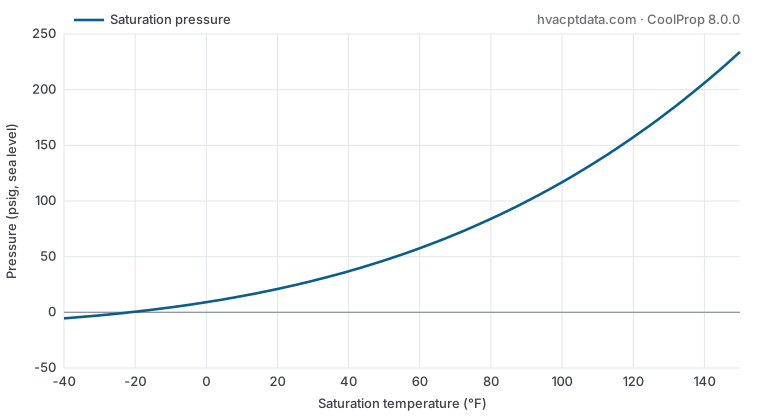
R-12 is an A1 CFC single-component refrigerant. It saturates at 36.9 psig at 40°F and 116.9 psig at 100°F.
Reviewed · PT values computed with CoolProp 8.0.0 and checked against NIST reference data (largest difference 0.1 psi)
R-12 at a glance
| Safety class (ASHRAE 34) | A1: lower toxicity, no flame propagation |
|---|---|
| Type | CFC, single-component refrigerant |
| GWP (100-year, AR4) | 10,900 · AR5: 10,200CFC, not an AIM Act regulated substance; regulated as a Class I ozone-depleting substance. |
| Ozone depletion potential | 1 |
| Lubricant | Mineral oil (alkylbenzene as alternate) |
| Boiling point at 14.7 psia | -21.5°F |
| Critical point | 233.5°F, 600 psia |
| 40°F evaporating | 36.9 psig |
| 100°F condensing | 116.9 psig |
| Charge as | Vapor or liquid |
| Typical use | Legacy automotive A/C (vehicles before the switch to R-134a, completed by model year 1995); Legacy domestic and commercial refrigeration |
| US status | Class I CFC; US production and import banned since Jan 1 1996, so servicing uses only recovered, recycled, reclaimed or pre-1996 stock. |
| Replaced by | R-134a, R-401A, R-409A, R-513A |
R-12 PT chart (°F and psig)
R-12 is a single-component refrigerant, so one pressure applies at each temperature for both the evaporator and the condenser. Tap a row to load it into the lookup.
-40°F to 150°F · psig at sea level · °C and kPa in the CSV · italic = inches Hg vacuum
| °F | psig |
|---|---|
| -40 | 11.0″ |
| -39 | 10.5″ |
| -38 | 10.0″ |
| -37 | 9.5″ |
| -36 | 8.9″ |
| -35 | 8.4″ |
| -34 | 7.8″ |
| -33 | 7.3″ |
| -32 | 6.7″ |
| -31 | 6.1″ |
| -30 | 5.5″ |
| -29 | 4.9″ |
| -28 | 4.3″ |
| -27 | 3.7″ |
| -26 | 3.0″ |
| -25 | 2.4″ |
| -24 | 1.7″ |
| -23 | 1.0″ |
| -22 | 0.3″ |
| -21 | 0.2 |
| -20 | 0.6 |
| -19 | 0.9 |
| -18 | 1.3 |
| -17 | 1.7 |
| -16 | 2.0 |
| -15 | 2.4 |
| -14 | 2.8 |
| -13 | 3.2 |
| -12 | 3.6 |
| -11 | 4.0 |
| -10 | 4.5 |
| -9 | 4.9 |
| -8 | 5.3 |
| -7 | 5.8 |
| -6 | 6.2 |
| -5 | 6.7 |
| -4 | 7.2 |
| -3 | 7.6 |
| -2 | 8.1 |
| -1 | 8.6 |
| 0 | 9.1 |
| 1 | 9.6 |
| 2 | 10.1 |
| 3 | 10.7 |
| 4 | 11.2 |
| 5 | 11.8 |
| 6 | 12.3 |
| 7 | 12.9 |
| 8 | 13.4 |
| 9 | 14.0 |
| 10 | 14.6 |
| 11 | 15.2 |
| 12 | 15.8 |
| 13 | 16.4 |
| 14 | 17.0 |
| 15 | 17.7 |
| 16 | 18.3 |
| 17 | 19.0 |
| 18 | 19.6 |
| 19 | 20.3 |
| 20 | 21.0 |
| 21 | 21.7 |
| 22 | 22.4 |
| 23 | 23.1 |
| 24 | 23.8 |
| 25 | 24.6 |
| 26 | 25.3 |
| 27 | 26.1 |
| 28 | 26.8 |
| 29 | 27.6 |
| 30 | 28.4 |
| 31 | 29.2 |
| 32 | 30.0 |
| 33 | 30.8 |
| 34 | 31.7 |
| 35 | 32.5 |
| 36 | 33.4 |
| 37 | 34.2 |
| 38 | 35.1 |
| 39 | 36.0 |
| 40 | 36.9 |
| 41 | 37.8 |
| 42 | 38.7 |
| 43 | 39.7 |
| 44 | 40.6 |
| 45 | 41.6 |
| 46 | 42.6 |
| 47 | 43.6 |
| 48 | 44.6 |
| 49 | 45.6 |
| 50 | 46.6 |
| 51 | 47.7 |
| 52 | 48.7 |
| 53 | 49.8 |
| 54 | 50.9 |
| 55 | 52.0 |
| 56 | 53.1 |
| 57 | 54.2 |
| 58 | 55.3 |
| 59 | 56.5 |
| 60 | 57.6 |
| 61 | 58.8 |
| 62 | 60.0 |
| 63 | 61.2 |
| 64 | 62.4 |
| 65 | 63.7 |
| 66 | 64.9 |
| 67 | 66.2 |
| 68 | 67.5 |
| 69 | 68.8 |
| 70 | 70.1 |
| 71 | 71.4 |
| 72 | 72.7 |
| 73 | 74.1 |
| 74 | 75.5 |
| 75 | 76.8 |
| 76 | 78.2 |
| 77 | 79.7 |
| 78 | 81.1 |
| 79 | 82.6 |
| 80 | 84.0 |
| 81 | 85.5 |
| 82 | 87.0 |
| 83 | 88.5 |
| 84 | 90.1 |
| 85 | 91.6 |
| 86 | 93.2 |
| 87 | 94.7 |
| 88 | 96.4 |
| 89 | 98.0 |
| 90 | 99.6 |
| 91 | 101.3 |
| 92 | 102.9 |
| 93 | 104.6 |
| 94 | 106.3 |
| 95 | 108.0 |
| 96 | 109.8 |
| 97 | 111.5 |
| 98 | 113.3 |
| 99 | 115.1 |
| 100 | 116.9 |
| 101 | 118.8 |
| 102 | 120.6 |
| 103 | 122.5 |
| 104 | 124.4 |
| 105 | 126.3 |
| 106 | 128.2 |
| 107 | 130.2 |
| 108 | 132.1 |
| 109 | 134.1 |
| 110 | 136.1 |
| 111 | 138.1 |
| 112 | 140.2 |
| 113 | 142.3 |
| 114 | 144.3 |
| 115 | 146.4 |
| 116 | 148.6 |
| 117 | 150.7 |
| 118 | 152.9 |
| 119 | 155.1 |
| 120 | 157.3 |
| 121 | 159.5 |
| 122 | 161.8 |
| 123 | 164.0 |
| 124 | 166.3 |
| 125 | 168.6 |
| 126 | 171.0 |
| 127 | 173.3 |
| 128 | 175.7 |
| 129 | 178.1 |
| 130 | 180.5 |
| 131 | 183.0 |
| 132 | 185.5 |
| 133 | 188.0 |
| 134 | 190.5 |
| 135 | 193.0 |
| 136 | 195.6 |
| 137 | 198.2 |
| 138 | 200.8 |
| 139 | 203.4 |
| 140 | 206.0 |
| 141 | 208.7 |
| 142 | 211.4 |
| 143 | 214.2 |
| 144 | 216.9 |
| 145 | 219.7 |
| 146 | 222.5 |
| 147 | 225.3 |
| 148 | 228.1 |
| 149 | 231.0 |
| 150 | 233.9 |
Where you will find R-12
R-12 (CFC-12, dichlorodifluoromethane) is the refrigerant of older vehicles and older refrigeration. On the road, EPA says use of R-12 in new vehicle A/C ended in the mid-1990s. Automakers began moving to R-134a with the 1992 model year, and by the 1995 model year every new US vehicle with A/C used R-134a. Any vehicle still on R-12 dates from before that switch and has never been converted.
In refrigeration it ran domestic refrigerators and freezers and a wide range of commercial equipment. Many of those units have since been retrofitted to service blends such as R-401A or R-409A, or to R-134a. So check for a retrofit tag before trusting the original nameplate.
The legacy R-12 cylinder color was white. Old stock may still be in white cylinders, while anything packaged since 2020 is light green-gray, so read the label.
Charging R-12
R-12 is a single-component refrigerant: no glide, no fractionation, one PT column for both sides. It can be charged as vapor or liquid.
Vehicle systems are charged by weight to the amount on the under-hood label. Stationary systems follow the equipment maker’s method. On fixed-restriction and cap-tube systems, use the manufacturer’s charging data. On TXV systems, charge by subcooling to the manufacturer’s target with the subcooling calculator. Weigh in the nameplate amount where one is given.
R-12 and R-134a run in a similar range, but the curves cross, so do not read one on the other’s chart. On this site’s tables R-12 reads 36.9 psig at 40°F against 35.1 psig for R-134a. At 100°F the order flips: 116.9 psig for R-12 against 124.2 psig for R-134a. The PT chart guide explains converting gauge pressure to saturation temperature.
Oil and compatibility
Chemours states that CFC-12 systems use mineral oils. Copeland lists mineral oil as preferred for R-12, with alkylbenzene listed as an alternate. Use the oil and viscosity the compressor manufacturer specifies.
This is the main obstacle in any conversion. R-134a mixes poorly with mineral oil and alkylbenzene; vehicle R-134a systems use PAG and stationary ones use POE. Converting an R-12 system to R-134a therefore means dealing with the mineral oil according to the retrofit procedure. The HCFC service blends R-401A and R-409A, by contrast, are listed by BITZER with mineral oil or AB. The refrigerant oil types guide compares the lubricants.
Never mix R-12 with a substitute in the same system. A mixture matches no PT chart, so the charge can no longer be checked.
Safety, handling and recovery
R-12 is ASHRAE class A1: lower toxicity, no flame propagation. Its problem is the ozone layer. It is a Class I ozone-depleting substance with an ODP of 1.0, the reference value in 40 CFR 82 Appendix A.
Knowingly venting it is prohibited, recovery is required, and sales are restricted to certified technicians. For stationary equipment, 40 CFR 82.152 names R-12 as an example of a medium-pressure refrigerant. Small appliances (factory-sealed, 5 lb or less) need Type I certification, other equipment Type II, and Universal covers both.
| Appliance (made on or after Nov 15 1993) | Required recovery |
|---|---|
| Small appliance | 90% (compressor running), 80% (not running), or 4 in Hg |
| Medium-pressure, under 200 lb | 10 in Hg |
| Medium-pressure, 200 lb or more | 15 in Hg |
Appliances with 50 lb or more are subject to the ODS leak-repair rules in 40 CFR 82.157.
Vehicles fall under Clean Air Act section 609 (40 CFR 82 subpart B), not the 608 appliance rules. Anyone servicing an MVAC for consideration must be certified under 82.40 and use approved equipment. Containers of Class I or II refrigerant under 20 lb may be sold only to certified technicians or for resale. Recovered R-12 cannot be sold to a new owner unless an EPA-certified reclaimer has reclaimed it (40 CFR 82.154(d)).
Status and replacements
US production and import of R-12 have been banned since Jan 1 1996 under 40 CFR 82.4, apart from narrow essential and critical uses. Using R-12 is not illegal. Servicing an existing system is legal with recovered, recycled, reclaimed or pre-1996 stockpiled refrigerant, but supply only gets smaller. R-12 is not an HFC, so the AIM Act phasedown and Part 84 rules do not apply to it.
Replacement options by application:
- Vehicles: EPA names R-134a as the primary refrigerant for retrofitting R-12 systems. See R-12 vs R-134a for fittings, oil and pressures.
- Refrigeration service blends: R-401A and R-409A, HCFC blends that can stay on mineral oil or AB. Their own HCFC supply is now limited.
- HFC/HFO options: R-134a or R-513A, both on POE. The R-134a replacement guide covers the lower-GWP choices.
Common questions
Can you convert R-12 to R-134a?
Yes. EPA names R-134a as the primary refrigerant for retrofitting R-12 vehicle systems. The conversion has to address the mineral oil, which R-134a does not mix with, and the service ports, since R-134a uses its own SAE quick-connect fittings. The comparison linked above walks through it.
What oil does R-12 use?
Mineral oil, with alkylbenzene as an alternate per Copeland. R-134a does not mix well with mineral oil, which is why the oil matters in any R-12 to R-134a conversion.
How this chart was computed
Every pressure on this page is calculated, not copied: CoolProp 8.0.0 (HEOS backend), the open-source implementation of the reference equations of state, using the model pure:R12. Gauge values assume sea-level air pressure (14.696 psia); kPa values in the CSV are absolute.
Spot check against NIST Chemistry WebBook, SRD 69, Thermophysical Properties of Fluid Systems: R12, saturation properties (temperature increments):
| °F | Column | Published | This chart | Difference |
|---|---|---|---|---|
| 0 | saturation | 23.8 psia | 23.8 psia | 0.0 psi |
| 40 | saturation | 51.6 psia | 51.6 psia | 0.0 psi |
| 120 | saturation | 172.0 psia | 172.0 psia | 0.0 psi |
| 0 | saturation | 9.20 psig | 9.12 psig | -0.1 psi |
| 40 | saturation | 37.0 psig | 36.9 psig | -0.1 psi |
| 100 | saturation | 117.0 psig | 116.9 psig | -0.1 psi |
NIST WebBook implements the same reference equation of state as CoolProp, so near-zero deviation there confirms the implementation and unit handling; the NRI chart (whole/0.1 psig) agrees within 0.11 psi.
Charts from different publishers can differ by a few tenths of a psi because of the equation of state and blend tolerances. Always charge to the equipment manufacturer's data. Full method and every spot check
Comparisons with R-12
Calculators for R-12
Sources
- eCFR 40 CFR 82.4: Class I production and import prohibitions ecfr.gov
- eCFR 40 CFR 82 Subpart A Appendix A: Class I controlled substances (ODP) ecfr.gov
- EPA: MVAC acceptable refrigerants and their impacts epa.gov
- eCFR 40 CFR Part 82 Subpart B: Servicing of motor vehicle air conditioners ecfr.gov
- eCFR 40 CFR 82.152: Section 608 definitions (pressure classes) ecfr.gov
- eCFR 40 CFR 82.154: Venting prohibition and sales restriction ecfr.gov
- Copeland AE Bulletin 93-11: Refrigerants and lubricants approved for Copeland compressors webapps.copeland.com
- Chemours: Freon 134a mobile air conditioning (R-12 oil note) freon.com
Reviewed . Found an error? Tell us and we will correct it.
More in Legacy CFCs and R-502