R-134a vs R-1234yf
Reviewed · pressures computed with CoolProp 8.0 from the same data as the PT charts
Can you put R-1234yf in an R-134a system?
No. EPA lists R-1234yf for new vehicles built to SAE J639: flammable-refrigerant label, high-pressure cutoff, relief device and unique fittings. An R-134a car has none of those. The pressures are close (R-1234yf is 3.4 psi higher at 40°F), but the safety class, fittings and service equipment are different.
Pressures side by side
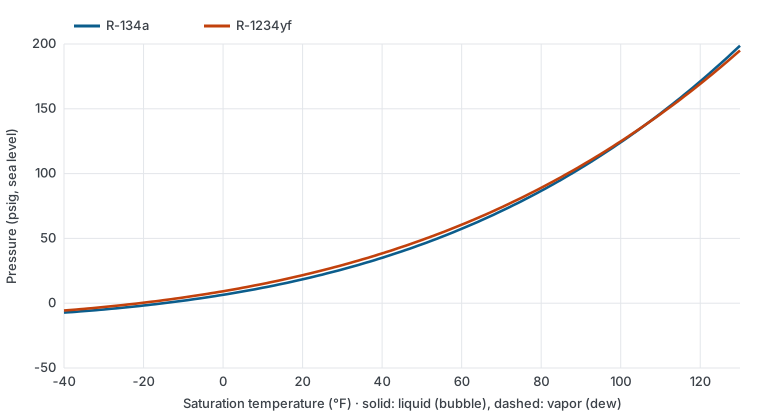
Saturation pressure in psig at sea level. Evaporating rows use the vapor (dew) value, condensing rows the liquid (bubble) value, which is what you compare with suction and liquid-line gauges. The last column is R-1234yf minus R-134a.
| Saturation | R-134a | R-1234yf | Difference |
|---|---|---|---|
| Evaporator (vapor, dew) | |||
| -20°F | 3.7″ Hg | 0.4 | +2.2 |
| 0°F | 6.5 | 9.2 | +2.7 (+42%) |
| 20°F | 18.4 | 21.6 | +3.2 (+17%) |
| 30°F | 26.1 | 29.4 | +3.3 (+13%) |
| 35°F | 30.4 | 33.8 | +3.4 (+11%) |
| 40°F | 35.1 | 38.4 | +3.4 (+10%) |
| 45°F | 40.1 | 43.4 | +3.4 (+8%) |
| 50°F | 45.4 | 48.8 | +3.3 (+7%) |
| Condenser (liquid, bubble) | |||
| 80°F | 86.7 | 89.0 | +2.3 (+3%) |
| 90°F | 104.3 | 106.0 | +1.6 (+2%) |
| 95°F | 114.0 | 115.2 | +1.2 (+1%) |
| 100°F | 124.2 | 124.9 | +0.7 (+1%) |
| 105°F | 135.0 | 135.1 | +0.2 (+0%) |
| 110°F | 146.4 | 145.9 | -0.5 (-0%) |
| 115°F | 158.4 | 157.3 | -1.2 (-1%) |
| 120°F | 171.2 | 169.2 | -1.9 (-1%) |
| 125°F | 184.6 | 181.8 | -2.8 (-2%) |
| 130°F | 198.7 | 195.0 | -3.7 (-2%) |
Properties
| Property | R-134a | R-1234yf |
|---|---|---|
| Safety class | A1 | A2L |
| Type | HFC, single-component refrigerant | HFO, single-component refrigerant |
| Composition (mass %) | Single component | Single component |
| GWP (AR4) | 1,430 | n/a |
| Lubricant | PAG (automotive), POE (stationary) | PAG made for R-1234yf, or POE (per compressor maker) |
| Boiling point (14.7 psia) | -14.9°F | -21.0°F |
| Critical point | 213.9°F, 589 psia | 202.5°F, 491 psia |
| Glide at 40°F evaporating | 0.0°F | 0.0°F |
| Glide at 100°F condensing | 0.0°F | 0.0°F |
| US status | AIM Act HFC; banned in most new equipment types from 2025 (light-duty vehicles from model year 2025), but servicing existing systems remains legal. | HFO, not a regulated substance under the AIM Act (40 CFR 84); EPA SNAP-acceptable in vehicle A/C subject to SAE J639 use conditions. |
Component compatibility
| Item | R-134a | R-1234yf |
|---|---|---|
| Safety class | A1 | A2L (mildly flammable) |
| Lubricant | PAG (vehicles), POE (stationary) | PAG made for yf, or OEM-specified POE |
| Service ports | SAE R-134a quick-connect | yf-specific (SAE J639) |
| Can and cylinder thread | Right-hand | Left-hand |
| Service equipment | R-134a recover/recycle machine | yf-rated machine and vacuum pump |
| Identifying the gas | Refrigerant identifier | Refrigerant identifier |
| Charging | By weight, per under-hood label | By weight, per under-hood label |
| Certification | Section 609 (vehicles) | Section 609 (vehicles) |
What changes in the field
Not the gauge readings. From the PT data, at 40°F evaporating R-134a is 35.1 psig and R-1234yf is 3.4 psi higher at 38.4 psig. At 100°F condensing they are within 0.7 psi (124.2 vs 124.9 psig). By 130°F the order flips and R-1234yf is 3.7 psi lower (195.0 vs 198.7 psig). Both are single-component with no glide. Because the curves nearly overlap, you can’t tell which refrigerant is in a car from its pressures. Use a refrigerant identifier before connecting recovery equipment.
The hardware is what changes. Chemours says R-1234yf “requires different fittings (left-hand thread).” R-134a cans, cylinders and tools are right-hand threaded, and the service ports, cans, cylinders and recover/recycle machines all differ. Chemours’ minimum tool list for yf work includes a yf manifold gauge and a yf-rated vacuum pump (2L flammable). EPA requires yf systems to meet SAE J639, which covers the warning label, high-pressure compressor cutoff, pressure relief devices and unique fittings.
Oil: R-134a vehicle systems use PAG, which nearly all vehicle makers selected (about 60–135 cSt, per Chemours). For R-1234yf, Chemours says it is compatible with POE and with PAGs formulated for yf. Its advice is to use the oil the compressor maker designates, because not every “yf compatible” oil has been tested. Electric high-voltage compressors use a dielectric POE. I-CAR (a secondary source) reports that as little as 1% standard PAG degrades the insulation. See refrigerant oil types.
Retrofit or replacement
Don’t put R-1234yf into an R-134a car, and don’t mix the two. EPA’s listing covers new passenger cars and light-duty trucks built to SAE J639. An R-134a system lacks the flammable-refrigerant label, the cutoff and relief hardware and the yf fittings. The two refrigerants are also serviced with separate machines so that neither supply gets contaminated.
The practical rules:
- Identify the refrigerant first, using the under-hood label and an identifier.
- Service R-134a cars with R-134a and R-134a equipment. Service yf cars with yf and yf-rated equipment.
- Charge by weight to the label amount, using the lubricant the label or compressor maker specifies.
R-134a remains legal for servicing existing vehicles. Technicians need Section 609 certification for vehicle A/C service. Since Jan 1 2018, refrigerant sales are restricted to certified technicians, except vehicle A/C cans of 2 lb or less with a self-sealing valve. Stationary uses of both refrigerants are covered on the R-134a replacement page.
Capacity, efficiency and cost
None of the sources here gives a verified capacity or efficiency percentage for R-1234yf against R-134a. Vehicle systems are designed and rated around one refrigerant.
On climate rules the gap is large. R-134a has a GWP of 1,430 (AR4). R-1234yf is an HFO, not a regulated HFC under 40 CFR Part 84, and the IPCC AR4 lists no value for it. Under 40 CFR 84.54, new light-duty vehicles from model year 2025 need refrigerant with GWP below 150. Medium-duty passenger vehicles, heavy-duty pickups and complete heavy-duty vans follow from model year 2028. Chemours said in 2020 that R-1234yf was in about 80% of new US cars sold. R-134a supply falls under the AIM Act phasedown, with allowances at 60% of baseline in 2024–2028 and 30% in 2029–2033. See AIM Act refrigerant rules and the GWP chart.
Common questions
Why can’t I use my R-134a tools on R-1234yf?
The fittings are different (left-hand thread on yf cans and cylinders), and yf is A2L. Chemours lists a yf-rated manifold, vacuum pump and recovery equipment for yf service.
Is R-1234yf better than R-134a?
Its GWP is far lower, and it is the refrigerant new vehicles must use. Performance depends on the vehicle system, which is designed for one refrigerant or the other.
Do R-134a and R-1234yf have the same pressures?
Close. They are within 3.7 psi of each other at every temperature in the table above, so pressure alone can’t identify the refrigerant.
PT charts and calculators
Sources
- EPA: MVAC acceptable refrigerants and their impacts epa.gov
- Chemours FAQ: Using Opteon YF opteon.com
- Chemours Opteon YF product information bulletin opteon.com
- Chemours: Freon 134a for Mobile Air Conditioning (C-11172) freon.com
- 40 CFR 84.54: Technology Transitions restrictions by sector ecfr.gov
- 40 CFR 82.154: Venting prohibition, exempt substitutes, sales restriction ecfr.gov
- I-CAR: high-voltage compressor oil (secondary source) rts.i-car.com
Reviewed . Found an error? Tell us and we will correct it.