R-600a vs R-134a
Reviewed · pressures computed with CoolProp 8.0 from the same data as the PT charts
Can you convert an R-134a refrigerator to R-600a?
No. EPA lists R-600a for new equipment only, and Danfoss says converting an R-134a system to R-600a is not recommended because it was not approved for a flammable refrigerant. R-600a also needs roughly double the compressor displacement, so the R-134a compressor and cap tube do not fit.
Pressures side by side
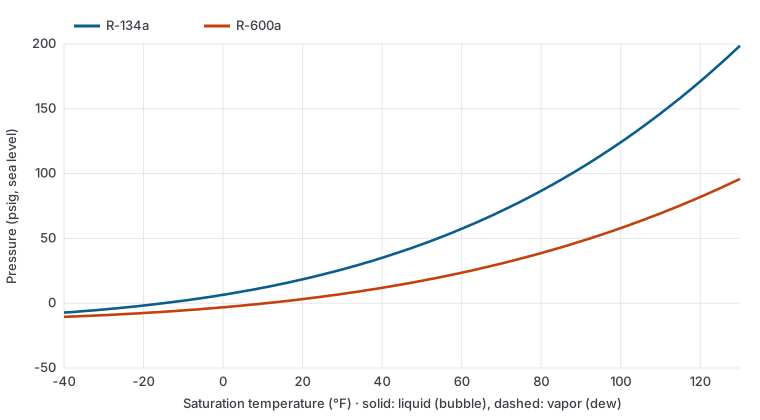
Saturation pressure in psig at sea level. Evaporating rows use the vapor (dew) value, condensing rows the liquid (bubble) value, which is what you compare with suction and liquid-line gauges. The last column is R-600a minus R-134a.
| Saturation | R-134a | R-600a | Difference |
|---|---|---|---|
| Evaporator (vapor, dew) | |||
| -20°F | 3.7″ Hg | 15.4″ Hg | -5.8 |
| 0°F | 6.5 | 6.4″ Hg | -9.6 (-149%) |
| 20°F | 18.4 | 3.2 | -15.3 (-83%) |
| 30°F | 26.1 | 7.2 | -18.9 (-72%) |
| 35°F | 30.4 | 9.4 | -21.0 (-69%) |
| 40°F | 35.1 | 11.9 | -23.2 (-66%) |
| 45°F | 40.1 | 14.5 | -25.6 (-64%) |
| 50°F | 45.4 | 17.3 | -28.1 (-62%) |
| Condenser (liquid, bubble) | |||
| 80°F | 86.7 | 38.7 | -48.0 (-55%) |
| 90°F | 104.3 | 47.8 | -56.6 (-54%) |
| 95°F | 114.0 | 52.7 | -61.2 (-54%) |
| 100°F | 124.2 | 58.0 | -66.2 (-53%) |
| 105°F | 135.0 | 63.5 | -71.5 (-53%) |
| 110°F | 146.4 | 69.3 | -77.1 (-53%) |
| 115°F | 158.4 | 75.5 | -83.0 (-52%) |
| 120°F | 171.2 | 82.0 | -89.2 (-52%) |
| 125°F | 184.6 | 88.8 | -95.8 (-52%) |
| 130°F | 198.7 | 95.9 | -102.8 (-52%) |
Properties
| Property | R-134a | R-600a |
|---|---|---|
| Safety class | A1 | A3 |
| Type | HFC, single-component refrigerant | HC, single-component refrigerant |
| Composition (mass %) | Single component | Single component |
| GWP (AR4) | 1,430 | n/a |
| Lubricant | PAG (automotive), POE (stationary) | Mineral oil (AB or POE also used) |
| Boiling point (14.7 psia) | -14.9°F | 10.9°F |
| Critical point | 213.9°F, 589 psia | 274.4°F, 526 psia |
| Glide at 40°F evaporating | 0.0°F | 0.0°F |
| Glide at 100°F condensing | 0.0°F | 0.0°F |
| US status | AIM Act HFC; banned in most new equipment types from 2025 (light-duty vehicles from model year 2025), but servicing existing systems remains legal. | Not an ODS or AIM Act regulated HFC; EPA SNAP-acceptable with use conditions in household refrigerators and freezers (2011, updated 2018), stand-alone retail and vending. |
Component compatibility
| Item | R-134a | R-600a |
|---|---|---|
| Lubricant | POE (stationary) | Mainly mineral oil; AB or POE possible (Danfoss) |
| Compressor displacement | Sized for R-134a | Up to about 2x the R-12 swept volume (Danfoss) |
| Charge size | Nameplate | About 40-45% of the R-134a mass (Danfoss); weigh in grams |
| Low side at freezer temperatures | Near or slightly below 0 psig | In a vacuum below 10.9°F |
| Section 608 class | Medium pressure | Medium pressure |
| Recovery machine | AHRI 740 (App. B3) | Flammable-rated (App. B4, UL 1963 SB) |
| Cylinder | RAL 7044 gray (legacy light blue) | RAL 7044 gray with red band |
| New household units (US) | Not allowed since Jan 1 2025 (GWP limit 150); service allowed | SNAP-listed for new equipment only, with use conditions |
What changes in the field
R-600a runs at a fraction of R-134a pressure. From the PT data, at 40°F saturation R-134a reads 35.1 psig and R-600a 11.9 psig. At 100°F condensing R-134a is 124.2 psig and R-600a 58.0 psig. Both are single-component refrigerants, so one PT column serves both sides.
Freezer evaporators on R-600a run in a vacuum. Isobutane boils at 10.9°F at sea level, so at 0°F saturation it reads 6.4 in Hg vacuum and at -20°F 15.4 in Hg, where R-134a reads 3.7 in Hg. Set the gauge or app to show in Hg correctly; the pressure converter handles psig, psia and in Hg. A low-side leak on R-600a pulls air in rather than letting refrigerant out.
Danfoss flags two service consequences. Evacuation has to be better than on R-134a: at -25°C (-13°F) evaporating, R-600a has about half the pressure of R-134a, so the same amount of non-condensables does about twice the harm. And the system is more sensitive to charge error, with undercharging in particular raising energy use. Charge by weight with a scale that reads grams, and see the evacuation microns guide.
Both are medium-pressure refrigerants under 40 CFR 82.152. A household refrigerator is a small appliance (Type I), recovered to 90% with the compressor running, 80% with it off, or 4 in Hg vacuum. R-600a is A3, so the recovery machine must be certified for flammable refrigerants under Appendix B4 of 40 CFR 82.158. Isobutane is exempt from the venting prohibition only in household refrigerators and freezers, stand-alone retail units and vending machines (40 CFR 82.154(a)(1)).
Retrofit or replacement
An R-134a refrigerator stays on R-134a. The reasons are specific:
- EPA’s SNAP listing for R-600a in household refrigerators and freezers (Dec 20 2011, updated Aug 8 2018 to UL 60335-2-24) covers new equipment only.
- Danfoss says converting an R-134a system to R-600a “is not recommended, since these systems are not approved for flammable refrigerant use, so electrical safety is not proven.”
- The compressor is wrong for it. Danfoss gives R-600a roughly 55% of R-134a’s volumetric capacity at 55°C (131°F) condensing, which calls for a swept volume up to twice that used for R-12. Capillary flow also has to be re-tuned.
Linde, which sells R-600a as CARE 10, states it is not a retrofit refrigerant. Do not top off an R-134a system with isobutane or anything else. If a compressor fails on an R-600a unit, replace it with one specified for R-600a and its factory oil; Danfoss says R-600a is mainly used with mineral compressor oil, while R-134a compressors use POE.
R-134a remains serviceable. Under 40 CFR 84.54, new household refrigerators and freezers have been limited to GWP below 150 since Jan 1 2025 (manufacture and import), which rules out R-134a in new units, but repairing existing ones is allowed.
Capacity, efficiency and cost
Danfoss’ 55% volumetric figure describes the refrigerant, not the appliance: the larger compressor makes up the difference. Danfoss also reports that compressors tend to be quieter on R-600a at low capacity, though the larger displacement can cause vibration and flow noise in some cabinets. None of the sources here gives a verified appliance efficiency percentage for R-600a against R-134a.
On GWP, R-134a is 1,430 (AR4). R-600a has no AR4 value; EPA’s SNAP page lists 3 and 40 CFR 84.64 assigns 1. R-600a is not a regulated HFC, so the AIM Act phasedown does not apply to it. See the GWP chart.
Common questions
Which is better, R-600a or R-134a?
For new household refrigerators the choice is made by the rules: R-134a is above the 150 GWP limit for new units, and R-600a is the common replacement. For an existing appliance, the better refrigerant is the one on the rating plate.
Why does my R-600a fridge show a vacuum on the low side?
Because isobutane boils at 10.9°F at sea level. Any evaporator running colder than that reads below 0 psig, which is normal. Compare with the R-600a PT chart, not an R-134a one.
PT charts and calculators
Sources
- Danfoss: Practical Application of Refrigerants R600a and R290 in Small Hermetic Systems assets.danfoss.com
- EPA SNAP: Substitutes in Household Refrigerators and Freezers epa.gov
- Linde CARE 10 (R-600a) product data static.prd.echannel.linde.com
- 40 CFR 84.54: Technology Transitions restrictions by sector ecfr.gov
- 40 CFR 82.154: Venting prohibition, exempt substitutes, sales restriction ecfr.gov
- 40 CFR 82.158: Standards for recovery and recycling equipment ecfr.gov
Reviewed . Found an error? Tell us and we will correct it.