R-290 vs R-600a
Reviewed · pressures computed with CoolProp 8.0 from the same data as the PT charts
Can you use R-290 in place of R-600a?
No. Both are A3 hydrocarbons, but propane runs about five times the pressure of isobutane at 40°F and needs a compressor with a fraction of the displacement. EPA lists each only for new equipment designed for it, so an R-600a appliance is serviced with R-600a and an R-290 unit with R-290.
Pressures side by side
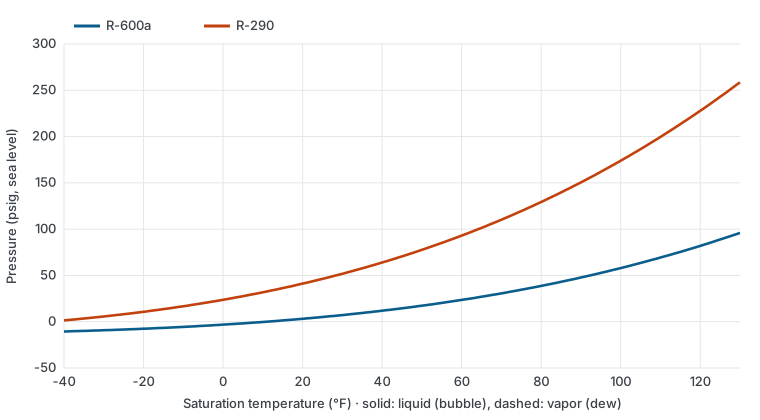
Saturation pressure in psig at sea level. Evaporating rows use the vapor (dew) value, condensing rows the liquid (bubble) value, which is what you compare with suction and liquid-line gauges. The last column is R-290 minus R-600a.
| Saturation | R-600a | R-290 | Difference |
|---|---|---|---|
| Evaporator (vapor, dew) | |||
| -20°F | 15.4″ Hg | 10.7 | +18.3 |
| 0°F | 6.4″ Hg | 23.7 | +26.9 |
| 20°F | 3.2 | 41.1 | +38.0 |
| 30°F | 7.2 | 51.8 | +44.6 (+621%) |
| 35°F | 9.4 | 57.7 | +48.3 (+511%) |
| 40°F | 11.9 | 63.9 | +52.1 (+438%) |
| 45°F | 14.5 | 70.6 | +56.1 (+387%) |
| 50°F | 17.3 | 77.6 | +60.3 (+349%) |
| Condenser (liquid, bubble) | |||
| 80°F | 38.7 | 129.3 | +90.7 (+234%) |
| 90°F | 47.8 | 150.5 | +102.8 (+215%) |
| 95°F | 52.7 | 161.9 | +109.2 (+207%) |
| 100°F | 58.0 | 173.9 | +116.0 (+200%) |
| 105°F | 63.5 | 186.5 | +123.0 (+194%) |
| 110°F | 69.3 | 199.6 | +130.3 (+188%) |
| 115°F | 75.5 | 213.4 | +138.0 (+183%) |
| 120°F | 82.0 | 227.9 | +145.9 (+178%) |
| 125°F | 88.8 | 242.9 | +154.2 (+174%) |
| 130°F | 95.9 | 258.7 | +162.7 (+170%) |
Properties
| Property | R-600a | R-290 |
|---|---|---|
| Safety class | A3 | A3 |
| Type | HC, single-component refrigerant | HC, single-component refrigerant |
| Composition (mass %) | Single component | Single component |
| GWP (AR4) | n/a | n/a |
| Lubricant | Mineral oil (AB or POE also used) | POE, PAG or PAO (per compressor maker) |
| Boiling point (14.7 psia) | 10.9°F | -43.8°F |
| Critical point | 274.4°F, 526 psia | 206.1°F, 617 psia |
| Glide at 40°F evaporating | 0.0°F | 0.0°F |
| Glide at 100°F condensing | 0.0°F | 0.0°F |
| US status | Not an ODS or AIM Act regulated HFC; EPA SNAP-acceptable with use conditions in household refrigerators and freezers (2011, updated 2018), stand-alone retail and vending. | Not an ODS or AIM Act regulated HFC; EPA SNAP-acceptable with use conditions in listed self-contained end uses, most recently commercial refrigeration (June 2024). |
Component compatibility
| Item | R-600a | R-290 |
|---|---|---|
| Typical equipment | Household refrigerators and freezers, small stand-alone cases | Reach-ins, merchandisers, ice machines, vending, water coolers, room AC, household |
| Lubricant | Mainly mineral oil; AB or POE possible (Danfoss) | Per compressor label: POE (Danfoss), PAG or PAO (BITZER) |
| Capillary flow (Danfoss) | Close to R-12 | Close to R-404A |
| Section 608 class | Medium pressure | High pressure |
| Venting exemption (82.154(a)(1)) | Household, stand-alone retail, vending only | Wider list incl. room AC, ice machines, water coolers |
| Recovery machine | Flammable-rated (App. B4) | Flammable-rated (App. B4) |
| Cylinder | RAL 7044 gray with red band | RAL 7044 gray with red band |
| Charging | By weight, gram-accurate scale | By weight, gram-accurate scale |
What changes in the field
Propane runs far higher than isobutane. From the PT data, at 40°F saturation R-600a reads 11.9 psig and R-290 63.9 psig. At 100°F condensing R-600a is 58.0 psig and R-290 173.9 psig. Both are single-component refrigerants with one PT column and no glide.
The low side looks completely different. R-600a boils at 10.9°F at sea level, so a freezer evaporator on isobutane runs in a vacuum: 6.4 in Hg at 0°F. R-290 at 0°F still reads 23.7 psig. A vacuum reading on the low side is normal on R-600a and a sign of trouble on R-290, so confirm the refrigerant on the rating plate before you diagnose.
The pressure gap also splits them in Section 608. At 104°F R-600a saturates at 77.0 psia (medium pressure) and R-290 at 198.6 psia (high pressure) under 40 CFR 82.152. Most of this equipment is small appliances (factory-sealed, 5 lb or less) under Type I, recovered to 90% with the compressor running, 80% with it off, or 4 in Hg vacuum. Larger units follow the class: medium pressure under 200 lb to 10 in Hg, high pressure under 200 lb to 0 in Hg.
What they share is flammability. Both are A3. Recovery machines must be certified for flammable refrigerants under Appendix B4 of 40 CFR 82.158, and Danfoss stresses good ventilation and routing the vacuum pump exhaust outdoors. Each is exempt from the venting prohibition only in the end uses listed in 40 CFR 82.154(a)(1), and R-290’s list is longer. See flammability classes.
Retrofit or replacement
You cannot swap one hydrocarbon for the other. The reasons:
- EPA’s SNAP listings for both are new equipment only, with use conditions tied to UL 60335-2-24 for household products and UL 60335-2-89 for commercial units.
- The compressor is matched to the refrigerant. Danfoss gives R-290 roughly 150% of R-134a’s volumetric capacity at 45°C (113°F) condensing, and R-600a roughly 55% of R-134a’s at 55°C (131°F), so an R-600a compressor needs a much larger displacement than an R-290 compressor for the same load.
- Metering differs. Danfoss says R-600a needs a capillary flow close to R-12, and R-290 a flow close to R-404A.
- Oil may differ. Danfoss says R-600a is mainly used with mineral oil and R-290 with POE; BITZER uses PAG as standard for R-290.
Danfoss also says converting R-22, R-12, R-502 or R-134a systems to either hydrocarbon is not recommended, because those systems are not approved for flammable refrigerants. Charge each unit only with the refrigerant and weight on its rating plate, and never add one hydrocarbon to the other. If the compressor fails, replace it with one specified for that refrigerant.
Both are charged by weight. Danfoss puts a hydrocarbon charge at about 40 to 45% of an equivalent HFC charge by mass and notes that R-600a systems are especially sensitive to charge error, so use a scale that reads grams. For R-600a it also calls for better evacuation than usual, because the low system pressure doubles the effect of non-condensables; see the evacuation microns guide.
Capacity, efficiency and cost
The Danfoss volumetric figures above describe the refrigerants and drive compressor selection; they are not appliance ratings. None of the sources used here gives an efficiency percentage for R-290 against R-600a, so none is quoted.
Neither is a regulated HFC, so the AIM Act phasedown and Technology Transitions GWP limits do not restrict them. Neither has an IPCC AR4 GWP. EPA’s 40 CFR 84.64 assigns 3.3 to propane and 1 to isobutane, and EPA’s SNAP pages list 3 for both. See the GWP chart.
For the older refrigerants they displaced, see R-290 vs R-134a and R-600a vs R-134a.
Common questions
Can you mix R-290 and R-600a?
No. Charge each system with the single refrigerant on its rating plate. A field mix of the two matches neither PT chart and neither listing.
Can you use the same charging hoses for R-290 and R-600a?
The gas is different but the precautions are the same: use tools rated for flammable refrigerants, an accurate scale, and gauges that read the pressure range in question, including in Hg vacuum for R-600a.
PT charts and calculators
Sources
- Danfoss: Practical Application of Refrigerants R600a and R290 in Small Hermetic Systems assets.danfoss.com
- EPA SNAP: Substitutes in Household Refrigerators and Freezers epa.gov
- 89 FR 50410 (June 13 2024), SNAP Rule 26: A2Ls and R-290 in commercial refrigeration federalregister.gov
- 40 CFR 82.152: Section 608 definitions (pressure classes) ecfr.gov
- 40 CFR 82.154: Venting prohibition, exempt substitutes, sales restriction ecfr.gov
- 40 CFR 82.158: Standards for recovery and recycling equipment ecfr.gov
- BITZER KT-500: Hydrocarbon refrigerants bitzer.de
Reviewed . Found an error? Tell us and we will correct it.