R-1270 (propylene) PT Chart and Refrigerant Profile
R-1270 (propylene) is an A3 hydrocarbon single-component refrigerant. It saturates at 81.8 psig at 40°F and 212.6 psig at 100°F.
Reviewed · PT values computed with CoolProp 8.0.0 and checked against NIST reference data (largest difference 0.0 psi)
R-1270 at a glance
| Safety class (ASHRAE 34) | A3: lower toxicity, highly flammable |
|---|---|
| Type | HC, single-component refrigerant |
| GWP (100-year, AR4) | Not listed in AR4Not in IPCC AR4 Table 2.14. EPA uses 1.8 under 40 CFR 84.64 (AR4 indirect value); EPA SNAP pages list 1.8 or 5. |
| Ozone depletion potential | 0 |
| Lubricant | PAO, PAG or POE (per compressor maker) |
| Boiling point at 14.7 psia | -53.7°F |
| Critical point | 195.9°F, 661 psia |
| 40°F evaporating | 81.8 psig |
| 100°F condensing | 212.6 psig |
| Charge as | Vapor or liquid |
| Typical use | Industrial process refrigeration; Low- and medium-temperature refrigeration; Cold storage and food processing (outside the US); Chillers (outside the US) |
| Trade names | CARE 45 (Linde) |
| US status | Not an ODS or AIM Act regulated HFC; SNAP-acceptable in industrial process refrigeration, unacceptable in new chillers and cold storage warehouses since January 3 2017. |
| Replaces | R-404A, R-507A, R-22 |
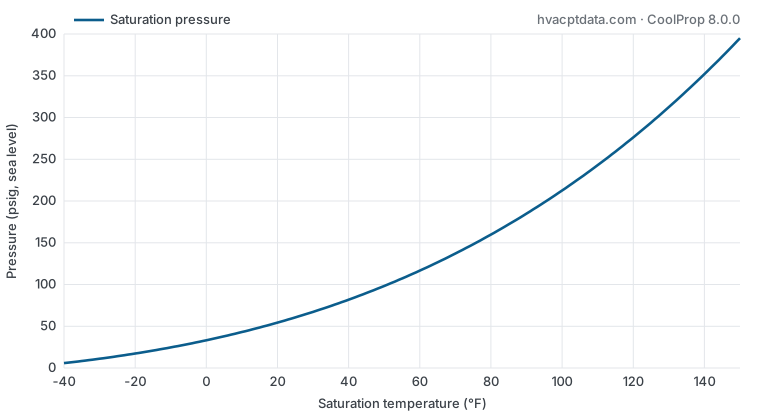
R-1270 PT chart (°F and psig)
R-1270 is a single-component refrigerant, so one pressure applies at each temperature for both the evaporator and the condenser. Tap a row to load it into the lookup.
-40°F to 150°F · psig at sea level · °C and kPa in the CSV · italic = inches Hg vacuum
| °F | psig |
|---|---|
| -40 | 5.8 |
| -39 | 6.3 |
| -38 | 6.8 |
| -37 | 7.3 |
| -36 | 7.8 |
| -35 | 8.3 |
| -34 | 8.9 |
| -33 | 9.4 |
| -32 | 10.0 |
| -31 | 10.5 |
| -30 | 11.1 |
| -29 | 11.7 |
| -28 | 12.3 |
| -27 | 12.9 |
| -26 | 13.5 |
| -25 | 14.1 |
| -24 | 14.7 |
| -23 | 15.4 |
| -22 | 16.0 |
| -21 | 16.7 |
| -20 | 17.3 |
| -19 | 18.0 |
| -18 | 18.7 |
| -17 | 19.4 |
| -16 | 20.1 |
| -15 | 20.9 |
| -14 | 21.6 |
| -13 | 22.3 |
| -12 | 23.1 |
| -11 | 23.9 |
| -10 | 24.7 |
| -9 | 25.5 |
| -8 | 26.3 |
| -7 | 27.1 |
| -6 | 27.9 |
| -5 | 28.8 |
| -4 | 29.6 |
| -3 | 30.5 |
| -2 | 31.4 |
| -1 | 32.3 |
| 0 | 33.2 |
| 1 | 34.1 |
| 2 | 35.1 |
| 3 | 36.0 |
| 4 | 37.0 |
| 5 | 38.0 |
| 6 | 39.0 |
| 7 | 40.0 |
| 8 | 41.0 |
| 9 | 42.0 |
| 10 | 43.1 |
| 11 | 44.1 |
| 12 | 45.2 |
| 13 | 46.3 |
| 14 | 47.4 |
| 15 | 48.5 |
| 16 | 49.7 |
| 17 | 50.8 |
| 18 | 52.0 |
| 19 | 53.2 |
| 20 | 54.4 |
| 21 | 55.6 |
| 22 | 56.8 |
| 23 | 58.1 |
| 24 | 59.3 |
| 25 | 60.6 |
| 26 | 61.9 |
| 27 | 63.2 |
| 28 | 64.5 |
| 29 | 65.9 |
| 30 | 67.2 |
| 31 | 68.6 |
| 32 | 70.0 |
| 33 | 71.4 |
| 34 | 72.9 |
| 35 | 74.3 |
| 36 | 75.8 |
| 37 | 77.3 |
| 38 | 78.8 |
| 39 | 80.3 |
| 40 | 81.8 |
| 41 | 83.4 |
| 42 | 85.0 |
| 43 | 86.6 |
| 44 | 88.2 |
| 45 | 89.8 |
| 46 | 91.4 |
| 47 | 93.1 |
| 48 | 94.8 |
| 49 | 96.5 |
| 50 | 98.2 |
| 51 | 100.0 |
| 52 | 101.7 |
| 53 | 103.5 |
| 54 | 105.3 |
| 55 | 107.2 |
| 56 | 109.0 |
| 57 | 110.9 |
| 58 | 112.8 |
| 59 | 114.7 |
| 60 | 116.6 |
| 61 | 118.6 |
| 62 | 120.5 |
| 63 | 122.5 |
| 64 | 124.5 |
| 65 | 126.6 |
| 66 | 128.6 |
| 67 | 130.7 |
| 68 | 132.8 |
| 69 | 134.9 |
| 70 | 137.1 |
| 71 | 139.3 |
| 72 | 141.4 |
| 73 | 143.7 |
| 74 | 145.9 |
| 75 | 148.2 |
| 76 | 150.4 |
| 77 | 152.7 |
| 78 | 155.1 |
| 79 | 157.4 |
| 80 | 159.8 |
| 81 | 162.2 |
| 82 | 164.6 |
| 83 | 167.1 |
| 84 | 169.6 |
| 85 | 172.1 |
| 86 | 174.6 |
| 87 | 177.1 |
| 88 | 179.7 |
| 89 | 182.3 |
| 90 | 184.9 |
| 91 | 187.6 |
| 92 | 190.2 |
| 93 | 192.9 |
| 94 | 195.7 |
| 95 | 198.4 |
| 96 | 201.2 |
| 97 | 204.0 |
| 98 | 206.8 |
| 99 | 209.7 |
| 100 | 212.6 |
| 101 | 215.5 |
| 102 | 218.4 |
| 103 | 221.4 |
| 104 | 224.4 |
| 105 | 227.4 |
| 106 | 230.5 |
| 107 | 233.5 |
| 108 | 236.6 |
| 109 | 239.8 |
| 110 | 242.9 |
| 111 | 246.1 |
| 112 | 249.4 |
| 113 | 252.6 |
| 114 | 255.9 |
| 115 | 259.2 |
| 116 | 262.5 |
| 117 | 265.9 |
| 118 | 269.3 |
| 119 | 272.7 |
| 120 | 276.2 |
| 121 | 279.7 |
| 122 | 283.2 |
| 123 | 286.7 |
| 124 | 290.3 |
| 125 | 293.9 |
| 126 | 297.6 |
| 127 | 301.3 |
| 128 | 305.0 |
| 129 | 308.7 |
| 130 | 312.5 |
| 131 | 316.3 |
| 132 | 320.1 |
| 133 | 324.0 |
| 134 | 327.9 |
| 135 | 331.8 |
| 136 | 335.8 |
| 137 | 339.8 |
| 138 | 343.8 |
| 139 | 347.9 |
| 140 | 352.0 |
| 141 | 356.1 |
| 142 | 360.3 |
| 143 | 364.5 |
| 144 | 368.8 |
| 145 | 373.1 |
| 146 | 377.4 |
| 147 | 381.7 |
| 148 | 386.1 |
| 149 | 390.5 |
| 150 | 395.0 |
Where you will find R-1270
R-1270 is refrigerant-grade propylene (propene), a hydrocarbon. Linde, which sells it as CARE 45, describes it for low- and medium-temperature refrigeration: commercial refrigeration, chill cabinets, cold storage and food processing, industrial refrigeration, and small to large air conditioning and chiller systems. BITZER gives an application range of +12°C to -40°C (about 54°F to -40°F) single stage and -20°C to -55°C (about -4°F to -67°F) two-stage, and lists it as a substitute for R-404A, R-507A and R-22.
In the US its listed territory is narrower. EPA’s SNAP program lists propylene as acceptable in industrial process refrigeration, new and retrofit, since March 18, 1994. So in the US, expect it mainly in industrial process refrigeration. Retail food and AC listings for it were not found on the EPA pages checked.
It runs higher than R-290 (propane). R-1270 boils at -53.7°F at sea level, against -43.8°F for R-290. At 40°F it saturates at 81.8 psig (R-290: 63.9 psig); at 100°F, 212.6 psig (R-290: 173.9 psig).
Charging R-1270
R-1270 is a single-component refrigerant: no glide, and composition does not shift, so vapor or liquid charging is possible. Charge by weight to the nameplate; no manufacturer charging procedure with numeric targets was found. Linde states that because propylene is flammable it requires different charging and recovery procedures, so follow the equipment manufacturer’s flammable-refrigerant procedure.
For running checks, convert suction pressure with the PT calculator or the superheat calculator, and liquid-line pressure with the subcooling calculator, with targets from the manufacturer.
Linde also says R-1270 is not suitable for retrofitting existing fluorocarbon refrigerant systems. Do not top off or convert an R-404A or R-22 system with propylene.
Oil and compatibility
BITZER lists PAO, PAG and POE, plus alkylbenzene and mineral oil “with limitations”. Linde’s product data summary lists mineral oil, alkylbenzene and POE. The sources differ, so the compressor manufacturer’s lubricant and viscosity choice governs.
Safety, handling and recovery
A3 under ASHRAE 34 (BITZER, Linde, EPA): lower toxicity, highly flammable (LFL at or below 0.10 kg/m³ or heat of combustion of 19,000 kJ/kg or more). The flammability safety classes page compares A3 with A2L. Keep ignition sources away, ventilate, and do not braze on a circuit that still holds refrigerant.
Section 608 pressure class: at 104°F R-1270 saturates at 224.4 psig (239.1 psia), between 170 and 355 psia, so it is a high-pressure refrigerant (40 CFR 82.152). Factory-sealed small appliances with 5 lb or less fall under Type I; other equipment needs Type II. Universal covers both.
Venting: 40 CFR 82.154(a)(1)(vi) exempts hydrocarbons only in industrial process refrigeration used for processing hydrocarbons. Everywhere else R-1270 is a non-exempt substitute: no venting, required recovery levels apply (high-pressure appliances under 200 lb to 0 in Hg, 200 lb or more to 10 in Hg; small appliances 90% or 80% recovery, or 4 in Hg vacuum), and since January 1, 2018 sales are restricted to certified technicians. A recovery machine used on it must be certified for flammable refrigerants (40 CFR 82.158 Appendix B4, which adds UL 1963 Supplement SB); see recovery machine compatibility.
Cylinders: AHRI Guideline N-2017 assigns no legacy color to R-1270. New containers are light green-gray RAL 7044 with a red band on the shoulder or top for flammable refrigerants. Linde’s CARE 45 cylinders (European product data) have a left-hand DIN 477-1 valve, so plan for a matching adapter. See cylinder colors.
Status and replacements
Propylene is not an ozone-depleting substance and not an AIM Act regulated HFC, so allowance rules and the Technology Transitions GWP limits do not restrict it. EPA assigns a GWP of 1.8 in 40 CFR 84.64 (the AR4 indirect value); EPA’s industrial process refrigeration page prints 5, and Linde prints 2.
Use in the US is set by SNAP, end use by end use:
- Industrial process refrigeration: acceptable, new and retrofit (listed March 18, 1994).
- New centrifugal chillers, new positive displacement chillers and new cold storage warehouses: unacceptable as of January 3, 2017 (rule of December 1, 2016, 81 FR 86778).
- Retail food, household, AC and other end uses: no R-1270 listing found on the EPA pages checked, so no acceptance is stated here.
For commercial refrigeration in the US, the hydrocarbon that EPA lists widely is R-290. For R-404A alternatives see the R-404A replacement comparison, and R-290 vs R-600a for the other common hydrocarbons.
Common questions
What is the difference between R-1270 and R-290?
Both are A3 hydrocarbons. R-1270 (propylene) runs higher pressures than R-290 (propane): 81.8 psig against 63.9 psig at 40°F, and 212.6 against 173.9 psig at 100°F. In the US R-290 has SNAP listings in many self-contained end uses, while R-1270’s acceptable listing is industrial process refrigeration.
What is the refrigerant number for propylene?
Propylene is R-1270 in ASHRAE Standard 34. Linde sells refrigerant-grade propylene as CARE 45.
How this chart was computed
Every pressure on this page is calculated, not copied: CoolProp 8.0.0 (HEOS backend), the open-source implementation of the reference equations of state, using the model pure:Propylene. Gauge values assume sea-level air pressure (14.696 psia); kPa values in the CSV are absolute.
Spot check against NIST Chemistry WebBook, SRD 69, Thermophysical Properties of Fluid Systems: Propene, saturation properties (temperature increments):
| °F | Column | Published | This chart | Difference |
|---|---|---|---|---|
| -40 | saturation | 20.5 psia | 20.5 psia | 0.0 psi |
| 0 | saturation | 47.9 psia | 47.9 psia | 0.0 psi |
| 40 | saturation | 96.5 psia | 96.5 psia | 0.0 psi |
| 120 | saturation | 290.9 psia | 290.9 psia | 0.0 psi |
NIST WebBook implements the same reference equation of state as CoolProp, so near-zero deviation there confirms the implementation and unit handling. No manufacturer chart was checked.
Charts from different publishers can differ by a few tenths of a psi because of the equation of state and blend tolerances. Always charge to the equipment manufacturer's data. Full method and every spot check
Calculators for R-1270
Sources
- Linde R1270 (CARE 45) propylene product data (March 2022) static.prd.echannel.linde.com
- BITZER Refrigerant Report: refrigerant data table bitzer.de
- EPA SNAP: Substitutes in Industrial Process Refrigeration epa.gov
- EPA SNAP: Substitutes in Centrifugal Chillers epa.gov
- EPA SNAP: Substitutes in Cold Storage Warehouses epa.gov
- eCFR 40 CFR 82.154: venting prohibition and exempt substitutes ecfr.gov
- eCFR 40 CFR 82.152: Section 608 definitions and pressure classes ecfr.gov
- eCFR 40 CFR 84.64: GWPs used for Technology Transitions ecfr.gov
Reviewed . Found an error? Tell us and we will correct it.
More in Natural refrigerants