R-22 vs R-32
Reviewed · pressures computed with CoolProp 8.0 from the same data as the PT charts
Can you put R-32 in an R-22 system?
No. R-32 condenses at roughly 130 psi above R-22 at 100°F, needs POE instead of mineral oil, and is an A2L refrigerant that EPA accepts only in new equipment built and listed for it. An R-22 system is repaired with R-22 or a listed retrofit blend, or replaced with new R-32 equipment.
Pressures side by side
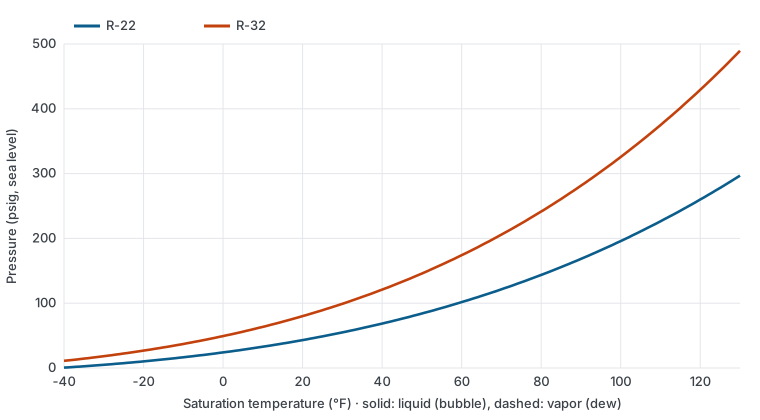
Saturation pressure in psig at sea level. Evaporating rows use the vapor (dew) value, condensing rows the liquid (bubble) value, which is what you compare with suction and liquid-line gauges. The last column is R-32 minus R-22.
| Saturation | R-22 | R-32 | Difference |
|---|---|---|---|
| Evaporator (vapor, dew) | |||
| -20°F | 10.2 | 26.8 | +16.6 (+163%) |
| 0°F | 24.0 | 49.3 | +25.2 (+105%) |
| 20°F | 43.1 | 80.0 | +36.9 (+86%) |
| 30°F | 55.0 | 99.1 | +44.1 (+80%) |
| 35°F | 61.5 | 109.7 | +48.1 (+78%) |
| 40°F | 68.6 | 121.0 | +52.4 (+76%) |
| 45°F | 76.1 | 133.0 | +56.9 (+75%) |
| 50°F | 84.1 | 145.9 | +61.8 (+73%) |
| Condenser (liquid, bubble) | |||
| 80°F | 143.6 | 241.5 | +97.9 (+68%) |
| 90°F | 168.4 | 281.3 | +112.9 (+67%) |
| 95°F | 181.8 | 302.9 | +121.1 (+67%) |
| 100°F | 195.9 | 325.7 | +129.8 (+66%) |
| 105°F | 210.8 | 349.7 | +138.9 (+66%) |
| 110°F | 226.4 | 374.9 | +148.5 (+66%) |
| 115°F | 242.8 | 401.4 | +158.7 (+65%) |
| 120°F | 260.0 | 429.3 | +169.4 (+65%) |
| 125°F | 278.0 | 458.7 | +180.7 (+65%) |
| 130°F | 296.9 | 489.5 | +192.6 (+65%) |
Properties
| Property | R-22 | R-32 |
|---|---|---|
| Safety class | A1 | A2L |
| Type | HCFC, single-component refrigerant | HFC, single-component refrigerant |
| Composition (mass %) | Single component | Single component |
| GWP (AR4) | 1,810 | 675 |
| Lubricant | Mineral oil (AB alternate) | POE |
| Boiling point (14.7 psia) | -41.5°F | -61.0°F |
| Critical point | 205.1°F, 724 psia | 172.6°F, 839 psia |
| Glide at 40°F evaporating | 0.0°F | 0.0°F |
| Glide at 100°F condensing | 0.0°F | 0.0°F |
| US status | US production and import ended Jan 1 2020; existing equipment may still be serviced with recovered, recycled, reclaimed or pre-2020 R-22. | GWP 675 is below the 700 limit for new US residential and light commercial AC/HP from Jan 1 2025; SNAP-acceptable in new equipment subject to use conditions. |
Component compatibility
| Item | R-22 | R-32 |
|---|---|---|
| Lubricant | Mineral oil or AB | POE (Copeland POE-46) |
| Safety class | A1 | A2L |
| Section 608 class | High pressure | Very high pressure |
| Equipment listing | A1 equipment | UL 60335-2-40 A2L use conditions (SNAP) |
| Recovery machine | AHRI 740 (App. B3) | Flammable-rated (App. B4, UL 1963 SB) |
| Gauges and hoses | R-22 range | Rated for R-32 pressures; check A2L listing |
| Cylinder | RAL 7044 gray (legacy light green) | RAL 7044 gray with red band (legacy light blue-green) |
| Supply | Recovered, reclaimed or pre-2020 stock | In production (HFC, AIM Act phasedown) |
What changes in the field
R-32 runs much higher than R-22. From the PT data, at 40°F evaporating R-22 reads 68.6 psig and R-32 121.0 psig, 52.4 psi more. At 100°F condensing R-22 is 195.9 psig and R-32 325.7 psig, 129.8 psi more. Both are single-component refrigerants with no glide, so each has one PT column.
The pressure difference crosses a Section 608 line. At 104°F R-22 saturates at 222.4 psia (high pressure) and R-32 at 359.4 psia, just over the 355 psia cutoff, so R-32 equipment is very high pressure under 40 CFR 82.152. Type II or Universal certification covers both. Recovery for equipment under 200 lb goes to 0 in Hg either way.
R-22 is A1. R-32 is A2L, which means a recovery machine certified for flammable refrigerants under Appendix B4 of 40 CFR 82.158, gauges and hoses rated for R-32 pressures, and the cylinder with a red band. Many A2L cylinders use left-hand thread valves, so an R-22 adapter set may not fit. Keep the two refrigerants in separate recovery cylinders. See recovery machine compatibility.
Oil is not compatible either. R-22 systems run mineral oil or alkylbenzene; Copeland’s approved-lubricant bulletin lists POE for R-32 compressors. The oil types guide explains why HFCs need POE.
Retrofit or replacement
You cannot convert an R-22 system to R-32:
- EPA’s SNAP listing for R-32 in residential and light commercial AC and heat pumps is for new equipment only, under use conditions based on UL 60335-2-40 (86 FR 24444). An R-22 system was never evaluated for a flammable refrigerant.
- The R-22 compressor, coils and components were designed for about 196 psig condensing at 100°F, not about 326 psig.
- The mineral oil is the wrong lubricant.
That leaves two paths. Repair the R-22 system with R-22, which remains legal using recovered, recycled, reclaimed or pre-2020 stock (production and import ended Jan 1 2020), or convert it to a listed R-22 retrofit blend after recovering all the R-22; see R-22 replacement refrigerants. Never add any other refrigerant to the R-22 left in a system.
Or replace the equipment with a new R-32 system and follow its installation manual on whether an existing line set can stay; this page has no manufacturer source on reusing R-22 line sets with R-32. New R-32 equipment is allowed under 40 CFR 84.54, since its AR4 GWP of 675 is under the 700 limit for new residential and light commercial AC and heat pumps. The R-22 phase-out page has the dates.
Capacity, efficiency and cost
None of the sources used here compares R-32 and R-22 systems directly, so no capacity or efficiency percentage is quoted. Arkema’s R-32 material compares it with R-410A, not R-22, and states that a typical R-32 charge is about 30% less than R-410A. A new R-32 system’s performance is in its AHRI rating, which reflects the whole matched system, not just the refrigerant.
On cost, R-22 is now a finite supply: recovered refrigerant cannot be sold to a new owner unless an EPA-certified reclaimer has reclaimed it. R-32 is in production but, as an HFC, its supply falls under the AIM Act phasedown, which caps allowances at 60% of baseline in 2024–2028 and 30% in 2029–2033. R-22 has an ODP of 0.055 and an AR4 GWP of 1,810.
Common questions
Which cools better, R-22 or R-32?
The refrigerant alone does not decide it. A new R-32 system is designed around R-32 and rated as a system; an old R-22 system is limited by its age and condition. Compare AHRI ratings, not refrigerants.
Can I use my R-22 gauges on R-32?
Only if they are rated for R-32 pressures and your tools are listed for A2L use, with R-32 in the PT data. Check the gauge’s rated range against the R-32 condensing pressures in the table above.
PT charts and calculators
Sources
- EPA SNAP: Substitutes in Residential and Light Commercial AC and Heat Pumps epa.gov
- 86 FR 24444 (May 6 2021), SNAP Rule 23: A2L refrigerants in residential and light commercial AC and heat pumps federalregister.gov
- 40 CFR 82.15: Class II (HCFC) prohibitions ecfr.gov
- 40 CFR 82.152: Section 608 definitions (pressure classes) ecfr.gov
- 40 CFR 82.158: Standards for recovery and recycling equipment ecfr.gov
- 40 CFR 84.54: Technology Transitions restrictions by sector ecfr.gov
- Copeland AE Bulletin 93-11: Refrigerants and Lubricants Approved for Use in Copeland Compressors webapps.copeland.com
- Arkema: R-32 as a replacement for R-410A forane.arkema.com
Reviewed . Found an error? Tell us and we will correct it.