R-448A vs R-449A
Reviewed · pressures computed with CoolProp 8.0 from the same data as the PT charts
Can you mix R-448A and R-449A?
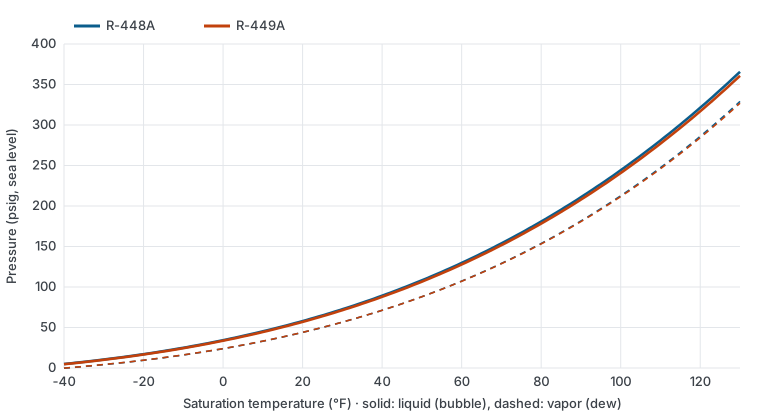
No. They are separate five- and four-component blends with their own PT charts. At 40°F evaporating they read the same, but R-449A runs 3.4 psi lower at 100°F condensing and the glide differs. A mix is neither refrigerant: recover, evacuate and recharge with one.
Pressures side by side
Saturation pressure in psig at sea level. Evaporating rows use the vapor (dew) value, condensing rows the liquid (bubble) value, which is what you compare with suction and liquid-line gauges. The last column is R-449A minus R-448A.
| Saturation | R-448A | R-449A | Difference |
|---|---|---|---|
| Evaporator (vapor, dew) | |||
| -20°F | 9.5 | 9.7 | +0.1 (+1%) |
| 0°F | 23.8 | 24.0 | +0.1 (+1%) |
| 20°F | 43.9 | 44.0 | +0.1 (+0%) |
| 30°F | 56.6 | 56.7 | +0.1 (+0%) |
| 35°F | 63.7 | 63.7 | +0.0 (+0%) |
| 40°F | 71.2 | 71.2 | -0.0 (-0%) |
| 45°F | 79.4 | 79.3 | -0.0 (-0%) |
| 50°F | 88.1 | 88.0 | -0.1 (-0%) |
| Condenser (liquid, bubble) | |||
| 80°F | 180.8 | 178.2 | -2.6 (-1%) |
| 90°F | 210.9 | 207.9 | -3.0 (-1%) |
| 95°F | 227.1 | 223.9 | -3.2 (-1%) |
| 100°F | 244.2 | 240.7 | -3.4 (-1%) |
| 105°F | 262.1 | 258.4 | -3.6 (-1%) |
| 110°F | 280.9 | 277.0 | -3.9 (-1%) |
| 115°F | 300.7 | 296.5 | -4.1 (-1%) |
| 120°F | 321.4 | 317.0 | -4.4 (-1%) |
| 125°F | 343.0 | 338.4 | -4.7 (-1%) |
| 130°F | 365.7 | 360.8 | -4.9 (-1%) |
Properties
| Property | R-448A | R-449A |
|---|---|---|
| Safety class | A1 | A1 |
| Type | HFC/HFO, zeotropic blend | HFC/HFO, zeotropic blend |
| Composition (mass %) | R-32 26, R-125 26, R-1234yf 20, R-134a 21, R-1234ze(E) 7 | R-32 24.3, R-125 24.7, R-1234yf 25.3, R-134a 25.7 |
| GWP (AR4) | 1,387 | 1,397 |
| Lubricant | POE (polyolester) | POE (polyolester) |
| Boiling point (14.7 psia) | -51.1°F | -50.6°F |
| Critical point | 181.0°F, 668 psia | 180.5°F, 655 psia |
| Glide at 40°F evaporating | 10.8°F | 10.1°F |
| Glide at 100°F condensing | 9.1°F | 8.5°F |
| US status | Allowed in new remote condensing units and supermarket systems (GWP under 1,400) until the 150/300 limits of Jan 1 2032; above the 700 limit for new cold storage since July 27 2026. | Allowed in new remote condensing units and supermarket systems (GWP under 1,400) until the 150/300 limits of Jan 1 2032; above the 700 limit for new cold storage since July 27 2026. |
Component compatibility
| Item | R-448A | R-449A |
|---|---|---|
| Composition (mass %) | R-32/R-125/R-1234yf/R-134a/R-1234ze(E) 26/26/20/21/7 | R-32/R-125/R-1234yf/R-134a 24.3/24.7/25.3/25.7 |
| Trade names | Solstice N40, Forane 448A | Opteon XP40, Forane 449A |
| Lubricant | POE (Copeland POE-32) | POE (Copeland POE-32) |
| Charging | Liquid from cylinder (Solstice) | Liquid only from cylinder (Chemours) |
| Read superheat on | Dew column | Dew column |
| Recovery machine | AHRI 740 machine (App. B3) | AHRI 740 machine (App. B3) |
| Cylinder | RAL 7044 gray (legacy gentian blue) | RAL 7044 gray (legacy grayish blue) |
| New RCU and supermarket (1 | Allowed until Jan 1 2032 | Allowed until Jan 1 2032 |
What changes in the field
On the low side, nothing you can see on a gauge. From the PT data, at 40°F evaporating (dew) R-448A reads 71.2 psig and R-449A reads 71.2 psig. At -20°F they are 9.5 and 9.7 psig. The high side separates a little: at 100°F condensing (bubble) R-448A is 244.2 psig and R-449A is 240.7 psig.
Both are zeotropes with a large glide. At 40°F evaporating it is 10.8°F for R-448A and 10.1°F for R-449A. Read the dew column for superheat and the bubble column for subcooling, and use the chart for the refrigerant on the label. A 0.7°F glide difference is small, but on a zeotrope the wrong column is a 10°F mistake. The temperature glide calculator shows both columns at any pressure.
R-448A contains R-1234ze(E) and R-449A does not. Otherwise both are built from R-32, R-125, R-1234yf and R-134a in different proportions. Both are A1, both run on POE (Copeland lists POE-32 for both), and both are high-pressure appliances under Section 608 (Type II or Universal).
Both must leave the cylinder as liquid. Solstice says it is “essential that systems be charged with liquid from the cylinder” and to throttle the liquid into the suction side. Chemours says to “remove liquid only from the charging cylinder.”
Retrofit or replacement
Pick one per system and keep it. Chemours’ retrofit guidelines for its own R-22 blends warn that mixing two different alternative refrigerants may have an adverse effect on system performance. A mix of R-448A and R-449A has no ASHRAE designation and no PT chart, so superheat and subcooling can’t be set against a known curve. It also can’t go back to a supplier as a single refrigerant.
To move a system from one to the other:
- Recover the full charge into a labeled recovery cylinder (0 in Hg under 200 lb, 10 in Hg at 200 lb or more for high-pressure equipment made on or after Nov 15 1993).
- Replace the filter-drier, evacuate and leak check.
- Charge the new refrigerant as liquid and set superheat on the dew column.
- Update controller refrigerant settings and relabel the system.
The POE oil stays. The more common job is converting R-404A or R-507A to one of these. Both Solstice and Chemours say the existing POE is suitable in that case. Chemours gives a starting charge of about 85% of the original for R-449A. Details are on the R-404A replacement page.
When choosing between them, check the compressor maker’s approval list (Copeland 93-11 covers both), what your supplier stocks, and whether the rack controller has the refrigerant in its library.
Capacity, efficiency and cost
The only sourced performance data here is from Chemours for R-449A against R-404A, not against R-448A. A display case and condensing unit converted from R-404A, with only the EEV updated for the R-449A PT curve, showed 8% lower energy consumption at 82°F ambient and 12% lower at 95°F in medium-temperature operation. In low-temperature operation the figures were 3% and 4% lower. Discharge temperature was 2–5 K higher. Chemours notes that actual performance depends on the system. No equivalent R-448A figure was verified for this page, so ask Solstice or the equipment maker for R-448A numbers.
On GWP the two are nearly identical: 1,387 for R-448A and 1,397 for R-449A on the AR4 basis. Both fall just under the 1,400 limit that 91 FR 31284 sets for new remote condensing units (from July 27 2026) and new supermarket systems (from Jan 1 2027). The 150/300 limits take over from Jan 1 2032. Both exceed the 700 limit for new cold storage. Both are HFC blends, so supply falls under the AIM Act phasedown. See the GWP chart.
Common questions
Is R-449A a drop-in for R-404A?
Not in the strict sense. Chemours says no lubricant or seal change is needed when retrofitting from R-404A or R-507, but superheat adjustments are likely. The R-404A charge still has to be fully recovered first.
Which runs higher, R-448A or R-449A?
On the condensing side R-448A is a few psi higher. On the suction side they are within 0.2 psi over the range in the table above.
PT charts and calculators
Sources
- Solstice N40 (R-448A) brochure prod-edam.solstice.com
- Chemours Opteon XP40 (R-449A) product information C-10021 meiersupply.com
- Copeland AE Bulletin 93-11: Refrigerants and Lubricants Approved for Use in Copeland Compressors webapps.copeland.com
- ASHRAE Refrigerant Designations (Standard 34 numbers and blend compositions) ashrae.org
- 40 CFR 84.54: Technology Transitions restrictions by sector ecfr.gov
- 91 FR 31284 (May 26 2026): Phasedown of HFCs, reconsideration of Technology Transitions requirements federalregister.gov
- Chemours Freon MO99 and NU-22B Retrofit Guidelines (mixing guidance) freon.com
Reviewed . Found an error? Tell us and we will correct it.