R-113 PT Chart and Refrigerant Profile
R-113 is an A1 CFC single-component refrigerant. It saturates at 24.4″ Hg vacuum at 40°F and 8.6″ Hg vacuum at 100°F.
Reviewed · PT values computed with CoolProp 8.0.0 and checked against NIST reference data (largest difference 0.0 psi)
R-113 at a glance
| Safety class (ASHRAE 34) | A1: lower toxicity, no flame propagation |
|---|---|
| Type | CFC, single-component refrigerant |
| GWP (100-year, AR4) | 6,130 · AR5: 5,820 |
| Ozone depletion potential | 0.8 |
| Lubricant | Mineral oil or alkylbenzene |
| Boiling point at 14.7 psia | 117.7°F |
| Critical point | 417.3°F, 492 psia |
| 40°F evaporating | 24.4″ Hg vacuum |
| 100°F condensing | 8.6″ Hg vacuum |
| Charge as | Vapor or liquid |
| Typical use | Low-capacity low-pressure centrifugal chillers; Legacy cooling systems; Former solvent and foam-blowing uses |
| Trade names | Freon 113 (Chemours), Genetron 113 (Honeywell), Forane 113 (Arkema) |
| US status | Class I CFC; US production and import banned since January 1 1996, so existing equipment runs only on recovered, recycled, reclaimed or stockpiled R-113. |
| Replaced by | R-123 |
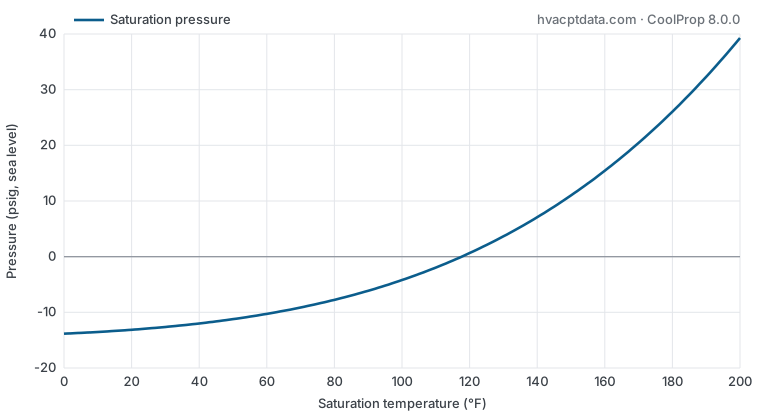
R-113 PT chart (°F and psig)
R-113 is a single-component refrigerant, so one pressure applies at each temperature for both the evaporator and the condenser. Tap a row to load it into the lookup.
0°F to 200°F · psig at sea level · °C and kPa in the CSV · italic = inches Hg vacuum
| °F | psig |
|---|---|
| 0 | 28.2″ |
| 1 | 28.1″ |
| 2 | 28.1″ |
| 3 | 28.0″ |
| 4 | 27.9″ |
| 5 | 27.9″ |
| 6 | 27.8″ |
| 7 | 27.8″ |
| 8 | 27.7″ |
| 9 | 27.6″ |
| 10 | 27.5″ |
| 11 | 27.5″ |
| 12 | 27.4″ |
| 13 | 27.3″ |
| 14 | 27.2″ |
| 15 | 27.2″ |
| 16 | 27.1″ |
| 17 | 27.0″ |
| 18 | 26.9″ |
| 19 | 26.8″ |
| 20 | 26.7″ |
| 21 | 26.7″ |
| 22 | 26.5″ |
| 23 | 26.4″ |
| 24 | 26.3″ |
| 25 | 26.2″ |
| 26 | 26.1″ |
| 27 | 26.0″ |
| 28 | 25.9″ |
| 29 | 25.8″ |
| 30 | 25.7″ |
| 31 | 25.6″ |
| 32 | 25.5″ |
| 33 | 25.3″ |
| 34 | 25.2″ |
| 35 | 25.1″ |
| 36 | 25.0″ |
| 37 | 24.8″ |
| 38 | 24.7″ |
| 39 | 24.6″ |
| 40 | 24.4″ |
| 41 | 24.3″ |
| 42 | 24.1″ |
| 43 | 24.0″ |
| 44 | 23.8″ |
| 45 | 23.7″ |
| 46 | 23.5″ |
| 47 | 23.4″ |
| 48 | 23.2″ |
| 49 | 23.0″ |
| 50 | 22.8″ |
| 51 | 22.7″ |
| 52 | 22.5″ |
| 53 | 22.3″ |
| 54 | 22.1″ |
| 55 | 21.9″ |
| 56 | 21.7″ |
| 57 | 21.5″ |
| 58 | 21.3″ |
| 59 | 21.1″ |
| 60 | 20.9″ |
| 61 | 20.7″ |
| 62 | 20.5″ |
| 63 | 20.3″ |
| 64 | 20.0″ |
| 65 | 19.8″ |
| 66 | 19.6″ |
| 67 | 19.3″ |
| 68 | 19.1″ |
| 69 | 18.8″ |
| 70 | 18.6″ |
| 71 | 18.3″ |
| 72 | 18.1″ |
| 73 | 17.8″ |
| 74 | 17.5″ |
| 75 | 17.2″ |
| 76 | 17.0″ |
| 77 | 16.7″ |
| 78 | 16.4″ |
| 79 | 16.1″ |
| 80 | 15.8″ |
| 81 | 15.5″ |
| 82 | 15.2″ |
| 83 | 14.9″ |
| 84 | 14.5″ |
| 85 | 14.2″ |
| 86 | 13.9″ |
| 87 | 13.5″ |
| 88 | 13.2″ |
| 89 | 12.8″ |
| 90 | 12.5″ |
| 91 | 12.1″ |
| 92 | 11.7″ |
| 93 | 11.4″ |
| 94 | 11.0″ |
| 95 | 10.6″ |
| 96 | 10.2″ |
| 97 | 9.8″ |
| 98 | 9.4″ |
| 99 | 9.0″ |
| 100 | 8.6″ |
| 101 | 8.1″ |
| 102 | 7.7″ |
| 103 | 7.3″ |
| 104 | 6.8″ |
| 105 | 6.4″ |
| 106 | 5.9″ |
| 107 | 5.4″ |
| 108 | 5.0″ |
| 109 | 4.5″ |
| 110 | 4.0″ |
| 111 | 3.5″ |
| 112 | 3.0″ |
| 113 | 2.5″ |
| 114 | 2.0″ |
| 115 | 1.4″ |
| 116 | 0.9″ |
| 117 | 0.4″ |
| 118 | 0.1 |
| 119 | 0.4 |
| 120 | 0.7 |
| 121 | 0.9 |
| 122 | 1.2 |
| 123 | 1.5 |
| 124 | 1.8 |
| 125 | 2.1 |
| 126 | 2.4 |
| 127 | 2.7 |
| 128 | 3.0 |
| 129 | 3.3 |
| 130 | 3.7 |
| 131 | 4.0 |
| 132 | 4.3 |
| 133 | 4.6 |
| 134 | 5.0 |
| 135 | 5.3 |
| 136 | 5.7 |
| 137 | 6.0 |
| 138 | 6.4 |
| 139 | 6.7 |
| 140 | 7.1 |
| 141 | 7.5 |
| 142 | 7.8 |
| 143 | 8.2 |
| 144 | 8.6 |
| 145 | 9.0 |
| 146 | 9.4 |
| 147 | 9.8 |
| 148 | 10.2 |
| 149 | 10.6 |
| 150 | 11.0 |
| 151 | 11.4 |
| 152 | 11.9 |
| 153 | 12.3 |
| 154 | 12.7 |
| 155 | 13.2 |
| 156 | 13.6 |
| 157 | 14.1 |
| 158 | 14.5 |
| 159 | 15.0 |
| 160 | 15.4 |
| 161 | 15.9 |
| 162 | 16.4 |
| 163 | 16.9 |
| 164 | 17.4 |
| 165 | 17.9 |
| 166 | 18.4 |
| 167 | 18.9 |
| 168 | 19.4 |
| 169 | 19.9 |
| 170 | 20.4 |
| 171 | 21.0 |
| 172 | 21.5 |
| 173 | 22.1 |
| 174 | 22.6 |
| 175 | 23.2 |
| 176 | 23.7 |
| 177 | 24.3 |
| 178 | 24.9 |
| 179 | 25.5 |
| 180 | 26.1 |
| 181 | 26.7 |
| 182 | 27.3 |
| 183 | 27.9 |
| 184 | 28.5 |
| 185 | 29.1 |
| 186 | 29.7 |
| 187 | 30.4 |
| 188 | 31.0 |
| 189 | 31.7 |
| 190 | 32.3 |
| 191 | 33.0 |
| 192 | 33.7 |
| 193 | 34.3 |
| 194 | 35.0 |
| 195 | 35.7 |
| 196 | 36.4 |
| 197 | 37.1 |
| 198 | 37.8 |
| 199 | 38.6 |
| 200 | 39.3 |
Where you will find R-113
R-113 (CFC-113) is a legacy low-pressure refrigerant. A University of Waterloo safety data sheet describes it in low-capacity packaged centrifugal chillers (low pressure, high volume), and A-Gas lists it as a refrigerant in cooling systems, a foam-blowing agent and a cleaner for electrical equipment. Any R-113 machine still running in the US is decades old: production ended in 1996. The chiller nameplate states the refrigerant and charge.
It has the lowest pressures of the common low-pressure refrigerants. R-113 boils at 117.7°F at sea level, so at normal operating temperatures both the evaporator and the condenser sit below atmospheric pressure. At 40°F saturation it reads 24.4 in Hg vacuum; at 100°F it is still in a vacuum, 8.6 in Hg. Compare R-11 at 100°F, 8.9 psig, and R-123 at 6.1 psig. Use a gauge or transducer that resolves inches of mercury accurately, and the pressure converter when controls display psia or kPa.
Charging R-113
R-113 is a single-component refrigerant and a liquid at room temperature, so it is handled and charged as a liquid. There is no glide and no fractionation: one column of the chart applies to the evaporator and the condenser, and topping off after a leak does not shift composition. No manufacturer charging procedure was found; charge amount and method come from the chiller maker’s service manual.
Because the whole system runs in a vacuum, a leak anywhere pulls air and moisture in rather than pushing refrigerant out. A condenser pressure above the saturation pressure for the measured condensing temperature points to non-condensables. Check the pair with the PT calculator.
Oil and compatibility
BITZER’s refrigerant table lists mineral oil and alkylbenzene for R-113, the same families used with R-11. Follow the chiller manufacturer for the exact grade. No retrofit flushing guidance specific to R-113 was found.
Safety, handling and recovery
R-113 is A1 under ASHRAE 34: lower toxicity, no flame propagation.
Section 608 pressure class: at 104°F R-113 saturates at -3.4 psig, 6.8 in Hg vacuum (11.3 psia). That is far under the 45 psia limit, so it is a low-pressure refrigerant, and 40 CFR 82.152 names R-113 as an example of one. Work on these machines needs Type III or Universal EPA 608 certification.
Recovery from a low-pressure appliance must reach 25 mm Hg absolute (40 CFR 82.156 Table 1, equipment made on or after November 15, 1993), close to 29 in Hg vacuum at sea level. As an ozone-depleting refrigerant R-113 may not be knowingly vented, sales are restricted to certified technicians, and appliances with 50 lb or more are subject to the leak repair rules of 40 CFR 82.157. The refrigerant recovery guide covers the procedure.
Cylinders: the legacy color for R-113 was dark purple (violet, PMS 266) in AHRI Guideline N-2017 Table 1. Since January 1, 2020 new containers are light green-gray RAL 7044, with the legacy color only on the label; existing painted inventory need not be repainted. Recovery cylinders are gray with a yellow top. See cylinder colors.
Status and replacements
CFC-113 is a Class I controlled substance with an ODP of 0.8 (40 CFR 82 Subpart A Appendix A). US production and import were banned from January 1, 1996 (40 CFR 82.4), with narrow essential-use exemptions. Existing equipment can still be serviced, but only with recovered, recycled or reclaimed R-113 or stock produced before the ban. Recovered refrigerant cannot go to a new owner unless an EPA-certified reclaimer has reclaimed it.
Its AR4 GWP is 6,130. R-113 is not an AIM Act regulated HFC, so the HFC phasedown does not apply to it; the ozone rules already ended its supply.
Replacement options:
- R-123: A-Gas names it as the replacement, and Linde lists R-123 as a retrofit replacement for R-11 and R-113. R-123 is itself a Class II HCFC: since January 1, 2020 it may be used only in equipment made before 2020, and consumption allowances reach zero in 2030 (see the R-123 profile).
- EPA’s chiller substitute list does not name CFC-113 as the refrigerant being replaced for any specific substitute. For new low-pressure chillers the current options are R-1233zd(E), R-1336mzz(Z) and R-514A.
An R-113 machine is usually a candidate for replacement rather than conversion; any conversion needs the chiller manufacturer’s data.
Common questions
What is R-113 refrigerant?
R-113 is CFC-113, 1,1,2-trichloro-1,2,2-trifluoroethane (CCl2FCClF2). It is a Class I CFC used in low-pressure centrifugal chillers and, outside refrigeration, as a solvent and foam-blowing agent.
What replaced R-113?
In chillers, R-123 was the listed retrofit replacement (A-Gas, Linde). With R-123 now restricted as well, new low-pressure chillers use HFO and HCFO refrigerants such as R-1233zd(E) and R-1336mzz(Z).
How this chart was computed
Every pressure on this page is calculated, not copied: CoolProp 8.0.0 (HEOS backend), the open-source implementation of the reference equations of state, using the model pure:R113. Gauge values assume sea-level air pressure (14.696 psia); kPa values in the CSV are absolute.
Spot check against NIST Chemistry WebBook, SRD 69, Thermophysical Properties of Fluid Systems: R113, saturation properties (temperature increments):
| °F | Column | Published | This chart | Difference |
|---|---|---|---|---|
| 0 | saturation | 0.86 psia | 0.86 psia | 0.0 psi |
| 50 | saturation | 3.47 psia | 3.47 psia | 0.0 psi |
| 100 | saturation | 10.5 psia | 10.5 psia | 0.0 psi |
| 200 | saturation | 54.0 psia | 54.0 psia | 0.0 psi |
NIST WebBook implements the same reference equation of state as CoolProp, so near-zero deviation there confirms the implementation and unit handling. No manufacturer chart was checked.
Charts from different publishers can differ by a few tenths of a psi because of the equation of state and blend tolerances. Always charge to the equipment manufacturer's data. Full method and every spot check
Calculators for R-113
Sources
- eCFR 40 CFR 82.152: Section 608 definitions and pressure classes ecfr.gov
- eCFR 40 CFR 82.4: Class I production and import prohibitions ecfr.gov
- EPA: Phaseout of Class I ozone-depleting substances epa.gov
- eCFR 40 CFR 82 Subpart A Appendix A: Class I controlled substances (ODP) ecfr.gov
- A-Gas US: R113 product page agas.com
- BITZER Refrigerant Report: refrigerant data table bitzer.de
- Linde Refrigerants Product Data Summary static.prd.echannel.linde.com
- AHRI Guideline N-2017: Assignment of Refrigerant Container Colors ahrinet.org
Reviewed . Found an error? Tell us and we will correct it.
More in Chiller refrigerants