R-14 (tetrafluoromethane) PT Chart and Refrigerant Profile
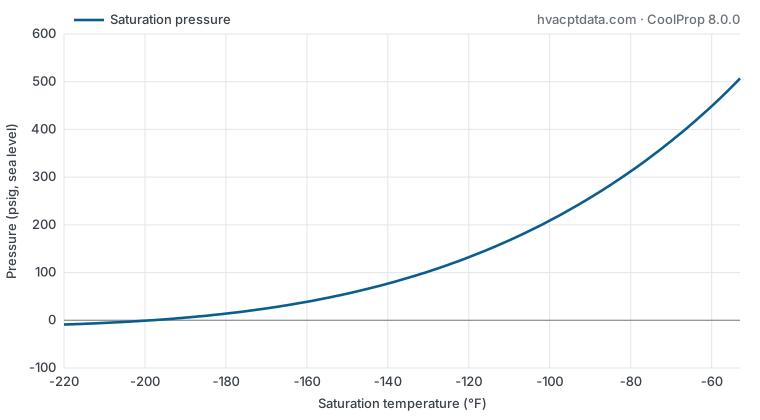
R-14 (tetrafluoromethane) is an A1 PFC single-component refrigerant. It saturates at 18.1″ Hg vacuum at -220°F and 506.9 psig at -53°F.
Reviewed · PT values computed with CoolProp 8.0.0 and checked against NIST reference data (largest difference 0.1 psi)
R-14 at a glance
| Safety class (ASHRAE 34) | A1: lower toxicity, no flame propagation |
|---|---|
| Type | PFC, single-component refrigerant |
| GWP (100-year, AR4) | 7,390 · AR5: 6,630Perfluorocarbon; not an AIM Act regulated substance, so EPA assigns no exchange value. |
| Ozone depletion potential | 0 |
| Lubricant | POE (polyolester) |
| Boiling point at 14.7 psia | -198.5°F |
| Critical point | -50.4°F, 546 psia |
| -220°F evaporating | 18.1″ Hg vacuum |
| -53°F condensing | 506.9 psig |
| Charge as | Vapor or liquid |
| Typical use | Lowest stage of very-low-temperature cascade systems; Ultra-low temperature refrigeration roughly -130°F to -193°F (BITZER range) |
| Trade names | Freon 14 (Chemours, formerly DuPont) |
| US status | Not an ozone-depleting substance and not an AIM Act regulated HFC; no R-14 entry found on EPA's SNAP refrigeration end-use pages. |
R-14 PT chart (°F and psig)
R-14 is a single-component refrigerant, so one pressure applies at each temperature for both the evaporator and the condenser. Tap a row to load it into the lookup.
-220°F to -53°F · psig at sea level · °C and kPa in the CSV · italic = inches Hg vacuum
| °F | psig |
|---|---|
| -220 | 18.1″ |
| -219 | 17.5″ |
| -218 | 16.9″ |
| -217 | 16.3″ |
| -216 | 15.7″ |
| -215 | 15.0″ |
| -214 | 14.3″ |
| -213 | 13.6″ |
| -212 | 12.8″ |
| -211 | 12.1″ |
| -210 | 11.3″ |
| -209 | 10.5″ |
| -208 | 9.6″ |
| -207 | 8.8″ |
| -206 | 7.8″ |
| -205 | 6.9″ |
| -204 | 5.9″ |
| -203 | 4.9″ |
| -202 | 3.9″ |
| -201 | 2.8″ |
| -200 | 1.7″ |
| -199 | 0.6″ |
| -198 | 0.3 |
| -197 | 0.9 |
| -196 | 1.5 |
| -195 | 2.1 |
| -194 | 2.8 |
| -193 | 3.4 |
| -192 | 4.1 |
| -191 | 4.8 |
| -190 | 5.5 |
| -189 | 6.3 |
| -188 | 7.1 |
| -187 | 7.8 |
| -186 | 8.7 |
| -185 | 9.5 |
| -184 | 10.3 |
| -183 | 11.2 |
| -182 | 12.1 |
| -181 | 13.1 |
| -180 | 14.0 |
| -179 | 15.0 |
| -178 | 16.0 |
| -177 | 17.0 |
| -176 | 18.1 |
| -175 | 19.1 |
| -174 | 20.2 |
| -173 | 21.4 |
| -172 | 22.5 |
| -171 | 23.7 |
| -170 | 24.9 |
| -169 | 26.2 |
| -168 | 27.5 |
| -167 | 28.8 |
| -166 | 30.1 |
| -165 | 31.5 |
| -164 | 32.9 |
| -163 | 34.3 |
| -162 | 35.7 |
| -161 | 37.2 |
| -160 | 38.8 |
| -159 | 40.3 |
| -158 | 41.9 |
| -157 | 43.5 |
| -156 | 45.2 |
| -155 | 46.9 |
| -154 | 48.6 |
| -153 | 50.4 |
| -152 | 52.2 |
| -151 | 54.0 |
| -150 | 55.9 |
| -149 | 57.8 |
| -148 | 59.8 |
| -147 | 61.8 |
| -146 | 63.8 |
| -145 | 65.9 |
| -144 | 68.0 |
| -143 | 70.2 |
| -142 | 72.4 |
| -141 | 74.6 |
| -140 | 76.9 |
| -139 | 79.2 |
| -138 | 81.6 |
| -137 | 84.0 |
| -136 | 86.4 |
| -135 | 88.9 |
| -134 | 91.5 |
| -133 | 94.1 |
| -132 | 96.7 |
| -131 | 99.4 |
| -130 | 102.1 |
| -129 | 104.9 |
| -128 | 107.8 |
| -127 | 110.6 |
| -126 | 113.6 |
| -125 | 116.5 |
| -124 | 119.6 |
| -123 | 122.7 |
| -122 | 125.8 |
| -121 | 129.0 |
| -120 | 132.2 |
| -119 | 135.5 |
| -118 | 138.8 |
| -117 | 142.2 |
| -116 | 145.7 |
| -115 | 149.2 |
| -114 | 152.8 |
| -113 | 156.4 |
| -112 | 160.1 |
| -111 | 163.8 |
| -110 | 167.6 |
| -109 | 171.5 |
| -108 | 175.4 |
| -107 | 179.4 |
| -106 | 183.4 |
| -105 | 187.5 |
| -104 | 191.7 |
| -103 | 195.9 |
| -102 | 200.2 |
| -101 | 204.6 |
| -100 | 209.0 |
| -99 | 213.5 |
| -98 | 218.0 |
| -97 | 222.6 |
| -96 | 227.3 |
| -95 | 232.1 |
| -94 | 236.9 |
| -93 | 241.8 |
| -92 | 246.8 |
| -91 | 251.8 |
| -90 | 256.9 |
| -89 | 262.1 |
| -88 | 267.4 |
| -87 | 272.7 |
| -86 | 278.1 |
| -85 | 283.6 |
| -84 | 289.2 |
| -83 | 294.8 |
| -82 | 300.5 |
| -81 | 306.3 |
| -80 | 312.2 |
| -79 | 318.2 |
| -78 | 324.2 |
| -77 | 330.3 |
| -76 | 336.6 |
| -75 | 342.9 |
| -74 | 349.3 |
| -73 | 355.7 |
| -72 | 362.3 |
| -71 | 369.0 |
| -70 | 375.7 |
| -69 | 382.6 |
| -68 | 389.5 |
| -67 | 396.6 |
| -66 | 403.7 |
| -65 | 410.9 |
| -64 | 418.3 |
| -63 | 425.7 |
| -62 | 433.3 |
| -61 | 441.0 |
| -60 | 448.8 |
| -59 | 456.7 |
| -58 | 464.7 |
| -57 | 472.9 |
| -56 | 481.2 |
| -55 | 489.6 |
| -54 | 498.2 |
| -53 | 506.9 |
Where you will find R-14
R-14 is tetrafluoromethane (CF4), also called PFC-14 or carbon tetrafluoride. It is a very low temperature refrigerant: BITZER gives its application range as -90°C to -125°C, roughly -130°F to -193°F. BITZER describes R-23 for products below -50°C (-58°F); R-14 covers the colder end. Expect it in the lowest stage of specialty cascade systems, such as ultra-low temperature test and process equipment, rather than in anything a typical service tech sees weekly. Safety data sheets from BOC and Praxair describe it as a refrigerant for industrial and professional use.
The chart explains the cascade. R-14 boils at -198.5°F at sea level, and its critical point is -50.4°F at 546 psia. It cannot be condensed against air, water or even a normal low-temperature refrigeration stage; a colder stage above it has to condense it. The PT chart here runs from -220°F to -53°F, just short of the critical point. Inside that range pressures climb steeply: 55.9 psig at -150°F, 132.2 psig at -120°F and 209.0 psig at -100°F.
Above -50.4°F R-14 has no saturation pressure at all. A cylinder, or a stopped cascade stage that warms toward room temperature, holds supercritical gas whose pressure depends on how much is in the volume, not on any chart value. Equipment designed for R-14 has to handle that standstill pressure; never assume a warm R-14 circuit is at a low pressure.
Charging R-14
R-14 is a single-component refrigerant, so composition cannot shift and it can be charged as vapor. No manufacturer charging procedure was found. Where the equipment nameplate gives a charge weight, weigh it in to that number; charge by weight is the only meaningful check on a stage that is supercritical at ambient temperature.
Running readings work like any pure refrigerant: convert low-stage suction pressure to saturation temperature with the chart or the PT calculator, then use the superheat calculator. The pressure converter handles psia and kPa readouts.
Check the pressure rating of every gauge, hose, recovery machine and recovery cylinder before connecting to an R-14 circuit.
Oil and compatibility
BITZER lists POE only for R-14. Oil behavior at these temperatures is a design matter for the compressor and system manufacturer, so use exactly the lubricant they specify.
Safety, handling and recovery
A1 under ASHRAE 34 (BITZER): lower toxicity, no flame propagation. Follow the supplier’s SDS for ventilation and exposure.
Section 608 pressure class: the critical temperature (-50.4°F) is below 104°F, so R-14 has no liquid saturation pressure at 104°F and falls in the very-high-pressure class under 40 CFR 82.152. That is a Type II job (Universal covers it). Required recovery for very-high-pressure appliances is 0 in Hg (40 CFR 82.156 Table 1). R-14 is a non-exempt substitute: no venting, and since January 1, 2018 sales are restricted to certified technicians (40 CFR 82.154(c)). See the refrigerant recovery guide.
Venting matters more than the regulatory class suggests. R-14’s AR4 GWP is 7,390 and IPCC gives it an atmospheric lifetime of about 50,000 years, so a release stays in the atmosphere essentially permanently.
Cylinders: the legacy color for R-14 was yellow-brown (mustard, PMS 124) in AHRI Guideline N-2017 Table 1. Since January 1, 2020 new containers are light green-gray RAL 7044, with the legacy color only on the label. See cylinder colors.
Status and replacements
R-14 is not an ozone-depleting substance (not in 40 CFR 82 Appendix A or B) and not an AIM Act regulated substance (not in 40 CFR 84 Appendix A). No HFC allowance requirement or Technology Transitions GWP limit applies to it. No R-14 entry was found on EPA’s SNAP very-low-temperature refrigeration page or the other refrigeration end-use pages checked, and no production-status statement was found.
No manufacturer source naming a replacement for R-14 was found. Very low temperature systems are engineered as a set (stages, oils, pressures), so any change is a redesign by the equipment maker, not a field retrofit. For other very low temperature refrigerants see the R-23 and R-508B profiles.
Common questions
Is R-14 refrigerant banned?
No US ban was found. R-14 is not an ozone-depleting substance and not an HFC regulated under the AIM Act. Venting is prohibited under Section 608, and sales are restricted to certified technicians.
What is R-14 used for?
Very low temperature refrigeration, typically the coldest stage of a cascade system. BITZER’s application range is -90°C to -125°C (about -130°F to -193°F).
How this chart was computed
Every pressure on this page is calculated, not copied: CoolProp 8.0.0 (HEOS backend), the open-source implementation of the reference equations of state, using the model pure:R14. Gauge values assume sea-level air pressure (14.696 psia); kPa values in the CSV are absolute.
Spot check against NIST Chemistry WebBook, SRD 69, Thermophysical Properties of Fluid Systems: Tetrafluoromethane (R14), saturation properties (temperature increments):
| °F | Column | Published | This chart | Difference |
|---|---|---|---|---|
| -200 | saturation | 13.8 psia | 13.8 psia | 0.0 psi |
| -170 | saturation | 39.6 psia | 39.6 psia | 0.0 psi |
| -140 | saturation | 91.6 psia | 91.6 psia | 0.0 psi |
| -110 | saturation | 182.3 psia | 182.3 psia | 0.0 psi |
| -80 | saturation | 326.9 psia | 326.9 psia | 0.0 psi |
| -200 | saturation | -0.90 psig | -0.85 psig | +0.1 psi |
| -150 | saturation | 55.9 psig | 55.9 psig | +0.0 psi |
| -100 | saturation | 208.9 psig | 209.0 psig | +0.1 psi |
NIST WebBook implements the same reference equation of state as CoolProp, so near-zero deviation there confirms the implementation and unit handling; the Hudson Technologies chart agrees within 0.08 psi. Table runs -220 to -53 °F (critical point -50.4 °F).
Charts from different publishers can differ by a few tenths of a psi because of the equation of state and blend tolerances. Always charge to the equipment manufacturer's data. Full method and every spot check
Calculators for R-14
Sources
- BITZER Refrigerant Report: refrigerant data table bitzer.de
- DuPont MSDS: FREON 14 refrigerant (2004) hudsontech.com
- BOC SDS: Tetrafluoromethane (R 14) sharedfacilities.pitt.edu
- IPCC AR4 WG1 Chapter 2, Table 2.14: 100-year GWPs ipcc.ch
- eCFR 40 CFR 82.152: Section 608 definitions and pressure classes ecfr.gov
- eCFR 40 CFR 82.154: venting prohibition and sales restriction ecfr.gov
- EPA SNAP: Substitutes in Very Low Temperature Refrigeration epa.gov
- AHRI Guideline N-2017: Assignment of Refrigerant Container Colors ahrinet.org
Reviewed . Found an error? Tell us and we will correct it.
More in Very low temperature