R-23 PT Chart and Refrigerant Profile
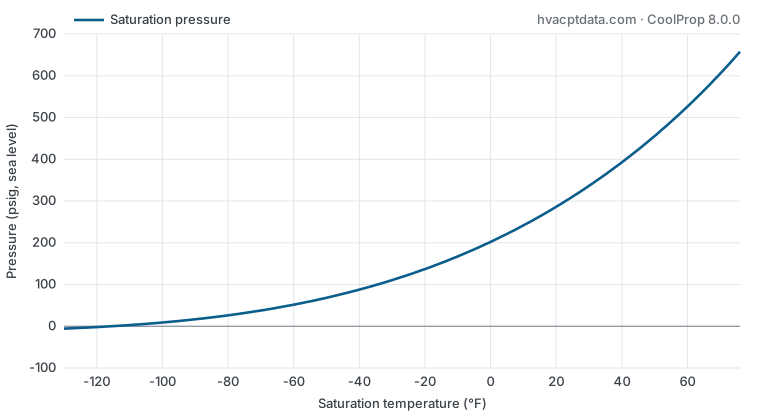
R-23 is an A1 HFC single-component refrigerant. It saturates at 392.7 psig at 40°F and 648.6 psig at 75°F.
Reviewed · PT values computed with CoolProp 8.0.0 and checked against NIST reference data (largest difference 0.1 psi)
R-23 at a glance
| Safety class (ASHRAE 34) | A1: lower toxicity, no flame propagation |
|---|---|
| Type | HFC, single-component refrigerant |
| GWP (100-year, AR4) | 14,800 · AR5: 12,400 |
| Ozone depletion potential | 0 |
| Lubricant | POE (polyolester) |
| Boiling point at 14.7 psia | -115.6°F |
| Critical point | 79.1°F, 701 psia |
| 40°F evaporating | 392.7 psig |
| 75°F condensing | 648.6 psig |
| Charge as | Vapor or liquid |
| Typical use | Low stage of cascade systems; Ultra-low temperature lab and medical freezers; Environmental test chambers; Very low temperature refrigeration below -58°F |
| US status | Regulated HFC under the AIM Act phasedown (exchange value 14,800); SNAP-acceptable in very-low-temperature refrigeration since August 26 1994. |
| Replaces | R-13, R-503 |
| Replaced by | R-469A, R-170 (ethane) |
R-23 PT chart (°F and psig)
R-23 is a single-component refrigerant, so one pressure applies at each temperature for both the evaporator and the condenser. Tap a row to load it into the lookup.
-130°F to 76°F · psig at sea level · °C and kPa in the CSV · italic = inches Hg vacuum
| °F | psig |
|---|---|
| -130 | 11.5″ |
| -129 | 10.8″ |
| -128 | 10.2″ |
| -127 | 9.4″ |
| -126 | 8.7″ |
| -125 | 8.0″ |
| -124 | 7.2″ |
| -123 | 6.5″ |
| -122 | 5.6″ |
| -121 | 4.8″ |
| -120 | 4.0″ |
| -119 | 3.1″ |
| -118 | 2.2″ |
| -117 | 1.3″ |
| -116 | 0.3″ |
| -115 | 0.3 |
| -114 | 0.8 |
| -113 | 1.3 |
| -112 | 1.8 |
| -111 | 2.3 |
| -110 | 2.9 |
| -109 | 3.4 |
| -108 | 4.0 |
| -107 | 4.6 |
| -106 | 5.1 |
| -105 | 5.7 |
| -104 | 6.4 |
| -103 | 7.0 |
| -102 | 7.6 |
| -101 | 8.3 |
| -100 | 9.0 |
| -99 | 9.7 |
| -98 | 10.4 |
| -97 | 11.1 |
| -96 | 11.9 |
| -95 | 12.6 |
| -94 | 13.4 |
| -93 | 14.2 |
| -92 | 15.0 |
| -91 | 15.8 |
| -90 | 16.7 |
| -89 | 17.5 |
| -88 | 18.4 |
| -87 | 19.3 |
| -86 | 20.2 |
| -85 | 21.2 |
| -84 | 22.1 |
| -83 | 23.1 |
| -82 | 24.1 |
| -81 | 25.1 |
| -80 | 26.2 |
| -79 | 27.2 |
| -78 | 28.3 |
| -77 | 29.4 |
| -76 | 30.5 |
| -75 | 31.7 |
| -74 | 32.9 |
| -73 | 34.0 |
| -72 | 35.3 |
| -71 | 36.5 |
| -70 | 37.8 |
| -69 | 39.0 |
| -68 | 40.3 |
| -67 | 41.7 |
| -66 | 43.0 |
| -65 | 44.4 |
| -64 | 45.8 |
| -63 | 47.2 |
| -62 | 48.7 |
| -61 | 50.2 |
| -60 | 51.7 |
| -59 | 53.2 |
| -58 | 54.8 |
| -57 | 56.4 |
| -56 | 58.0 |
| -55 | 59.6 |
| -54 | 61.3 |
| -53 | 63.0 |
| -52 | 64.7 |
| -51 | 66.5 |
| -50 | 68.3 |
| -49 | 70.1 |
| -48 | 71.9 |
| -47 | 73.8 |
| -46 | 75.7 |
| -45 | 77.6 |
| -44 | 79.6 |
| -43 | 81.6 |
| -42 | 83.6 |
| -41 | 85.7 |
| -40 | 87.8 |
| -39 | 89.9 |
| -38 | 92.1 |
| -37 | 94.3 |
| -36 | 96.5 |
| -35 | 98.8 |
| -34 | 101.1 |
| -33 | 103.4 |
| -32 | 105.7 |
| -31 | 108.2 |
| -30 | 110.6 |
| -29 | 113.1 |
| -28 | 115.6 |
| -27 | 118.1 |
| -26 | 120.7 |
| -25 | 123.3 |
| -24 | 126.0 |
| -23 | 128.7 |
| -22 | 131.4 |
| -21 | 134.2 |
| -20 | 137.0 |
| -19 | 139.9 |
| -18 | 142.8 |
| -17 | 145.7 |
| -16 | 148.7 |
| -15 | 151.7 |
| -14 | 154.7 |
| -13 | 157.8 |
| -12 | 161.0 |
| -11 | 164.2 |
| -10 | 167.4 |
| -9 | 170.7 |
| -8 | 174.0 |
| -7 | 177.3 |
| -6 | 180.7 |
| -5 | 184.2 |
| -4 | 187.7 |
| -3 | 191.2 |
| -2 | 194.8 |
| -1 | 198.4 |
| 0 | 202.1 |
| 1 | 205.8 |
| 2 | 209.6 |
| 3 | 213.4 |
| 4 | 217.3 |
| 5 | 221.2 |
| 6 | 225.2 |
| 7 | 229.2 |
| 8 | 233.3 |
| 9 | 237.4 |
| 10 | 241.6 |
| 11 | 245.8 |
| 12 | 250.1 |
| 13 | 254.4 |
| 14 | 258.8 |
| 15 | 263.2 |
| 16 | 267.7 |
| 17 | 272.2 |
| 18 | 276.8 |
| 19 | 281.5 |
| 20 | 286.2 |
| 21 | 290.9 |
| 22 | 295.7 |
| 23 | 300.6 |
| 24 | 305.5 |
| 25 | 310.5 |
| 26 | 315.6 |
| 27 | 320.7 |
| 28 | 325.9 |
| 29 | 331.1 |
| 30 | 336.4 |
| 31 | 341.7 |
| 32 | 347.1 |
| 33 | 352.6 |
| 34 | 358.1 |
| 35 | 363.7 |
| 36 | 369.4 |
| 37 | 375.1 |
| 38 | 380.9 |
| 39 | 386.8 |
| 40 | 392.7 |
| 41 | 398.7 |
| 42 | 404.8 |
| 43 | 410.9 |
| 44 | 417.1 |
| 45 | 423.4 |
| 46 | 429.7 |
| 47 | 436.1 |
| 48 | 442.6 |
| 49 | 449.2 |
| 50 | 455.8 |
| 51 | 462.5 |
| 52 | 469.3 |
| 53 | 476.1 |
| 54 | 483.1 |
| 55 | 490.1 |
| 56 | 497.2 |
| 57 | 504.3 |
| 58 | 511.6 |
| 59 | 518.9 |
| 60 | 526.3 |
| 61 | 533.8 |
| 62 | 541.4 |
| 63 | 549.1 |
| 64 | 556.9 |
| 65 | 564.7 |
| 66 | 572.6 |
| 67 | 580.7 |
| 68 | 588.8 |
| 69 | 597.0 |
| 70 | 605.4 |
| 71 | 613.8 |
| 72 | 622.3 |
| 73 | 631.0 |
| 74 | 639.8 |
| 75 | 648.6 |
| 76 | 657.6 |
Where you will find R-23
R-23 is a very low temperature refrigerant. BITZER describes it for cooling products below -50°C (-58°F). In practice that means the low stage of a cascade system: ultra-low temperature freezers in labs and hospitals, environmental test chambers and other very low temperature process equipment. It replaced R-13 and R-503 in those applications. EPA lists HFC-23 as acceptable in very-low-temperature refrigeration, for new and retrofit equipment, since August 26, 1994.
The reason it needs a cascade is on the chart. The critical point of R-23 is 79.1°F, so it cannot be condensed against room air or outdoor air. A separate high stage condenses the R-23 in a cascade heat exchanger, and the R-23 stage then evaporates at the very low box temperature. The PT chart here runs from -130°F to 76°F, just short of the critical point.
R-23 pressures at low temperature look ordinary: 9.0 psig at -100°F, and a vacuum of 4.0 in Hg at -120°F. Toward the warm end they climb fast, to 392.7 psig at 40°F. A stopped cascade low stage that warms to room temperature is close to or above the critical temperature, so its standstill pressure is not a PT-chart value; the system design and its pressure ratings have to handle that, and you should never assume a low stage at rest sits at a low pressure.
Charging R-23
R-23 is a single-component refrigerant: its composition cannot shift, so it can be charged as vapor or liquid. No manufacturer charging procedure is quoted here; where the nameplate gives a charge weight, weigh it in to that number.
Readings on the low stage work like any pure refrigerant on the low side. Convert suction pressure to saturation temperature with the chart and use the superheat calculator or the PT calculator. Readings near -120°F and below are in a vacuum, so check that your gauge reads in Hg accurately; the pressure converter converts in Hg, psia and kPa. BITZER notes that R-23 discharge temperatures are higher than those of R-13, which the design has to account for.
Check the pressure rating of every gauge, hose and recovery cylinder before connecting to a warm R-23 circuit.
Oil and compatibility
BITZER: polyol ester oils are suitable but must be matched to the special requirements of very low temperature operation. Its refrigerant table also lists PVE, and alkylbenzene with limitations. Use the oil the compressor maker specifies for the low stage. For the oil families, see the refrigerant oil types guide.
Safety, handling and recovery
A1 under ASHRAE 34: lower toxicity, no flame propagation. Section 608 treats R-23 as very-high-pressure, because its critical temperature is below 104°F (40 CFR 82.152 names R-23 as an example). That makes it a Type II job (Universal covers it).
R-23 is a non-exempt substitute. Venting is prohibited, recovery is required to 0 in Hg for very-high-pressure appliances (40 CFR 82.156 Table 1), and since January 1, 2018 sales are restricted to certified technicians (40 CFR 82.154(c)). Use a recovery machine and recovery cylinder rated for the pressure; a warm R-23 charge is not something a standard setup should be assumed to handle.
Cylinders: the legacy color for R-23 was light blue-gray. Since January 1, 2020 new containers are light green-gray RAL 7044 under AHRI Guideline N-2017, with the legacy color kept only on the label. See cylinder colors.
Status and replacements
HFC-23 is a regulated substance under the AIM Act with an exchange value of 14,800 (40 CFR 84 Appendix A). Production and import allowances are 60% of baseline in 2024–2028, 30% in 2029–2033, 20% in 2034–2035 and 15% from 2036 (40 CFR 84.7), so supply tightens as the steps arrive. No Technology Transitions sector limit for very-low-temperature equipment was found in 40 CFR 84.54. The leak repair rule (40 CFR 84.106) applies from January 1, 2026 to appliances with 15 lb or more of HFC charge; many lab freezers hold less, so check the charge on the nameplate.
Alternatives: BITZER lists R-469A, a non-flammable blend of R-32, R-125 and CO2 with a GWP of 1,398, for applications such as climatic stress chambers; it has a distinct temperature glide that needs evaluation per system. R-170 (ethane) is SNAP-acceptable with use conditions in very-low-temperature refrigeration (April 10, 2015), but it is A3, highly flammable. R-508B, an azeotrope of 46% R-23 and 54% R-116, serves the same ultra-low range but still contains R-23. Compare GWPs on the GWP chart.
Common questions
Is there a drop-in replacement for R-23?
No drop-in is listed in the sources used here. BITZER presents R-469A as an alternative in specific applications and warns that its distinct glide needs individual evaluation; ethane is A3 and needs equipment built for a flammable refrigerant.
How this chart was computed
Every pressure on this page is calculated, not copied: CoolProp 8.0.0 (HEOS backend), the open-source implementation of the reference equations of state, using the model pure:R23. Gauge values assume sea-level air pressure (14.696 psia); kPa values in the CSV are absolute.
Spot check against NIST Chemistry WebBook, SRD 69, Thermophysical Properties of Fluid Systems: R23, saturation properties (temperature increments):
| °F | Column | Published | This chart | Difference |
|---|---|---|---|---|
| -100 | saturation | 23.7 psia | 23.7 psia | 0.0 psi |
| -70 | saturation | 52.4 psia | 52.4 psia | 0.0 psi |
| -40 | saturation | 102.5 psia | 102.5 psia | 0.0 psi |
| -60 | saturation | 66.4 psia | 66.4 psia | 0.0 psi |
| -40 | saturation | 102.5 psia | 102.5 psia | -0.0 psi |
| 0 | saturation | 216.9 psia | 216.8 psia | -0.0 psi |
| 40 | saturation | 407.5 psia | 407.4 psia | -0.1 psi |
NIST WebBook implements the same reference equation of state as CoolProp, so near-zero deviation there confirms the implementation and unit handling; Chemours FE-13 bulletin agrees within 0.09 psi.
Charts from different publishers can differ by a few tenths of a psi because of the equation of state and blend tolerances. Always charge to the equipment manufacturer's data. Full method and every spot check
Calculators for R-23
Sources
- BITZER Refrigerant Report: R-23 and VLT refrigerants bitzer.de
- EPA SNAP: Substitutes in Very Low Temperature Refrigeration epa.gov
- eCFR 40 CFR Part 84 Appendix A: regulated substances and exchange values ecfr.gov
- eCFR 40 CFR 84.7: HFC phasedown schedule ecfr.gov
- 89 FR 82682 (Oct 11 2024): HFC Emissions Reduction and Reclamation rule federalregister.gov
- eCFR 40 CFR 82.152: Section 608 definitions and pressure classes ecfr.gov
- eCFR 40 CFR 82.154: venting prohibition and sales restriction ecfr.gov
Reviewed . Found an error? Tell us and we will correct it.
More in Very low temperature