R-245fa PT Chart and Refrigerant Profile
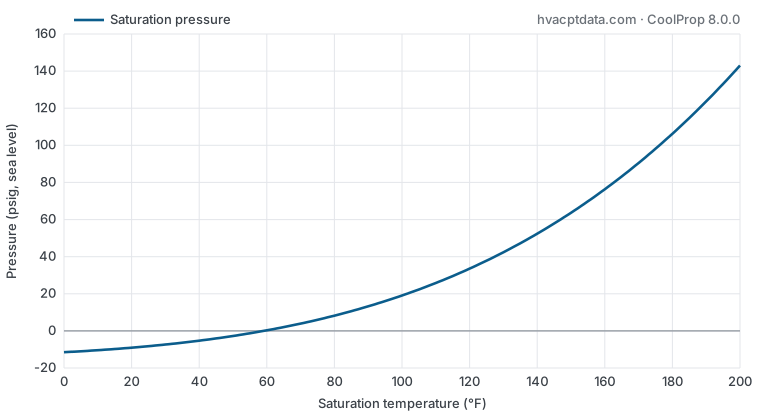
R-245fa is a B1 HFC single-component refrigerant. It saturates at 10.7″ Hg vacuum at 40°F and 19.1 psig at 100°F.
Reviewed · PT values computed with CoolProp 8.0.0 and checked against NIST reference data (largest difference 0.0 psi)
R-245fa at a glance
| Safety class (ASHRAE 34) | B1: higher toxicity, no flame propagation |
|---|---|
| Type | HFC, single-component refrigerant |
| GWP (100-year, AR4) | 1,030 · AR5: 858EPA exchange value 1,030 (40 CFR 84 Appendix A); the 2006 SNAP notice cited 950. |
| Ozone depletion potential | 0 |
| Lubricant | POE (polyolester) |
| Boiling point at 14.7 psia | 59.1°F |
| Critical point | 308.9°F, 530 psia |
| 40°F evaporating | 10.7″ Hg vacuum |
| 100°F condensing | 19.1 psig |
| Charge as | Vapor or liquid |
| Typical use | Low-pressure centrifugal chillers; Organic Rankine cycle (ORC) and waste heat recovery; Industrial process refrigeration; Non-mechanical heat transfer |
| Trade names | Genetron 245fa (Solstice Advanced Materials) |
| US status | Regulated HFC under the AIM Act; EPA's SNAP chiller table lists it unacceptable in new centrifugal chillers (narrowed use limit) as of January 1 2024. |
| Replaces | R-11, R-123, R-113 |
| Replaced by | R-1336mzz(Z), R-1336mzz(E) |
R-245fa PT chart (°F and psig)
R-245fa is a single-component refrigerant, so one pressure applies at each temperature for both the evaporator and the condenser. Tap a row to load it into the lookup.
0°F to 200°F · psig at sea level · °C and kPa in the CSV · italic = inches Hg vacuum
| °F | psig |
|---|---|
| 0 | 23.4″ |
| 1 | 23.2″ |
| 2 | 23.0″ |
| 3 | 22.8″ |
| 4 | 22.6″ |
| 5 | 22.4″ |
| 6 | 22.1″ |
| 7 | 21.9″ |
| 8 | 21.7″ |
| 9 | 21.4″ |
| 10 | 21.2″ |
| 11 | 20.9″ |
| 12 | 20.7″ |
| 13 | 20.4″ |
| 14 | 20.2″ |
| 15 | 19.9″ |
| 16 | 19.6″ |
| 17 | 19.3″ |
| 18 | 19.0″ |
| 19 | 18.7″ |
| 20 | 18.4″ |
| 21 | 18.1″ |
| 22 | 17.8″ |
| 23 | 17.5″ |
| 24 | 17.1″ |
| 25 | 16.8″ |
| 26 | 16.4″ |
| 27 | 16.1″ |
| 28 | 15.7″ |
| 29 | 15.4″ |
| 30 | 15.0″ |
| 31 | 14.6″ |
| 32 | 14.2″ |
| 33 | 13.8″ |
| 34 | 13.4″ |
| 35 | 12.9″ |
| 36 | 12.5″ |
| 37 | 12.1″ |
| 38 | 11.6″ |
| 39 | 11.2″ |
| 40 | 10.7″ |
| 41 | 10.3″ |
| 42 | 9.8″ |
| 43 | 9.3″ |
| 44 | 8.8″ |
| 45 | 8.3″ |
| 46 | 7.8″ |
| 47 | 7.2″ |
| 48 | 6.7″ |
| 49 | 6.1″ |
| 50 | 5.6″ |
| 51 | 5.0″ |
| 52 | 4.4″ |
| 53 | 3.8″ |
| 54 | 3.2″ |
| 55 | 2.6″ |
| 56 | 2.0″ |
| 57 | 1.4″ |
| 58 | 0.7″ |
| 59 | 0.1″ |
| 60 | 0.3 |
| 61 | 0.6 |
| 62 | 1.0 |
| 63 | 1.3 |
| 64 | 1.7 |
| 65 | 2.0 |
| 66 | 2.4 |
| 67 | 2.8 |
| 68 | 3.2 |
| 69 | 3.5 |
| 70 | 3.9 |
| 71 | 4.3 |
| 72 | 4.7 |
| 73 | 5.1 |
| 74 | 5.6 |
| 75 | 6.0 |
| 76 | 6.4 |
| 77 | 6.9 |
| 78 | 7.3 |
| 79 | 7.8 |
| 80 | 8.2 |
| 81 | 8.7 |
| 82 | 9.2 |
| 83 | 9.6 |
| 84 | 10.1 |
| 85 | 10.6 |
| 86 | 11.1 |
| 87 | 11.7 |
| 88 | 12.2 |
| 89 | 12.7 |
| 90 | 13.2 |
| 91 | 13.8 |
| 92 | 14.3 |
| 93 | 14.9 |
| 94 | 15.5 |
| 95 | 16.1 |
| 96 | 16.6 |
| 97 | 17.2 |
| 98 | 17.8 |
| 99 | 18.5 |
| 100 | 19.1 |
| 101 | 19.7 |
| 102 | 20.4 |
| 103 | 21.0 |
| 104 | 21.7 |
| 105 | 22.3 |
| 106 | 23.0 |
| 107 | 23.7 |
| 108 | 24.4 |
| 109 | 25.1 |
| 110 | 25.8 |
| 111 | 26.5 |
| 112 | 27.3 |
| 113 | 28.0 |
| 114 | 28.8 |
| 115 | 29.6 |
| 116 | 30.3 |
| 117 | 31.1 |
| 118 | 31.9 |
| 119 | 32.7 |
| 120 | 33.6 |
| 121 | 34.4 |
| 122 | 35.2 |
| 123 | 36.1 |
| 124 | 37.0 |
| 125 | 37.8 |
| 126 | 38.7 |
| 127 | 39.6 |
| 128 | 40.5 |
| 129 | 41.4 |
| 130 | 42.4 |
| 131 | 43.3 |
| 132 | 44.3 |
| 133 | 45.3 |
| 134 | 46.2 |
| 135 | 47.2 |
| 136 | 48.2 |
| 137 | 49.3 |
| 138 | 50.3 |
| 139 | 51.3 |
| 140 | 52.4 |
| 141 | 53.5 |
| 142 | 54.5 |
| 143 | 55.6 |
| 144 | 56.7 |
| 145 | 57.9 |
| 146 | 59.0 |
| 147 | 60.1 |
| 148 | 61.3 |
| 149 | 62.5 |
| 150 | 63.7 |
| 151 | 64.9 |
| 152 | 66.1 |
| 153 | 67.3 |
| 154 | 68.6 |
| 155 | 69.8 |
| 156 | 71.1 |
| 157 | 72.4 |
| 158 | 73.7 |
| 159 | 75.0 |
| 160 | 76.3 |
| 161 | 77.7 |
| 162 | 79.0 |
| 163 | 80.4 |
| 164 | 81.8 |
| 165 | 83.2 |
| 166 | 84.6 |
| 167 | 86.1 |
| 168 | 87.5 |
| 169 | 89.0 |
| 170 | 90.5 |
| 171 | 92.0 |
| 172 | 93.5 |
| 173 | 95.0 |
| 174 | 96.6 |
| 175 | 98.2 |
| 176 | 99.7 |
| 177 | 101.3 |
| 178 | 103.0 |
| 179 | 104.6 |
| 180 | 106.2 |
| 181 | 107.9 |
| 182 | 109.6 |
| 183 | 111.3 |
| 184 | 113.0 |
| 185 | 114.8 |
| 186 | 116.5 |
| 187 | 118.3 |
| 188 | 120.1 |
| 189 | 121.9 |
| 190 | 123.7 |
| 191 | 125.6 |
| 192 | 127.4 |
| 193 | 129.3 |
| 194 | 131.2 |
| 195 | 133.1 |
| 196 | 135.1 |
| 197 | 137.0 |
| 198 | 139.0 |
| 199 | 141.0 |
| 200 | 143.0 |
Where you will find R-245fa
R-245fa (HFC-245fa) is a low-pressure HFC. In HVAC it shows up in low-pressure centrifugal chillers, where Solstice (formerly Honeywell) describes Genetron 245fa as replacing R-11 in new chillers. It is also a working fluid in organic Rankine cycle (ORC) units, heat pipes and waste heat recovery systems, and EPA lists it for industrial process refrigeration, non-mechanical heat transfer and very low temperature refrigeration. EPA first listed it as acceptable in centrifugal chillers on March 29, 2006.
R-245fa runs at higher pressures than R-123 and R-11, but still low. It boils at 59.1°F at sea level, so a chiller evaporator at 40°F saturation is in a vacuum, 10.7 in Hg. At 100°F it reads 19.1 psig, against 6.1 psig for R-123 and 14.5 psig for R-1233zd(E). Do not read an R-245fa machine against any of those charts. The pressure converter handles in Hg, psia and kPa.
Charging R-245fa
R-245fa is a single-component refrigerant, so it can be charged as liquid or vapor and composition does not shift during leaks or top-offs. One PT column serves the evaporator and condenser. No manufacturer charging procedure was found for chillers or ORC units; charge weight and method come from the equipment manufacturer’s service manual.
The low side of a chiller runs below atmospheric pressure, so low-side leaks draw in air and moisture. A condenser pressure above the saturation pressure for the measured condensing temperature points to non-condensables; check the pair with the PT calculator.
Oil and compatibility
BITZER lists POE for R-245fa. That is a change from the mineral oil or alkylbenzene used with R-11 and R-123, so an R-245fa machine is not interchangeable with those on oil alone. Use the lubricant the chiller or ORC manufacturer specifies.
Safety, handling and recovery
Safety class: B1 under ASHRAE 34, as BITZER and the ICC’s 2021 IMC Table 1103.1 list it. EPA’s SNAP tables for centrifugal chillers and industrial process refrigeration print A1. This page uses the ASHRAE classification. B means higher toxicity (occupational exposure limit below 400 ppm), as with R-123; 1 means no flame propagation. The 2021 IMC refrigerant table also carries it as B1.
Section 608: at 104°F R-245fa saturates at 21.7 psig (36.4 psia), under the 45 psia limit, so it is a low-pressure refrigerant; 40 CFR 82.152 names R-245fa as an example. That requires Type III or Universal 608 certification. Recovery from a low-pressure appliance must reach 25 mm Hg absolute (40 CFR 82.156 Table 1), close to 29 in Hg vacuum at sea level. As a non-exempt substitute it may not be vented, and since January 1, 2018 sales are restricted to certified technicians (40 CFR 82.154(c)).
From January 1, 2026 the HFC leak repair rule (40 CFR 84.106) applies to appliances with 15 lb or more of HFC charge, which covers most chillers.
Cylinders: the legacy color for R-245fa was maroon (PMS 194) in AHRI Guideline N-2017 Table 1. Since January 1, 2020 new containers are light green-gray RAL 7044, with the legacy color only on the label. See cylinder colors.
Status and replacements
HFC-245fa is a regulated substance under the AIM Act, exchange value 1,030 (40 CFR 84 Appendix A). Production and import allowances step down to 60% of baseline in 2024–2028, 30% in 2029–2033, 20% in 2034–2035 and 15% from 2036 (40 CFR 84.7).
New chillers, two separate rules:
- SNAP: EPA’s centrifugal chiller table lists HFC-245fa (Genetron 245fa) as acceptable for new and retrofit use from March 29, 2006, then, under the December 1, 2016 rule (81 FR 86778), “unacceptable in new equipment, except as otherwise allowed under a narrowed use limit, as of January 1, 2024.” That is how EPA prints it; the listing covers new equipment only.
- Technology Transitions: 40 CFR 84.54 bars manufacture and import of comfort-cooling chillers using a regulated substance with GWP 700 or more from January 1, 2025, and of industrial process chillers with leaving fluid above -22°F from January 1, 2026. At 1,030, R-245fa is over that limit.
Servicing existing R-245fa chillers remains legal, and EPA’s industrial process refrigeration table still lists HFC-245fa as acceptable for new and retrofit use.
Replacement options: BITZER lists R-1336mzz(Z) and R-1336mzz(E) as substitutes for R-245fa. For new low-pressure centrifugal chillers EPA also lists R-1233zd(E) and R-514A. Any change of refrigerant in an existing machine needs the chiller manufacturer’s data.
Common questions
Is R-245fa being phased out?
It is under the AIM Act HFC phasedown, so supply tightens in steps through 2036, and new comfort-cooling chillers with GWP 700 or more have been barred since January 1, 2025. Existing equipment can still be serviced.
Is R-245fa A1 or B1?
ASHRAE 34 classifies it B1 (BITZER, ICC 2021 IMC Table 1103.1). EPA’s SNAP tables print A1. Treat it as B1 for machine-room and code purposes.
How this chart was computed
Every pressure on this page is calculated, not copied: CoolProp 8.0.0 (HEOS backend), the open-source implementation of the reference equations of state, using the model pure:R245fa. Gauge values assume sea-level air pressure (14.696 psia); kPa values in the CSV are absolute.
Spot check against NIST Chemistry WebBook, SRD 69, Thermophysical Properties of Fluid Systems: R245fa, saturation properties (temperature increments):
| °F | Column | Published | This chart | Difference |
|---|---|---|---|---|
| 0 | saturation | 3.21 psia | 3.21 psia | 0.0 psi |
| 50 | saturation | 12.0 psia | 12.0 psia | 0.0 psi |
| 100 | saturation | 33.8 psia | 33.8 psia | 0.0 psi |
| 200 | saturation | 157.7 psia | 157.7 psia | 0.0 psi |
NIST WebBook implements the same reference equation of state as CoolProp, so near-zero deviation there confirms the implementation and unit handling. No manufacturer chart was checked.
Charts from different publishers can differ by a few tenths of a psi because of the equation of state and blend tolerances. Always charge to the equipment manufacturer's data. Full method and every spot check
Calculators for R-245fa
Sources
- EPA SNAP: Substitutes in Centrifugal Chillers epa.gov
- EPA SNAP: Substitutes in Industrial Process Refrigeration epa.gov
- 81 FR 86778 (Dec 1 2016): SNAP change of listing status govinfo.gov
- eCFR 40 CFR 84.54: Technology Transitions restrictions ecfr.gov
- eCFR 40 CFR 84.7: HFC phasedown schedule ecfr.gov
- eCFR 40 CFR 82.152: Section 608 definitions and pressure classes ecfr.gov
- BITZER Refrigerant Report: refrigerant data table bitzer.de
- ICC: 2021 IMC A2L changes, Table 1103.1 refrigerant classification iccsafe.org
Reviewed . Found an error? Tell us and we will correct it.
More in Chiller refrigerants