R-407F PT Chart and Refrigerant Profile
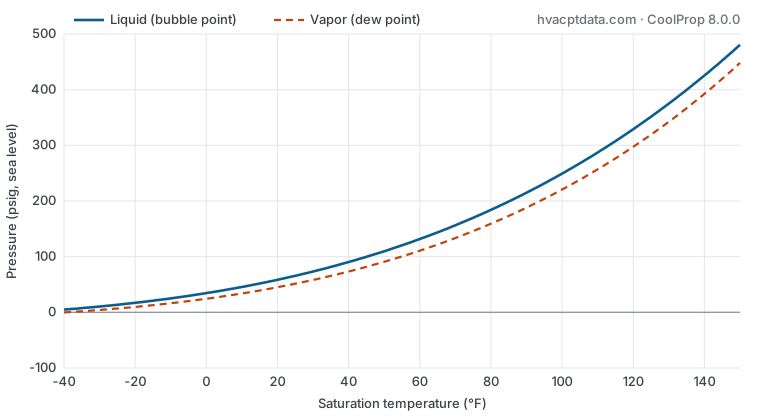
R-407F is an A1 HFC zeotropic blend of R-32, R-125 and R-134a (30/30/40 % by mass). At 40°F its vapor (dew) pressure is 73.4 psig; at 100°F its liquid (bubble) pressure is 249.3 psig.
Reviewed · PT values computed with CoolProp 8.0.0 and checked against a published chart (largest difference 0.2 psi)
R-407F at a glance
| Safety class (ASHRAE 34) | A1: lower toxicity, no flame propagation |
|---|---|
| Type | HFC, zeotropic blend |
| Composition | R-32 30% · R-125 30% · R-134a 40% by mass |
| GWP (100-year, AR4) | 1,825 · AR5: 1,674EPA's 40 CFR 84.64 calculation gives 1,824.5. |
| Ozone depletion potential | 0 |
| Lubricant | POE (polyolester) |
| Boiling point at 14.7 psia | -50.9°F bubble · -39.4°F dew |
| Critical point | 180.7°F, 689 psia |
| 40°F evaporating | 73.4 psig (dew), glide 10.0°F |
| 100°F condensing | 249.3 psig (bubble), glide 8.0°F |
| Charge as | Liquid only (blend can fractionate as vapor) |
| Typical use | Supermarket medium- and low-temperature refrigeration; R-22 and R-404A retrofits |
| Trade names | Genetron Performax LT (Honeywell) |
| US status | Legal to service; GWP 1,825 is above the limits for new remote condensing units (July 27 2026), supermarket systems (Jan 1 2027) and cold storage (700, July 27 2026). |
| Replaces | R-22, R-404A |
| Replaced by | R-448A, R-449A |
R-407F PT chart (°F and psig)
R-407F is a blend, so it has two saturation pressures at each temperature. Read the vapor (dew) column against suction pressure for superheat and the liquid (bubble) column against liquid-line pressure for subcooling. Tap a row to load it into the lookup.
-40°F to 150°F · psig at sea level · °C and kPa in the CSV · italic = inches Hg vacuum
| °F | Liquidbubble psig | Vapordew psig |
|---|---|---|
| -40 | 4.9 | 0.5″ |
| -39 | 5.4 | 0.2 |
| -38 | 5.9 | 0.6 |
| -37 | 6.4 | 1.0 |
| -36 | 7.0 | 1.4 |
| -35 | 7.5 | 1.9 |
| -34 | 8.1 | 2.3 |
| -33 | 8.6 | 2.8 |
| -32 | 9.2 | 3.3 |
| -31 | 9.8 | 3.7 |
| -30 | 10.4 | 4.2 |
| -29 | 11.0 | 4.7 |
| -28 | 11.7 | 5.2 |
| -27 | 12.3 | 5.8 |
| -26 | 12.9 | 6.3 |
| -25 | 13.6 | 6.8 |
| -24 | 14.3 | 7.4 |
| -23 | 15.0 | 8.0 |
| -22 | 15.7 | 8.5 |
| -21 | 16.4 | 9.1 |
| -20 | 17.1 | 9.7 |
| -19 | 17.8 | 10.3 |
| -18 | 18.6 | 10.9 |
| -17 | 19.3 | 11.6 |
| -16 | 20.1 | 12.2 |
| -15 | 20.9 | 12.9 |
| -14 | 21.7 | 13.6 |
| -13 | 22.5 | 14.2 |
| -12 | 23.4 | 14.9 |
| -11 | 24.2 | 15.7 |
| -10 | 25.1 | 16.4 |
| -9 | 26.0 | 17.1 |
| -8 | 26.8 | 17.9 |
| -7 | 27.7 | 18.6 |
| -6 | 28.7 | 19.4 |
| -5 | 29.6 | 20.2 |
| -4 | 30.6 | 21.0 |
| -3 | 31.5 | 21.8 |
| -2 | 32.5 | 22.7 |
| -1 | 33.5 | 23.5 |
| 0 | 34.5 | 24.4 |
| 1 | 35.5 | 25.3 |
| 2 | 36.6 | 26.2 |
| 3 | 37.7 | 27.1 |
| 4 | 38.7 | 28.0 |
| 5 | 39.8 | 28.9 |
| 6 | 41.0 | 29.9 |
| 7 | 42.1 | 30.9 |
| 8 | 43.2 | 31.9 |
| 9 | 44.4 | 32.9 |
| 10 | 45.6 | 33.9 |
| 11 | 46.8 | 34.9 |
| 12 | 48.0 | 36.0 |
| 13 | 49.3 | 37.1 |
| 14 | 50.5 | 38.2 |
| 15 | 51.8 | 39.3 |
| 16 | 53.1 | 40.4 |
| 17 | 54.4 | 41.6 |
| 18 | 55.7 | 42.7 |
| 19 | 57.1 | 43.9 |
| 20 | 58.5 | 45.1 |
| 21 | 59.9 | 46.3 |
| 22 | 61.3 | 47.6 |
| 23 | 62.7 | 48.8 |
| 24 | 64.2 | 50.1 |
| 25 | 65.6 | 51.4 |
| 26 | 67.1 | 52.7 |
| 27 | 68.6 | 54.1 |
| 28 | 70.2 | 55.4 |
| 29 | 71.7 | 56.8 |
| 30 | 73.3 | 58.2 |
| 31 | 74.9 | 59.6 |
| 32 | 76.5 | 61.1 |
| 33 | 78.2 | 62.5 |
| 34 | 79.9 | 64.0 |
| 35 | 81.6 | 65.5 |
| 36 | 83.3 | 67.0 |
| 37 | 85.0 | 68.6 |
| 38 | 86.8 | 70.1 |
| 39 | 88.5 | 71.7 |
| 40 | 90.3 | 73.4 |
| 41 | 92.2 | 75.0 |
| 42 | 94.0 | 76.7 |
| 43 | 95.9 | 78.3 |
| 44 | 97.8 | 80.1 |
| 45 | 99.7 | 81.8 |
| 46 | 101.7 | 83.5 |
| 47 | 103.7 | 85.3 |
| 48 | 105.7 | 87.1 |
| 49 | 107.7 | 89.0 |
| 50 | 109.7 | 90.8 |
| 51 | 111.8 | 92.7 |
| 52 | 113.9 | 94.6 |
| 53 | 116.0 | 96.5 |
| 54 | 118.2 | 98.5 |
| 55 | 120.4 | 100.5 |
| 56 | 122.6 | 102.5 |
| 57 | 124.8 | 104.5 |
| 58 | 127.1 | 106.6 |
| 59 | 129.4 | 108.7 |
| 60 | 131.7 | 110.8 |
| 61 | 134.0 | 112.9 |
| 62 | 136.4 | 115.1 |
| 63 | 138.8 | 117.3 |
| 64 | 141.2 | 119.5 |
| 65 | 143.7 | 121.8 |
| 66 | 146.2 | 124.1 |
| 67 | 148.7 | 126.4 |
| 68 | 151.2 | 128.7 |
| 69 | 153.8 | 131.1 |
| 70 | 156.4 | 133.5 |
| 71 | 159.0 | 135.9 |
| 72 | 161.7 | 138.4 |
| 73 | 164.4 | 140.9 |
| 74 | 167.1 | 143.4 |
| 75 | 169.9 | 146.0 |
| 76 | 172.6 | 148.6 |
| 77 | 175.5 | 151.2 |
| 78 | 178.3 | 153.8 |
| 79 | 181.2 | 156.5 |
| 80 | 184.1 | 159.2 |
| 81 | 187.0 | 161.9 |
| 82 | 190.0 | 164.7 |
| 83 | 193.0 | 167.5 |
| 84 | 196.0 | 170.4 |
| 85 | 199.1 | 173.3 |
| 86 | 202.2 | 176.2 |
| 87 | 205.4 | 179.1 |
| 88 | 208.5 | 182.1 |
| 89 | 211.7 | 185.1 |
| 90 | 215.0 | 188.2 |
| 91 | 218.2 | 191.2 |
| 92 | 221.5 | 194.4 |
| 93 | 224.9 | 197.5 |
| 94 | 228.3 | 200.7 |
| 95 | 231.7 | 203.9 |
| 96 | 235.1 | 207.2 |
| 97 | 238.6 | 210.5 |
| 98 | 242.1 | 213.8 |
| 99 | 245.7 | 217.2 |
| 100 | 249.3 | 220.6 |
| 101 | 252.9 | 224.1 |
| 102 | 256.5 | 227.6 |
| 103 | 260.2 | 231.1 |
| 104 | 264.0 | 234.7 |
| 105 | 267.8 | 238.3 |
| 106 | 271.6 | 241.9 |
| 107 | 275.4 | 245.6 |
| 108 | 279.3 | 249.3 |
| 109 | 283.2 | 253.1 |
| 110 | 287.2 | 256.9 |
| 111 | 291.2 | 260.8 |
| 112 | 295.3 | 264.7 |
| 113 | 299.3 | 268.6 |
| 114 | 303.5 | 272.6 |
| 115 | 307.6 | 276.6 |
| 116 | 311.8 | 280.7 |
| 117 | 316.1 | 284.8 |
| 118 | 320.3 | 289.0 |
| 119 | 324.7 | 293.2 |
| 120 | 329.0 | 297.4 |
| 121 | 333.4 | 301.7 |
| 122 | 337.9 | 306.0 |
| 123 | 342.4 | 310.4 |
| 124 | 346.9 | 314.8 |
| 125 | 351.5 | 319.3 |
| 126 | 356.1 | 323.8 |
| 127 | 360.8 | 328.4 |
| 128 | 365.5 | 333.0 |
| 129 | 370.2 | 337.7 |
| 130 | 375.0 | 342.4 |
| 131 | 379.9 | 347.2 |
| 132 | 384.7 | 352.0 |
| 133 | 389.7 | 356.9 |
| 134 | 394.6 | 361.8 |
| 135 | 399.7 | 366.8 |
| 136 | 404.7 | 371.8 |
| 137 | 409.8 | 376.9 |
| 138 | 415.0 | 382.0 |
| 139 | 420.2 | 387.2 |
| 140 | 425.4 | 392.4 |
| 141 | 430.7 | 397.7 |
| 142 | 436.1 | 403.1 |
| 143 | 441.5 | 408.5 |
| 144 | 446.9 | 414.0 |
| 145 | 452.4 | 419.5 |
| 146 | 457.9 | 425.1 |
| 147 | 463.5 | 430.7 |
| 148 | 469.1 | 436.4 |
| 149 | 474.8 | 442.2 |
| 150 | 480.6 | 448.0 |
Where you will find R-407F
R-407F is an all-HFC blend that Honeywell sold as Genetron Performax LT for supermarket medium- and low-temperature refrigeration and for converting R-22 and R-404A systems (BITZER). The Performax LT name does not appear on the current US product list of Solstice Advanced Materials, Honeywell’s refrigerants spin-off, so expect to find R-407F mostly in existing supermarket racks rather than new installs.
It shares its three components with R-407A and R-407C but in a 30/30/40 mix, with the most R-32 of the three. That gives it higher pressures than R-407A: at a 40°F evaporating dew point the computed charts give 73.4 psig for R-407F and 69.4 psig for R-407A. Do not use an R-407C or R-407A chart on an R-407F system. Check the rack’s refrigerant label and any retrofit tag, since converted racks often still carry R-22 or R-404A compressor labels.
Charging R-407F
R-407F is zeotropic, with about 10.0°F of glide at 40°F evaporating and 8.0°F at 100°F condensing (computed data). Charge it as liquid, as for any zeotropic blend, so the circulating composition matches the cylinder. No R-407F-specific manufacturer charging statement was found for this page; follow the equipment maker’s or retrofit guideline’s procedure for metering rate and final charge.
At 40°F the bubble pressure is 90.3 psig and the dew pressure 73.4 psig. Use the dew column with suction pressure for superheat and the bubble column with liquid-line pressure for subcooling. The temperature glide calculator shows the spread at the pressure on your gauge, and the PT chart guide covers bubble and dew.
On TXV and EEV systems, charge to the manufacturer’s subcooling or charging instructions and check the result with the subcooling calculator. The target superheat calculator follows the CEC table for fixed-metering comfort air conditioners and does not apply to refrigeration racks.
BITZER notes that R-407F runs a higher discharge temperature than R-404A, so extra compressor cooling may be needed. On a conversion from R-404A, confirm with the compressor maker that R-407F is approved at your operating conditions and what cooling it requires.
This chart was spot-checked against Honeywell’s PT chart for Performax LT, with differences of 0.16 psi or less.
Oil and compatibility
Honeywell lists POE for R-407F, and BITZER lists POE or PVE, with alkylbenzene only of limited use. Use the oil grade on the compressor label.
Because the lubricant is POE, an R-22 system running mineral oil needs an oil change when converted; the acceptable residual mineral oil comes from the retrofit guideline. R-404A systems already run POE. The oil types guide explains POE, PVE, mineral oil and alkylbenzene.
Safety, handling and recovery
R-407F is class A1: lower toxicity, no flame propagation. Standard tools apply, and the recovery machine should be certified to Appendix B3 (AHRI 740).
It is a high-pressure appliance refrigerant under 40 CFR 82.152 (liquid saturation pressure 170–355 psia at 104°F). Section 608 Type II or Universal certification is required, and sales are restricted to certified technicians. Recover to 0 in Hg on systems under 200 lb and to 10 in Hg on 200 lb or more (equipment made after November 15, 1993, 40 CFR 82.156).
From January 1, 2026, appliances with 15 lb or more of HFC are covered by the leak repair rules in 40 CFR 84.106, and commercial refrigeration with 1,500 lb or more needs automatic leak detection (84.108).
No legacy cylinder color for R-407F was verified. New containers since January 1, 2020 are light green-gray (RAL 7044) under AHRI Guideline N-2017, with the refrigerant named on the label. See cylinder colors.
Status and replacements
Servicing existing R-407F systems is legal. Supply follows the AIM Act allowance cuts in 40 CFR 84.7 (60% of baseline in 2024–2028, 30% from 2029).
For new equipment, R-407F’s GWP of 1,825 is above the 1,400 limit the May 2026 final rule (91 FR 31284) set for new remote condensing units from July 27, 2026 and new supermarket systems from January 1, 2027, and above the 700 limit for new cold storage from July 27, 2026. Lower 150/300 limits apply in those sectors from January 1, 2032. 40 CFR 84.54 also names R-407F as restricted in new large ice machines and refrigerated food processing and dispensing equipment from 2027. EPA SNAP still lists R-407F as acceptable in cold storage warehouses, but the Technology Transitions GWP limit now governs new cold storage systems.
From January 1, 2029, servicing supermarket systems, refrigerated transport and automatic commercial ice makers must use reclaimed refrigerant (40 CFR 84.112(e)). Supermarket racks are R-407F’s main use, so that requirement will cover most R-407F service.
The listed successors are R-448A and R-449A, both A1 POE blends with GWP under 1,400. New systems that must meet the 2032 limits are moving to A2L blends such as R-454A and R-454C, or to CO2. See the R-404A replacement comparison.
Common questions
What is the difference between R-407F and R-407C?
Both are R-32/R-125/R-134a blends. R-407F is 30/30/40 and was built for refrigeration; R-407C is 23/25/52 and is the air-conditioning blend. R-407F runs higher pressures (73.4 psig vs 63.2 psig at a 40°F dew point on the computed charts), so the charts are not interchangeable.
What oil does R-407F use?
POE (Honeywell). BITZER also lists PVE and limited alkylbenzene use.
How this chart was computed
Every pressure on this page is calculated, not copied: CoolProp 8.0.0 (HEOS backend), the open-source implementation of the reference equations of state, using the model mix:R407F at the nominal ASHRAE 34 composition. Gauge values assume sea-level air pressure (14.696 psia); kPa values in the CSV are absolute.
Spot check against Honeywell PT Charts for A/C and Refrigeration, G525-710, August 2017 (Genetron Performax LT / R-407F columns):
| °F | Column | Published | This chart | Difference |
|---|---|---|---|---|
| 1.8 | dew | 26.0 psig | 26.0 psig | -0.0 psi |
| -0.5 | bubble | 34.0 psig | 34.0 psig | 0.0 psi |
| 36 | dew | 67.0 psig | 67.0 psig | +0.0 psi |
| 35.9 | bubble | 83.0 psig | 83.1 psig | +0.1 psi |
| 97.5 | dew | 212.0 psig | 212.2 psig | +0.2 psi |
| 99.1 | bubble | 246.0 psig | 246.0 psig | +0.0 psi |
Honeywell chart is pressure-based; computed pressure at the printed temperature.
Charts from different publishers can differ by a few tenths of a psi because of the equation of state and blend tolerances. Always charge to the equipment manufacturer's data. Full method and every spot check
Calculators for R-407F
Sources
- BITZER Refrigerant Report: R-407F bitzer.de
- BITZER Refrigerant Report refrigerant data table bitzer.de
- eCFR 40 CFR 84.54 - Technology Transitions restrictions ecfr.gov
- 91 FR 31284 (May 26 2026): Reconsideration of Technology Transitions requirements, final rule federalregister.gov
- eCFR 40 CFR 84.112 - Reclaimed refrigerant servicing requirements ecfr.gov
- EPA SNAP: Substitutes in Cold Storage Warehouses epa.gov
- eCFR 40 CFR 82.156 - Evacuation requirements for recovery ecfr.gov
Reviewed . Found an error? Tell us and we will correct it.
More in Commercial refrigeration