R-717 (ammonia) PT Chart and Refrigerant Profile
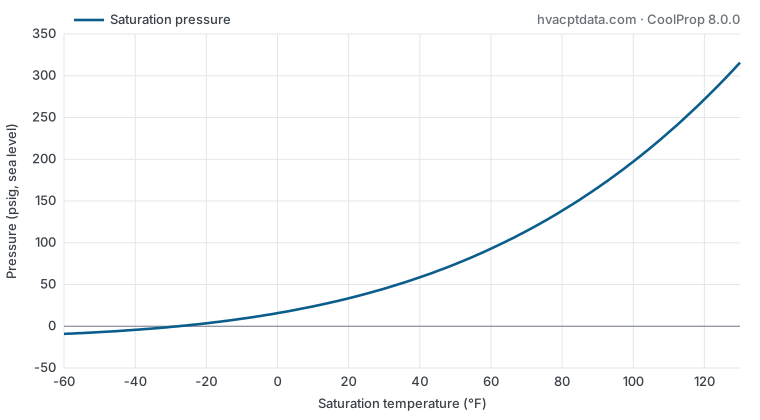
R-717 (ammonia) is a B2L natural single-component refrigerant. It saturates at 58.6 psig at 40°F and 197.2 psig at 100°F.
Reviewed · PT values computed with CoolProp 8.0.0 and checked against NIST reference data (largest difference 0.0 psi)
R-717 at a glance
| Safety class (ASHRAE 34) | B2L: higher toxicity, mildly flammable |
|---|---|
| Type | Natural, single-component refrigerant |
| GWP (100-year, AR4) | Not listed in AR4No IPCC value. EPA uses 1 under 40 CFR 84.64; EPA SNAP pages list 0. |
| Ozone depletion potential | 0 |
| Lubricant | Mineral oil or PAO |
| Boiling point at 14.7 psia | -28.0°F |
| Critical point | 270.3°F, 1,648 psia |
| 40°F evaporating | 58.6 psig |
| 100°F condensing | 197.2 psig |
| Charge as | Vapor or liquid |
| Typical use | Industrial refrigeration (food processing; cold storage warehouses); Ice rinks; Ammonia/CO2 cascade systems; Packaged low-charge ammonia chillers; Absorption systems |
| US status | Not an ODS or regulated HFC; SNAP-acceptable in cold storage warehouses and centrifugal chillers since March 18 1994; venting-exempt in commercial and industrial process refrigeration. |
R-717 PT chart (°F and psig)
R-717 is a single-component refrigerant, so one pressure applies at each temperature for both the evaporator and the condenser. Tap a row to load it into the lookup.
-60°F to 130°F · psig at sea level · °C and kPa in the CSV · italic = inches Hg vacuum
| °F | psig |
|---|---|
| -60 | 18.6″ |
| -59 | 18.3″ |
| -58 | 17.9″ |
| -57 | 17.5″ |
| -56 | 17.1″ |
| -55 | 16.6″ |
| -54 | 16.2″ |
| -53 | 15.8″ |
| -52 | 15.3″ |
| -51 | 14.8″ |
| -50 | 14.4″ |
| -49 | 13.8″ |
| -48 | 13.3″ |
| -47 | 12.8″ |
| -46 | 12.3″ |
| -45 | 11.7″ |
| -44 | 11.2″ |
| -43 | 10.6″ |
| -42 | 10.0″ |
| -41 | 9.4″ |
| -40 | 8.8″ |
| -39 | 8.1″ |
| -38 | 7.5″ |
| -37 | 6.8″ |
| -36 | 6.1″ |
| -35 | 5.4″ |
| -34 | 4.7″ |
| -33 | 4.0″ |
| -32 | 3.2″ |
| -31 | 2.4″ |
| -30 | 1.6″ |
| -29 | 0.9″ |
| -28 | 0.0″ |
| -27 | 0.4 |
| -26 | 0.8 |
| -25 | 1.3 |
| -24 | 1.7 |
| -23 | 2.2 |
| -22 | 2.6 |
| -21 | 3.1 |
| -20 | 3.6 |
| -19 | 4.1 |
| -18 | 4.6 |
| -17 | 5.1 |
| -16 | 5.6 |
| -15 | 6.2 |
| -14 | 6.7 |
| -13 | 7.3 |
| -12 | 7.8 |
| -11 | 8.4 |
| -10 | 9.0 |
| -9 | 9.6 |
| -8 | 10.3 |
| -7 | 10.9 |
| -6 | 11.5 |
| -5 | 12.2 |
| -4 | 12.9 |
| -3 | 13.6 |
| -2 | 14.3 |
| -1 | 15.0 |
| 0 | 15.7 |
| 1 | 16.4 |
| 2 | 17.2 |
| 3 | 18.0 |
| 4 | 18.8 |
| 5 | 19.6 |
| 6 | 20.4 |
| 7 | 21.2 |
| 8 | 22.0 |
| 9 | 22.9 |
| 10 | 23.8 |
| 11 | 24.7 |
| 12 | 25.6 |
| 13 | 26.5 |
| 14 | 27.5 |
| 15 | 28.4 |
| 16 | 29.4 |
| 17 | 30.4 |
| 18 | 31.4 |
| 19 | 32.4 |
| 20 | 33.5 |
| 21 | 34.6 |
| 22 | 35.6 |
| 23 | 36.7 |
| 24 | 37.9 |
| 25 | 39.0 |
| 26 | 40.2 |
| 27 | 41.4 |
| 28 | 42.6 |
| 29 | 43.8 |
| 30 | 45.0 |
| 31 | 46.3 |
| 32 | 47.6 |
| 33 | 48.9 |
| 34 | 50.2 |
| 35 | 51.5 |
| 36 | 52.9 |
| 37 | 54.3 |
| 38 | 55.7 |
| 39 | 57.1 |
| 40 | 58.6 |
| 41 | 60.1 |
| 42 | 61.6 |
| 43 | 63.1 |
| 44 | 64.7 |
| 45 | 66.2 |
| 46 | 67.8 |
| 47 | 69.5 |
| 48 | 71.1 |
| 49 | 72.8 |
| 50 | 74.5 |
| 51 | 76.2 |
| 52 | 77.9 |
| 53 | 79.7 |
| 54 | 81.5 |
| 55 | 83.3 |
| 56 | 85.2 |
| 57 | 87.1 |
| 58 | 89.0 |
| 59 | 90.9 |
| 60 | 92.9 |
| 61 | 94.9 |
| 62 | 96.9 |
| 63 | 98.9 |
| 64 | 101.0 |
| 65 | 103.1 |
| 66 | 105.3 |
| 67 | 107.4 |
| 68 | 109.6 |
| 69 | 111.8 |
| 70 | 114.1 |
| 71 | 116.4 |
| 72 | 118.7 |
| 73 | 121.0 |
| 74 | 123.4 |
| 75 | 125.8 |
| 76 | 128.3 |
| 77 | 130.7 |
| 78 | 133.2 |
| 79 | 135.8 |
| 80 | 138.4 |
| 81 | 141.0 |
| 82 | 143.6 |
| 83 | 146.3 |
| 84 | 149.0 |
| 85 | 151.7 |
| 86 | 154.5 |
| 87 | 157.3 |
| 88 | 160.2 |
| 89 | 163.0 |
| 90 | 166.0 |
| 91 | 168.9 |
| 92 | 171.9 |
| 93 | 174.9 |
| 94 | 178.0 |
| 95 | 181.1 |
| 96 | 184.3 |
| 97 | 187.4 |
| 98 | 190.6 |
| 99 | 193.9 |
| 100 | 197.2 |
| 101 | 200.5 |
| 102 | 203.9 |
| 103 | 207.3 |
| 104 | 210.8 |
| 105 | 214.3 |
| 106 | 217.8 |
| 107 | 221.4 |
| 108 | 225.0 |
| 109 | 228.7 |
| 110 | 232.4 |
| 111 | 236.1 |
| 112 | 239.9 |
| 113 | 243.7 |
| 114 | 247.6 |
| 115 | 251.5 |
| 116 | 255.5 |
| 117 | 259.5 |
| 118 | 263.5 |
| 119 | 267.6 |
| 120 | 271.8 |
| 121 | 275.9 |
| 122 | 280.2 |
| 123 | 284.4 |
| 124 | 288.8 |
| 125 | 293.1 |
| 126 | 297.6 |
| 127 | 302.0 |
| 128 | 306.5 |
| 129 | 311.1 |
| 130 | 315.7 |
Where you will find R-717
Ammonia is the workhorse of industrial refrigeration: food processing plants, cold storage warehouses, ice rinks, ammonia/CO2 cascade systems (ammonia on the high stage, R-744 on the low stage), packaged low-charge ammonia chillers and absorption systems.
EPA lists ammonia vapor compression as acceptable in centrifugal chillers and cold storage warehouses, first listed March 18, 1994. You will not find it in residential or light commercial comfort equipment.
On the gauges, ammonia sits in a familiar range. At 40°F saturation it reads 58.6 psig, at 0°F 15.7 psig, and it drops into a vacuum below its boiling point (shown in the at-a-glance table): at -40°F it reads 8.8 in Hg vacuum. What sets it apart is the energy per pound. At 40°F its latent heat is 535.6 Btu/lb, against 86.6 Btu/lb for R-22, more than six times as much, so circulated mass and charge per ton are far smaller.
Charging R-717
No manufacturer charging statement is quoted here. Industrial ammonia systems are engineered plants, charged to the system designer’s documented procedure; follow it.
Ammonia is a single-component refrigerant, so it has no glide and one PT column applies to the evaporator and the condenser alike. The chart works as with any pure fluid: convert suction pressure to saturation temperature for superheat with the superheat calculator, and condenser pressure to saturation temperature for subcooling with the subcooling calculator. Low-temperature systems run in a vacuum, so make sure your gauge reads in Hg; the pressure converter handles in Hg, psig, psia and bar.
Oil and compatibility
Mineral oil and PAO are standard. Both are virtually insoluble in ammonia, so oil that leaves the compressor collects in the system and is drained from low points (BITZER). BITZER’s standard oils for its ammonia compressors are Reniso KC68 (mineral) or SHC226E (PAO), with Reniso UltraCool 68 (PAO) recommended. PAG oil is soluble in ammonia but strongly hygroscopic, and BITZER does not approve it for its reciprocating compressors. Use the oil the compressor maker specifies. More in the refrigerant oil types guide.
Safety, handling and recovery
R-717 is B2L under ASHRAE 34. The B means higher toxicity: occupational exposure limit below 400 ppm. The 2L means mildly flammable: LFL above 0.10 kg/m³, heat of combustion below 19,000 kJ/kg and burning velocity of 10 cm/s or less. Ammonia was classed B2 before ASHRAE 34 introduced the 2L class (the 2010 edition), and EPA’s SNAP pages still print B2. The flammability classes page explains the letters and numbers.
Section 608: at 104°F ammonia saturates at 210.8 psig (225.5 psia), which is the high-pressure class (170 to 355 psia) in 40 CFR 82.152. Under 40 CFR 82.154(a)(1), ammonia is exempt from the venting prohibition in commercial or industrial process refrigeration and in absorption units. In those uses the 608 certification requirement does not apply. In any other use it would be treated like other non-exempt refrigerants: Type II certification, and recovery to 0 in Hg for a high-pressure appliance under 200 lb or 10 in Hg for 200 lb or more.
Federal workplace safety and accident-prevention programs for large ammonia inventories are separate from Section 608 and are not covered here; confirm what applies to your site with the facility’s safety program.
Cylinders: AHRI Guideline N-2017 assigns light green-gray RAL 7044 to new refrigerant containers, but ammonia is normally supplied as an industrial gas in its own cylinders or in bulk. Identify it from the label and the supplier’s documentation. See cylinder colors.
Status and replacements
Ammonia is not an ozone-depleting substance and not a regulated HFC, so the AIM Act allowance phasedown and Technology Transitions GWP limits do not restrict it. There is no IPCC GWP value for it; EPA assigns 1 in 40 CFR 84.64 and its SNAP pages list 0. No replacement is listed for it; ammonia/CO2 cascades and packaged low-charge ammonia chillers are current ways it is applied. See how it compares on the GWP chart.
Common questions
What is R-717?
R-717 is the ASHRAE refrigerant number for ammonia (NH3). It is a natural refrigerant used mainly in industrial refrigeration, classed B2L: higher toxicity, mildly flammable.
What is ammonia’s refrigerant safety classification?
ASHRAE 34 gives B2L. Some EPA pages still show B2, the classification used before ASHRAE 34 added the 2L subclass in its 2010 edition.
How this chart was computed
Every pressure on this page is calculated, not copied: CoolProp 8.0.0 (HEOS backend), the open-source implementation of the reference equations of state, using the model pure:Ammonia. Gauge values assume sea-level air pressure (14.696 psia); kPa values in the CSV are absolute.
Spot check against NIST Chemistry WebBook, SRD 69, Thermophysical Properties of Fluid Systems: Ammonia, saturation properties (temperature increments):
| °F | Column | Published | This chart | Difference |
|---|---|---|---|---|
| -40 | saturation | 10.4 psia | 10.4 psia | 0.0 psi |
| 0 | saturation | 30.4 psia | 30.4 psia | 0.0 psi |
| 40 | saturation | 73.3 psia | 73.3 psia | 0.0 psi |
| 120 | saturation | 286.4 psia | 286.4 psia | 0.0 psi |
| 0 | saturation | 15.7 psig | 15.7 psig | -0.0 psi |
| 40 | saturation | 58.6 psig | 58.6 psig | 0.0 psi |
| 100 | saturation | 197.2 psig | 197.2 psig | -0.0 psi |
NIST WebBook implements the same reference equation of state as CoolProp, so near-zero deviation there confirms the implementation and unit handling; Tanner Industries table agrees within 0.01 psi.
Charts from different publishers can differ by a few tenths of a psi because of the equation of state and blend tolerances. Always charge to the equipment manufacturer's data. Full method and every spot check
Calculators for R-717
Sources
- UNEP/ASHRAE Factsheet: refrigerant designations and safety classifications ashrae.org
- BITZER AT-640: ammonia compressor lubricants bitzer.de
- BITZER Refrigerant Report: refrigerant data table bitzer.de
- EPA SNAP: Substitutes in Cold Storage Warehouses epa.gov
- EPA SNAP: Substitutes in Centrifugal Chillers epa.gov
- eCFR 40 CFR 82.154: venting prohibition and exempt substitutes ecfr.gov
- eCFR 40 CFR 82.152: Section 608 definitions and pressure classes ecfr.gov
Reviewed . Found an error? Tell us and we will correct it.
More in Natural refrigerants