R-416A PT Chart and Refrigerant Profile
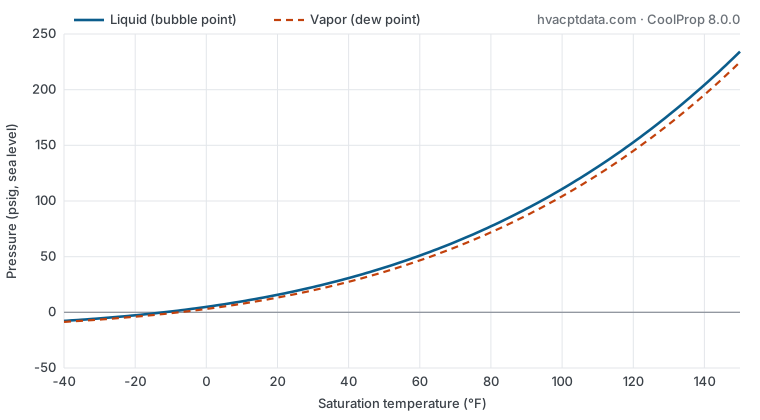
R-416A is an A1 HCFC/HFC blend zeotropic blend of R-134a, R-124 and R-600 (59/39.5/1.5 % by mass). At 40°F its vapor (dew) pressure is 27.4 psig; at 100°F its liquid (bubble) pressure is 110.8 psig.
Reviewed · PT values computed with CoolProp 8.0.0 and checked against a published chart (largest difference 2.8 psi)
Accuracy note. The open mixture model used for R-416A gives liquid (bubble) pressures up to 2.8 psi above the manufacturer's published chart (at 100°F). The difference is listed in How this chart was computed. When you set a charge on R-416A, use the manufacturer's chart or the equipment charging chart.
R-416A at a glance
| Safety class (ASHRAE 34) | A1: lower toxicity, no flame propagation |
|---|---|
| Type | HCFC/HFC blend, zeotropic blend |
| Composition | R-134a 59% · R-124 39.5% · R-600 1.5% by mass |
| GWP (100-year, AR4) | 1,084 · AR5: 975AR4 sum uses 4 for the butane share. EPA's 40 CFR 84.64 value is 843.8 because HCFC-124 is not counted. |
| Ozone depletion potential | 0.009 |
| Lubricant | No manufacturer guidance found; follow the compressor maker |
| Boiling point at 14.7 psia | -12.0°F bubble · -7.8°F dew |
| Critical point | 222.9°F, 569 psia |
| 40°F evaporating | 27.4 psig (dew), glide 4.0°F |
| 100°F condensing | 110.8 psig (bubble), glide 3.5°F |
| Charge as | Liquid only (blend can fractionate as vapor) |
| Typical use | R-12 retrofit in vehicle A/C (listed 1995) and stationary refrigeration (household, vending, ice machines, cold storage, transport) |
| Trade names | ASPEN R416A (ASPEN Refrigerants), Frigc R-416A (CFC Refimax) |
| US status | HCFC-124-containing blend; newly produced HCFC-124 may only service equipment made before Jan 1 2020, and HCFC-124 allowances reach zero in 2030. |
| Replaces | R-12 |
R-416A PT chart (°F and psig)
R-416A is a blend, so it has two saturation pressures at each temperature. Read the vapor (dew) column against suction pressure for superheat and the liquid (bubble) column against liquid-line pressure for subcooling. Tap a row to load it into the lookup.
-40°F to 150°F · psig at sea level · °C and kPa in the CSV · italic = inches Hg vacuum
| °F | Liquidbubble psig | Vapordew psig |
|---|---|---|
| -40 | 15.7″ | 17.4″ |
| -39 | 15.2″ | 17.0″ |
| -38 | 14.8″ | 16.7″ |
| -37 | 14.4″ | 16.3″ |
| -36 | 14.0″ | 15.9″ |
| -35 | 13.5″ | 15.5″ |
| -34 | 13.1″ | 15.0″ |
| -33 | 12.6″ | 14.6″ |
| -32 | 12.1″ | 14.2″ |
| -31 | 11.6″ | 13.7″ |
| -30 | 11.1″ | 13.3″ |
| -29 | 10.6″ | 12.8″ |
| -28 | 10.1″ | 12.3″ |
| -27 | 9.5″ | 11.8″ |
| -26 | 9.0″ | 11.3″ |
| -25 | 8.4″ | 10.8″ |
| -24 | 7.8″ | 10.3″ |
| -23 | 7.3″ | 9.7″ |
| -22 | 6.7″ | 9.2″ |
| -21 | 6.0″ | 8.6″ |
| -20 | 5.4″ | 8.0″ |
| -19 | 4.8″ | 7.5″ |
| -18 | 4.2″ | 6.9″ |
| -17 | 3.5″ | 6.3″ |
| -16 | 2.8″ | 5.6″ |
| -15 | 2.1″ | 5.0″ |
| -14 | 1.4″ | 4.3″ |
| -13 | 0.7″ | 3.7″ |
| -12 | 0.0 | 3.0″ |
| -11 | 0.4 | 2.3″ |
| -10 | 0.8 | 1.6″ |
| -9 | 1.1 | 0.9″ |
| -8 | 1.5 | 0.2″ |
| -7 | 1.9 | 0.3 |
| -6 | 2.3 | 0.7 |
| -5 | 2.7 | 1.0 |
| -4 | 3.1 | 1.4 |
| -3 | 3.6 | 1.8 |
| -2 | 4.0 | 2.2 |
| -1 | 4.4 | 2.6 |
| 0 | 4.9 | 3.1 |
| 1 | 5.4 | 3.5 |
| 2 | 5.8 | 3.9 |
| 3 | 6.3 | 4.4 |
| 4 | 6.8 | 4.8 |
| 5 | 7.3 | 5.3 |
| 6 | 7.8 | 5.7 |
| 7 | 8.3 | 6.2 |
| 8 | 8.8 | 6.7 |
| 9 | 9.3 | 7.2 |
| 10 | 9.9 | 7.7 |
| 11 | 10.4 | 8.2 |
| 12 | 11.0 | 8.7 |
| 13 | 11.5 | 9.3 |
| 14 | 12.1 | 9.8 |
| 15 | 12.7 | 10.3 |
| 16 | 13.3 | 10.9 |
| 17 | 13.9 | 11.5 |
| 18 | 14.5 | 12.1 |
| 19 | 15.1 | 12.6 |
| 20 | 15.8 | 13.2 |
| 21 | 16.4 | 13.8 |
| 22 | 17.1 | 14.5 |
| 23 | 17.7 | 15.1 |
| 24 | 18.4 | 15.7 |
| 25 | 19.1 | 16.4 |
| 26 | 19.8 | 17.0 |
| 27 | 20.5 | 17.7 |
| 28 | 21.2 | 18.4 |
| 29 | 21.9 | 19.1 |
| 30 | 22.7 | 19.8 |
| 31 | 23.4 | 20.5 |
| 32 | 24.2 | 21.2 |
| 33 | 25.0 | 22.0 |
| 34 | 25.8 | 22.7 |
| 35 | 26.6 | 23.5 |
| 36 | 27.4 | 24.2 |
| 37 | 28.2 | 25.0 |
| 38 | 29.1 | 25.8 |
| 39 | 29.9 | 26.6 |
| 40 | 30.8 | 27.4 |
| 41 | 31.7 | 28.3 |
| 42 | 32.6 | 29.1 |
| 43 | 33.5 | 30.0 |
| 44 | 34.4 | 30.9 |
| 45 | 35.3 | 31.7 |
| 46 | 36.3 | 32.6 |
| 47 | 37.2 | 33.5 |
| 48 | 38.2 | 34.5 |
| 49 | 39.2 | 35.4 |
| 50 | 40.2 | 36.4 |
| 51 | 41.2 | 37.3 |
| 52 | 42.2 | 38.3 |
| 53 | 43.2 | 39.3 |
| 54 | 44.3 | 40.3 |
| 55 | 45.4 | 41.3 |
| 56 | 46.5 | 42.4 |
| 57 | 47.6 | 43.4 |
| 58 | 48.7 | 44.5 |
| 59 | 49.8 | 45.6 |
| 60 | 50.9 | 46.6 |
| 61 | 52.1 | 47.8 |
| 62 | 53.3 | 48.9 |
| 63 | 54.5 | 50.0 |
| 64 | 55.7 | 51.2 |
| 65 | 56.9 | 52.3 |
| 66 | 58.1 | 53.5 |
| 67 | 59.4 | 54.7 |
| 68 | 60.7 | 56.0 |
| 69 | 62.0 | 57.2 |
| 70 | 63.3 | 58.4 |
| 71 | 64.6 | 59.7 |
| 72 | 65.9 | 61.0 |
| 73 | 67.3 | 62.3 |
| 74 | 68.6 | 63.6 |
| 75 | 70.0 | 64.9 |
| 76 | 71.4 | 66.3 |
| 77 | 72.9 | 67.7 |
| 78 | 74.3 | 69.0 |
| 79 | 75.8 | 70.5 |
| 80 | 77.2 | 71.9 |
| 81 | 78.7 | 73.3 |
| 82 | 80.3 | 74.8 |
| 83 | 81.8 | 76.2 |
| 84 | 83.3 | 77.7 |
| 85 | 84.9 | 79.3 |
| 86 | 86.5 | 80.8 |
| 87 | 88.1 | 82.3 |
| 88 | 89.7 | 83.9 |
| 89 | 91.4 | 85.5 |
| 90 | 93.0 | 87.1 |
| 91 | 94.7 | 88.7 |
| 92 | 96.4 | 90.4 |
| 93 | 98.2 | 92.0 |
| 94 | 99.9 | 93.7 |
| 95 | 101.7 | 95.4 |
| 96 | 103.4 | 97.1 |
| 97 | 105.3 | 98.9 |
| 98 | 107.1 | 100.7 |
| 99 | 108.9 | 102.4 |
| 100 | 110.8 | 104.2 |
| 101 | 112.7 | 106.1 |
| 102 | 114.6 | 107.9 |
| 103 | 116.5 | 109.8 |
| 104 | 118.5 | 111.7 |
| 105 | 120.4 | 113.6 |
| 106 | 122.4 | 115.5 |
| 107 | 124.4 | 117.5 |
| 108 | 126.5 | 119.5 |
| 109 | 128.5 | 121.5 |
| 110 | 130.6 | 123.5 |
| 111 | 132.7 | 125.5 |
| 112 | 134.9 | 127.6 |
| 113 | 137.0 | 129.7 |
| 114 | 139.2 | 131.8 |
| 115 | 141.4 | 134.0 |
| 116 | 143.6 | 136.1 |
| 117 | 145.9 | 138.3 |
| 118 | 148.1 | 140.5 |
| 119 | 150.4 | 142.7 |
| 120 | 152.7 | 145.0 |
| 121 | 155.1 | 147.3 |
| 122 | 157.4 | 149.6 |
| 123 | 159.8 | 151.9 |
| 124 | 162.2 | 154.3 |
| 125 | 164.7 | 156.6 |
| 126 | 167.1 | 159.0 |
| 127 | 169.6 | 161.5 |
| 128 | 172.1 | 163.9 |
| 129 | 174.7 | 166.4 |
| 130 | 177.2 | 168.9 |
| 131 | 179.8 | 171.4 |
| 132 | 182.4 | 174.0 |
| 133 | 185.1 | 176.6 |
| 134 | 187.8 | 179.2 |
| 135 | 190.4 | 181.8 |
| 136 | 193.2 | 184.5 |
| 137 | 195.9 | 187.2 |
| 138 | 198.7 | 189.9 |
| 139 | 201.5 | 192.7 |
| 140 | 204.3 | 195.4 |
| 141 | 207.2 | 198.2 |
| 142 | 210.1 | 201.1 |
| 143 | 213.0 | 203.9 |
| 144 | 215.9 | 206.8 |
| 145 | 218.9 | 209.7 |
| 146 | 221.9 | 212.7 |
| 147 | 224.9 | 215.7 |
| 148 | 228.0 | 218.7 |
| 149 | 231.1 | 221.7 |
| 150 | 234.2 | 224.8 |
Where you will find R-416A
R-416A is an R-12 replacement made of R-134a, HCFC-124 and a small share of n-butane (59/39.5/1.5 by mass, per ASHRAE 34 and the ASPEN Refrigerants SDS). The HCFC-124 makes it an ozone-depleting blend. It is not HFC-only, whatever some listings say; the SDS classes it as hazardous to the ozone layer.
EPA’s SNAP program listed it for R-12 motor vehicle A/C on Jun 13 1995. Stationary listings followed in 1996 and 1998: household refrigerators and freezers, vending machines, water coolers, ice machines, supermarket and stand-alone equipment, cold storage, transport, centrifugal chillers, dehumidifiers and industrial process refrigeration. ACHR News described Frigc R-416A in 2000 as an R-12 drop-in, marketed by producer CFC Refimax with InterCool Distribution.
The naming is muddled. EPA’s SNAP tables label “FRIGC FR-12” as R-416A, but EPA’s blend compositions page lists FRIGC FR-12 separately with a different makeup, and ACHR News calls FR-12 a sister product. Products with similar names, such as the Freeze 12 family, are not confirmed to be R-416A. Identify by the label and SDS, not the brand name, and test any unknown charge before adding refrigerant (see how to identify a refrigerant).
The legacy cylinder color assigned in AHRI Guideline N-2017 was yellow-green (lime). Containers made since 2020 are light green-gray.
Charging R-416A
Accuracy first. This site’s R-416A chart is computed from a custom mixture model. Against the only published chart found, from Hudson Technologies, it reads 0.3 to 2.8 psi high between 40°F and 100°F. The largest gap is 2.8 psi on the liquid (bubble) column at 100°F. Use the manufacturer’s chart or the equipment charging data when you set a charge, and treat this table as a reference only. The spot check is listed under “How this chart was computed” below.
R-416A is a zeotropic blend with a modest glide (about 4°F on the computed table). Like any zeotrope it should leave the cylinder as liquid. Vapor charging shifts the blend.
No manufacturer charging procedure for R-416A was found: no charge percentage against R-12, no superheat or subcooling target. Follow the retrofit tag or the equipment maker. For superheat, read suction pressure against the dew column; for subcooling, read liquid-line pressure against the bubble column. The PT chart guide explains both, and the subcooling calculator does the arithmetic.
On vehicles, follow EPA’s MVAC requirements for the substitute. EPA’s MVAC SNAP page lists R-416A as unacceptable in new light-duty vehicles from model year 2017 under its July 20 2015 rule; check that page for the conditions on existing vehicles.
Oil and compatibility
No R-416A lubricant guidance was found from a refrigerant maker or compressor maker. The SDS is silent, and BITZER and Copeland do not list the blend. So the only safe rule is the compressor manufacturer’s approval for this refrigerant.
Do not mix R-416A with R-12, R-134a or another blend in the same system. A mixture matches no chart and cannot be charged by pressure. The refrigerant oil types guide covers the oil families found in R-12 era equipment.
Safety, handling and recovery
R-416A is A1: lower toxicity, no flame propagation, despite the butane share. ODP is 0.009, from its HCFC-124 content (40 CFR 82 Appendix B). Knowingly venting it is prohibited, recovery is required, and sales are restricted to certified technicians.
For stationary equipment it is a medium-pressure refrigerant: its 104°F liquid saturation pressure sits well inside the 45-170 psia band even allowing for the chart difference. Small appliances need Type I certification, other equipment Type II; Universal covers both. Vehicle work needs Section 609 certification and approved recovery equipment.
| Appliance (made on or after Nov 15 1993) | Required recovery |
|---|---|
| Small appliance | 90% (compressor running), 80% (not running), or 4 in Hg |
| Medium-pressure, under 200 lb | 10 in Hg |
| Medium-pressure, 200 lb or more | 15 in Hg |
Appliances with 50 lb or more fall under the ODS leak-repair rules in 40 CFR 82.157.
Status and replacements
Since Jan 1 2020, newly produced HCFC-124 may be used as a refrigerant only in equipment made before that date, and HCFC-124 allowances decline to zero in 2030 (40 CFR 82.15). R-416A therefore has no place in new equipment. It also contains HFC-134a, so its HFC share counts under the AIM Act (EPA basis 843.8). Hudson Technologies’ line card still lists R-416A in 25 and 125 lb cylinders.
No manufacturer or EPA source names a successor. When an R-416A system needs major work, the realistic paths are the ones for any R-12 era system: R-134a or R-513A after recovery and an oil review. The R-12 vs R-134a and R-134a replacement pages cover those conversions.
How this chart was computed
Every pressure on this page is calculated, not copied: CoolProp 8.0.0 (HEOS backend), the open-source implementation of the reference equations of state, using the model custom:R134a&R124&n-Butane:0.59,0.395,0.015 at the nominal ASHRAE 34 composition. Gauge values assume sea-level air pressure (14.696 psia); kPa values in the CSV are absolute.
Spot check against Hudson Technologies R-416A Pressure Temperature Chart:
| °F | Column | Published | This chart | Difference |
|---|---|---|---|---|
| 0 | bubble | 4.00 psig | 4.89 psig | +0.9 psi |
| 0 | dew | 2.80 psig | 3.06 psig | +0.3 psi |
| 40 | bubble | 29.3 psig | 30.8 psig | +1.5 psi |
| 40 | dew | 26.8 psig | 27.4 psig | +0.6 psi |
| 100 | bubble | 108.0 psig | 110.8 psig | +2.8 psi |
| 100 | dew | 102.0 psig | 104.2 psig | +2.2 psi |
Custom model (R-124/n-butane from the R-134a/n-butane surrogate). Only reference found is the Hudson Technologies chart (0.1 psi to 95 °F, whole psi above); model reads 0.3-2.8 psi (up to 2.3%) high at 40-100 °F. Kept with disclosure.
Charts from different publishers can differ by a few tenths of a psi because of the equation of state and blend tolerances. Always charge to the equipment manufacturer's data. Full method and every spot check
Calculators for R-416A
Sources
- ASHRAE refrigerant designations (Standard 34) ashrae.org
- ASPEN Refrigerants SDS: Halocarbon R-416A (rev. 2/12/2019) cdn11.bigcommerce.com
- Hudson Technologies R-416A pressure temperature chart hudsontech.com
- EPA SNAP: Substitutes in MVAC (light-, medium-, heavy-duty and off-road) epa.gov
- EPA SNAP: Substitutes in household refrigerators and freezers epa.gov
- EPA: Compositions of refrigerant blends epa.gov
- ACHR News: Joint venture to market refrigerant underway (Dec 2000) achrnews.com
- eCFR 40 CFR 82.15: Class II (HCFC) prohibitions ecfr.gov
Reviewed . Found an error? Tell us and we will correct it.