R-407A vs R-407C
Reviewed · pressures computed with CoolProp 8.0 from the same data as the PT charts
Is R-407A the same as R-407C?
No. Both blend R-32, R-125 and R-134a, but R-407A has more R-125 and less R-134a, so it runs higher pressures and is aimed at medium- and low-temperature refrigeration while R-407C is the AC and medium-temperature blend. Each has its own PT chart; a system is charged with the one on its label.
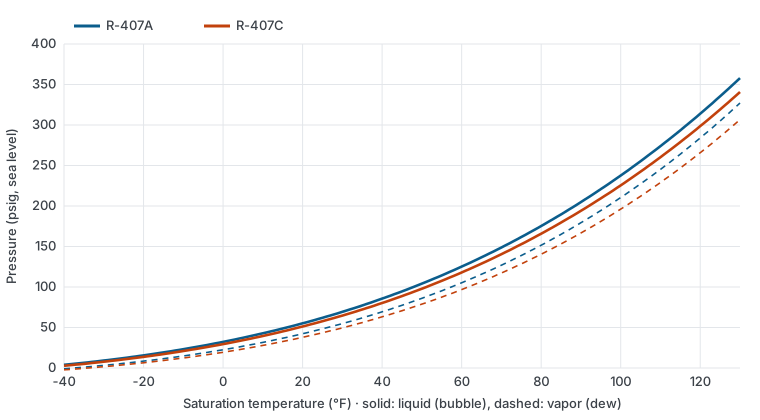
Pressures side by side
Saturation pressure in psig at sea level. Evaporating rows use the vapor (dew) value, condensing rows the liquid (bubble) value, which is what you compare with suction and liquid-line gauges. The last column is R-407C minus R-407A.
| Saturation | R-407A | R-407C | Difference |
|---|---|---|---|
| Evaporator (vapor, dew) | |||
| -20°F | 8.5 | 6.5 | -2.0 (-24%) |
| 0°F | 22.5 | 19.4 | -3.1 (-14%) |
| 20°F | 42.3 | 37.9 | -4.4 (-11%) |
| 30°F | 54.8 | 49.6 | -5.3 (-10%) |
| 35°F | 61.8 | 56.1 | -5.7 (-9%) |
| 40°F | 69.4 | 63.2 | -6.2 (-9%) |
| 45°F | 77.4 | 70.7 | -6.7 (-9%) |
| 50°F | 86.1 | 78.8 | -7.2 (-8%) |
| Condenser (liquid, bubble) | |||
| 80°F | 175.3 | 165.8 | -9.5 (-5%) |
| 90°F | 204.8 | 194.1 | -10.7 (-5%) |
| 95°F | 220.8 | 209.4 | -11.4 (-5%) |
| 100°F | 237.7 | 225.5 | -12.2 (-5%) |
| 105°F | 255.3 | 242.4 | -12.9 (-5%) |
| 110°F | 273.9 | 260.3 | -13.7 (-5%) |
| 115°F | 293.5 | 279.0 | -14.5 (-5%) |
| 120°F | 314.0 | 298.6 | -15.4 (-5%) |
| 125°F | 335.4 | 319.2 | -16.3 (-5%) |
| 130°F | 357.9 | 340.7 | -17.2 (-5%) |
Properties
| Property | R-407A | R-407C |
|---|---|---|
| Safety class | A1 | A1 |
| Type | HFC, zeotropic blend | HFC, zeotropic blend |
| Composition (mass %) | R-32 20, R-125 40, R-134a 40 | R-32 23, R-125 25, R-134a 52 |
| GWP (AR4) | 2,107 | 1,774 |
| Lubricant | POE (polyolester) | POE |
| Boiling point (14.7 psia) | -49.0°F | -46.5°F |
| Critical point | 180.0°F, 655 psia | 187.0°F, 673 psia |
| Glide at 40°F evaporating | 10.0°F | 11.1°F |
| Glide at 100°F condensing | 7.9°F | 9.0°F |
| US status | Legal to service; GWP 2,107 is above the limits for new remote condensing units, supermarket systems and cold storage, and SNAP-unacceptable in new cold storage since Jan 1 2023. | GWP 1,774 is above the 700 limit for new US residential and light commercial AC/HP from Jan 1 2025; servicing and R-22 retrofits of existing systems remain allowed. |
Component compatibility
| Item | R-407A | R-407C |
|---|---|---|
| Composition (R-32/R-125/R-134a) | 20 / 40 / 40 | 23 / 25 / 52 |
| R-22 retrofit use (Arkema) | MT and LT DX equipment | AC and MT DX equipment |
| Lubricant | POE; change to POE required on R-22 retrofit | POE; change to POE required on R-22 retrofit |
| Retrofit charge (Arkema) | 95-100% of R-22 weight | 90-95% of R-22 weight |
| Charging | Liquid only | Liquid only |
| Recovery machine | AHRI 740 (App. B3) | AHRI 740 (App. B3) |
| Cylinder | RAL 7044 gray (legacy lime green) | RAL 7044 gray (legacy medium brown) |
| Trade names | Klea 407A (formerly Klea 60), Genetron 407A, Forane 407A | Freon 407C, Forane 407C, Klea 407C, Genetron 407C |
What changes in the field
R-407A runs higher than R-407C. From the PT data, at 40°F evaporating (dew) R-407A reads 69.4 psig and R-407C 63.2 psig, 6.2 psi lower. At 100°F condensing (bubble) R-407A is 237.7 psig and R-407C 225.5 psig, 12.2 psi lower. The names are one letter apart and the pressures close enough to look plausible on the wrong chart, so set the manifold to the refrigerant on the label.
Both glide a lot. The computed glide is 10.0°F (R-407A) and 11.1°F (R-407C) at 40°F evaporating, and 7.9°F and 9.0°F at 100°F condensing. Use the dew column with suction pressure for superheat and the bubble column with liquid-line pressure for subcooling. The glide calculator shows the spread at your gauge reading, and the PT chart guide covers bubble and dew.
Handling is the same. Both are A1, both are high-pressure refrigerants under Section 608 (40 CFR 82.152 names both as examples), and both recover to 0 in Hg under 200 lb or 10 in Hg at 200 lb or more for equipment made after Nov 15 1993. Both use POE; Copeland’s bulletin lists POE-32 for each. Charge both as liquid, since vapor drawn from a zeotrope cylinder has a different composition from the liquid. Keep separate recovery cylinders.
Retrofit or replacement
Do not swap one for the other or mix them. A blend of the two in a system is neither refrigerant and matches no chart; it has to be recovered as mixed refrigerant. Moving a system from one to the other is a full recovery, a new charge and a new label.
The real choice comes up on R-22 equipment, and it depends on the application. Arkema’s retrofit quick reference gives:
| R-407A | R-407C | |
|---|---|---|
| Recommended for | R-22 MT and LT DX equipment | R-22 AC and MT DX equipment |
| Lubricant | Change to POE required | Change to POE required |
| Charge | 95-100% of R-22 weight | 90-95% of R-22 weight |
| Charging | Liquid phase only | Liquid phase only |
| Suction vs R-22 | 0-3 psi higher | 0-2 psi lower |
| Discharge vs R-22 | 25-35 psi higher | 15-25 psi higher |
| Discharge temperature vs R-22 | 20-35°F lower | 10-15°F lower |
Arkema labels these as general guidelines, with actual results varying by system, and says to follow OEM retrofit recommendations and change to a suitable filter-drier. Arkema also does not recommend R-407C for flooded evaporators. For the R-22 side of the decision see R-22 vs R-407C and R-22 replacement refrigerants.
R-407A was also used as a lower-GWP option to R-404A and R-507A in supermarket and cold storage systems (Orbia). From R-407A, the usual next steps on existing racks are R-448A or R-449A, which keep POE.
Capacity, efficiency and cost
None of the sources used here gives a capacity or efficiency percentage for R-407A against R-407C, or for either against R-22, so none is quoted. Arkema’s pressure and discharge-temperature ranges in the table are the closest manufacturer guidance.
GWP and the rules split them further. R-407A is 2,107 and R-407C 1,774 on the AR4 basis. Under 40 CFR 84.54, as amended by the 2026 rule, R-407A is above the limits for new remote condensing units (1,400 from July 27 2026), supermarket systems (1,400 from Jan 1 2027) and cold storage (700). R-407C, at 700 or more, carries the same restrictions as R-410A for new residential and light commercial AC and heat pumps. Servicing and retrofitting existing systems with either remains allowed, and EPA SNAP lists both as acceptable R-22 substitutes in residential and light commercial AC.
Common questions
What is the difference between R-407C and R-407A?
The ratio. R-407A has 40% R-125 and 40% R-134a; R-407C has 25% R-125 and 52% R-134a. R-407A runs higher pressures and Arkema places it in medium- and low-temperature refrigeration; R-407C is its pick for R-22 air conditioning and medium-temperature work.
Can R-407A be used in an air conditioner?
Arkema recommends R-407C for R-22 AC equipment and R-407A for medium- and low-temperature refrigeration. Use the refrigerant the equipment or retrofit label names.
PT charts and calculators
Sources
- Arkema: Retrofitting with Forane Refrigerants, Quick Reference Guide (2013) forane.arkema.com
- Arkema Forane 407C product page forane.arkema.com
- Orbia Klea 407A product page orbia-fem.com
- Copeland AE Bulletin 93-11: Refrigerants and Lubricants Approved for Use in Copeland Compressors webapps.copeland.com
- EPA SNAP: Substitutes in Residential and Light Commercial AC and Heat Pumps epa.gov
- 40 CFR 84.54: Technology Transitions restrictions by sector ecfr.gov
- 91 FR 31284 (May 26 2026): Reconsideration of Certain Technology Transitions Requirements federalregister.gov
- 40 CFR 82.156: Required evacuation levels ecfr.gov
Reviewed . Found an error? Tell us and we will correct it.