R-152a PT Chart and Refrigerant Profile
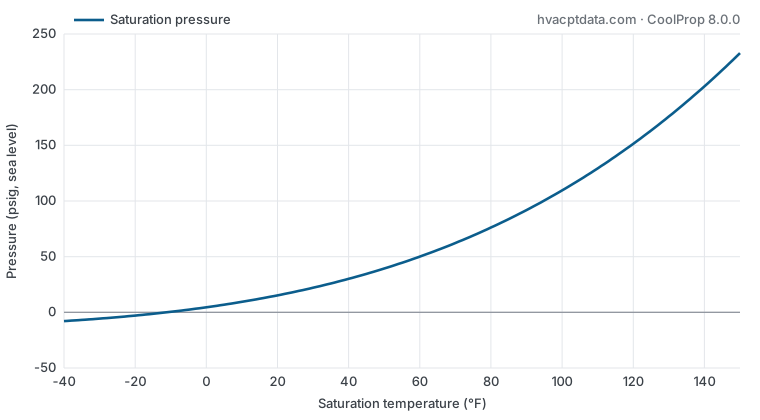
R-152a is an A2 HFC single-component refrigerant. It saturates at 30.1 psig at 40°F and 109.5 psig at 100°F.
Reviewed · PT values computed with CoolProp 8.0.0 and checked against NIST reference data (largest difference 0.0 psi)
R-152a at a glance
| Safety class (ASHRAE 34) | A2: lower toxicity, flammable |
|---|---|
| Type | HFC, single-component refrigerant |
| GWP (100-year, AR4) | 124 · AR5: 138 |
| Ozone depletion potential | 0 |
| Lubricant | POE or PVE (AB with limitations) |
| Boiling point at 14.7 psia | -11.2°F |
| Critical point | 235.9°F, 655 psia |
| 40°F evaporating | 30.1 psig |
| 100°F condensing | 109.5 psig |
| Charge as | Vapor or liquid |
| Typical use | Component of blends such as R-401A, R-500, R-457A and R-516A; Vehicle A/C (EPA SNAP-acceptable with use conditions); Aerosol propellant and foam blowing (non-refrigerant uses) |
| US status | AIM Act HFC (exchange value 124); acceptable in vehicle A/C only under EPA SNAP use conditions that limit passenger-compartment concentration. |
| Replaces | R-12, R-134a |
R-152a PT chart (°F and psig)
R-152a is a single-component refrigerant, so one pressure applies at each temperature for both the evaporator and the condenser. Tap a row to load it into the lookup.
-40°F to 150°F · psig at sea level · °C and kPa in the CSV · italic = inches Hg vacuum
| °F | psig |
|---|---|
| -40 | 16.0″ |
| -39 | 15.6″ |
| -38 | 15.2″ |
| -37 | 14.7″ |
| -36 | 14.3″ |
| -35 | 13.9″ |
| -34 | 13.4″ |
| -33 | 12.9″ |
| -32 | 12.5″ |
| -31 | 12.0″ |
| -30 | 11.5″ |
| -29 | 11.0″ |
| -28 | 10.5″ |
| -27 | 9.9″ |
| -26 | 9.4″ |
| -25 | 8.9″ |
| -24 | 8.3″ |
| -23 | 7.7″ |
| -22 | 7.1″ |
| -21 | 6.5″ |
| -20 | 5.9″ |
| -19 | 5.3″ |
| -18 | 4.7″ |
| -17 | 4.0″ |
| -16 | 3.3″ |
| -15 | 2.7″ |
| -14 | 2.0″ |
| -13 | 1.3″ |
| -12 | 0.5″ |
| -11 | 0.1 |
| -10 | 0.5 |
| -9 | 0.8 |
| -8 | 1.2 |
| -7 | 1.6 |
| -6 | 2.0 |
| -5 | 2.4 |
| -4 | 2.8 |
| -3 | 3.2 |
| -2 | 3.7 |
| -1 | 4.1 |
| 0 | 4.5 |
| 1 | 5.0 |
| 2 | 5.4 |
| 3 | 5.9 |
| 4 | 6.4 |
| 5 | 6.9 |
| 6 | 7.4 |
| 7 | 7.9 |
| 8 | 8.4 |
| 9 | 8.9 |
| 10 | 9.4 |
| 11 | 10.0 |
| 12 | 10.5 |
| 13 | 11.1 |
| 14 | 11.6 |
| 15 | 12.2 |
| 16 | 12.8 |
| 17 | 13.4 |
| 18 | 14.0 |
| 19 | 14.6 |
| 20 | 15.2 |
| 21 | 15.9 |
| 22 | 16.5 |
| 23 | 17.2 |
| 24 | 17.9 |
| 25 | 18.5 |
| 26 | 19.2 |
| 27 | 19.9 |
| 28 | 20.6 |
| 29 | 21.4 |
| 30 | 22.1 |
| 31 | 22.8 |
| 32 | 23.6 |
| 33 | 24.4 |
| 34 | 25.1 |
| 35 | 25.9 |
| 36 | 26.7 |
| 37 | 27.6 |
| 38 | 28.4 |
| 39 | 29.2 |
| 40 | 30.1 |
| 41 | 31.0 |
| 42 | 31.8 |
| 43 | 32.7 |
| 44 | 33.6 |
| 45 | 34.6 |
| 46 | 35.5 |
| 47 | 36.4 |
| 48 | 37.4 |
| 49 | 38.4 |
| 50 | 39.4 |
| 51 | 40.4 |
| 52 | 41.4 |
| 53 | 42.4 |
| 54 | 43.5 |
| 55 | 44.5 |
| 56 | 45.6 |
| 57 | 46.7 |
| 58 | 47.8 |
| 59 | 48.9 |
| 60 | 50.1 |
| 61 | 51.2 |
| 62 | 52.4 |
| 63 | 53.6 |
| 64 | 54.8 |
| 65 | 56.0 |
| 66 | 57.2 |
| 67 | 58.4 |
| 68 | 59.7 |
| 69 | 61.0 |
| 70 | 62.3 |
| 71 | 63.6 |
| 72 | 64.9 |
| 73 | 66.3 |
| 74 | 67.6 |
| 75 | 69.0 |
| 76 | 70.4 |
| 77 | 71.8 |
| 78 | 73.2 |
| 79 | 74.7 |
| 80 | 76.2 |
| 81 | 77.6 |
| 82 | 79.2 |
| 83 | 80.7 |
| 84 | 82.2 |
| 85 | 83.8 |
| 86 | 85.4 |
| 87 | 87.0 |
| 88 | 88.6 |
| 89 | 90.2 |
| 90 | 91.9 |
| 91 | 93.5 |
| 92 | 95.2 |
| 93 | 97.0 |
| 94 | 98.7 |
| 95 | 100.4 |
| 96 | 102.2 |
| 97 | 104.0 |
| 98 | 105.8 |
| 99 | 107.7 |
| 100 | 109.5 |
| 101 | 111.4 |
| 102 | 113.3 |
| 103 | 115.2 |
| 104 | 117.2 |
| 105 | 119.2 |
| 106 | 121.1 |
| 107 | 123.2 |
| 108 | 125.2 |
| 109 | 127.2 |
| 110 | 129.3 |
| 111 | 131.4 |
| 112 | 133.5 |
| 113 | 135.7 |
| 114 | 137.9 |
| 115 | 140.1 |
| 116 | 142.3 |
| 117 | 144.5 |
| 118 | 146.8 |
| 119 | 149.1 |
| 120 | 151.4 |
| 121 | 153.7 |
| 122 | 156.1 |
| 123 | 158.5 |
| 124 | 160.9 |
| 125 | 163.3 |
| 126 | 165.8 |
| 127 | 168.3 |
| 128 | 170.8 |
| 129 | 173.3 |
| 130 | 175.9 |
| 131 | 178.5 |
| 132 | 181.1 |
| 133 | 183.7 |
| 134 | 186.4 |
| 135 | 189.1 |
| 136 | 191.8 |
| 137 | 194.6 |
| 138 | 197.3 |
| 139 | 200.1 |
| 140 | 203.0 |
| 141 | 205.8 |
| 142 | 208.7 |
| 143 | 211.6 |
| 144 | 214.6 |
| 145 | 217.6 |
| 146 | 220.6 |
| 147 | 223.6 |
| 148 | 226.7 |
| 149 | 229.7 |
| 150 | 232.9 |
Where you will find R-152a
You are more likely to meet R-152a inside a blend than in a cylinder by itself. It is a component of the R-12 service blend R-401A, the old azeotrope R-500 and newer blends such as R-457A and R-516A. Outside refrigeration it is used as an aerosol propellant and foam blowing agent.
As a straight refrigerant it is an option rather than a standard. EPA lists R-152a as acceptable in vehicle A/C subject to use conditions. EPA’s household refrigerator listing shows it as an acceptable R-12 substitute in new household refrigerators and freezers since 1994. BITZER lists it as an alternative to R-12 and R-134a. EPA reports R-1234yf, not R-152a, in the majority of US light-duty vehicles. If you find R-152a on a nameplate, follow that manufacturer’s service literature.
It sits in roughly the same pressure range as R-134a but a little lower. The tables on this site give 30.1 psig at 40°F for R-152a against 35.1 psig for R-134a, and 109.5 psig against 124.2 psig at 100°F. Do not read an R-152a system on an R-134a chart.
Charging R-152a
R-152a is a single-component refrigerant, so it has no glide and does not fractionate. One PT column applies to both the evaporator and the condenser, and it can be charged as vapor or liquid. No manufacturer charging statement for R-152a was found for this page, so take the method and charge amount from the equipment maker.
In general terms, fixed-restriction systems are charged to the manufacturer’s superheat data. TXV or EEV systems are charged by subcooling to the nameplate target with the subcooling calculator. Where a charge weight is given, weigh it in.
Because it is flammable, keep the charge to the nameplate amount and do not top off a system with an unknown leak. A flammable refrigerant leaking into a confined space is the hazard the EPA use conditions are written around.
Oil and compatibility
BITZER lists POE and PVE for R-152a, and alkylbenzene with limitations. Use the oil the compressor manufacturer specifies for the refrigerant on the nameplate.
Blends that contain R-152a, such as R-401A, have their own oil rules and PT chart.
Safety, handling and recovery
R-152a is ASHRAE class A2: lower toxicity, flammable. It is not a 2L refrigerant. Class 2 means it propagates flame but falls short of class 3: its lower flammability limit is above 0.10 kg/m³ and its heat of combustion is below 19,000 kJ/kg. Treat it with more caution than an A2L. Remove ignition sources, ventilate the work area, and use tools and recovery equipment rated for flammable refrigerants. The flammability classes page lays out the categories.
EPA’s vehicle use condition makes the point concrete. Engineering strategies or devices must keep foreseeable leaks from producing 3.7% v/v or more in the passenger compartment, and the system must follow SAE J639 and J2773. Vehicle service falls under Clean Air Act section 609 (40 CFR 82 subpart B): certified technicians and approved equipment.
For stationary equipment it is medium-pressure under 40 CFR 82.152, so Type II certification applies (Type I for small appliances). It is not on the venting-exempt list in 82.154(a)(1), which names only certain hydrocarbons. Venting is therefore prohibited, and sales are limited to certified technicians.
Required recovery for medium-pressure appliances made on or after Nov 15 1993 is 10 in Hg below 200 lb charge and 15 in Hg at 200 lb or more. Small appliances need 90% recovery with the compressor running, 80% with it not running, or 4 in Hg. Recovery machines for flammable refrigerants are certified under 40 CFR 82.158 Appendix B4, which adds UL 1963 Supplement SB; see recovery machine compatibility.
New cylinders under AHRI Guideline N are light green-gray (RAL 7044) with a red band on the shoulder or top for flammables. EPA SNAP use conditions specify red PMS #185 / RAL 3020 markings. No legacy cylinder color for R-152a was verified.
Status and replacements
R-152a is a regulated HFC under the AIM Act with an exchange value of 124 (40 CFR 84 Appendix A), far below R-134a’s 1,430. Supply falls under the allowance schedule: 90% of baseline in 2022–2023, 60% in 2024–2028, 30% in 2029–2033, 20% in 2034–2035 and 15% from 2036. Its GWP of 124 is below the 150 limit that Technology Transitions sets for new light-duty vehicles from model year 2025.
The Emissions Reduction and Reclamation rule covers HFCs, so its rules apply where an appliance qualifies. Leak repair applies to 15 lb or more of HFC from Jan 1 2026, excluding residential and light commercial AC and heat pumps. Reclaimed refrigerant is required for supermarket, transport and ice-maker servicing from Jan 1 2029.
No replacement is listed for R-152a itself. For the vehicle side, see R-134a vs R-1234yf; for stationary R-134a alternatives, see the R-134a replacement guide.
Common questions
What safety class is R-152a?
A2 under ASHRAE 34: lower toxicity, flammable. That is a step above the A2L class of R-1234yf, so it needs flammable-rated recovery equipment and red-banded cylinders.
Can R-152a replace R-134a?
EPA lists it as acceptable in vehicle A/C only under strict use conditions, and BITZER lists it as an R-134a alternative. It runs at lower pressure than R-134a and is class A2 flammable, so it is not a field swap. Follow the equipment maker.
How this chart was computed
Every pressure on this page is calculated, not copied: CoolProp 8.0.0 (HEOS backend), the open-source implementation of the reference equations of state, using the model pure:R152A. Gauge values assume sea-level air pressure (14.696 psia); kPa values in the CSV are absolute.
Spot check against NIST Chemistry WebBook, SRD 69, Thermophysical Properties of Fluid Systems: R152a, saturation properties (temperature increments):
| °F | Column | Published | This chart | Difference |
|---|---|---|---|---|
| 0 | saturation | 19.2 psia | 19.2 psia | 0.0 psi |
| 40 | saturation | 44.8 psia | 44.8 psia | 0.0 psi |
| 120 | saturation | 166.1 psia | 166.1 psia | 0.0 psi |
NIST WebBook implements the same reference equation of state as CoolProp, so near-zero deviation there confirms the implementation and unit handling. No manufacturer PT chart with 0/40/100 °F values was found.
Charts from different publishers can differ by a few tenths of a psi because of the equation of state and blend tolerances. Always charge to the equipment manufacturer's data. Full method and every spot check
Calculators for R-152a
Sources
- EPA: MVAC acceptable refrigerants and their impacts epa.gov
- BITZER Refrigerant Report: R-152a bitzer.de
- EPA SNAP: Substitutes in household refrigerators and freezers epa.gov
- eCFR 40 CFR Part 84 Appendix A: Regulated substances and exchange values ecfr.gov
- eCFR 40 CFR 82.154: Venting prohibition, exempt substitutes, sales restriction ecfr.gov
- eCFR 40 CFR Part 82 Subpart B: Servicing of motor vehicle air conditioners ecfr.gov
- eCFR 40 CFR 82.152: Section 608 definitions (pressure classes) ecfr.gov
Reviewed . Found an error? Tell us and we will correct it.