R-422A (MO79) PT Chart and Refrigerant Profile
R-422A (MO79) is an A1 HFC/HC zeotropic blend of R-125, R-134a and R-600a (85.1/11.5/3.4 % by mass). At 40°F its vapor (dew) pressure is 84.1 psig; at 100°F its liquid (bubble) pressure is 242.4 psig.
Reviewed · PT values computed with CoolProp 8.0.0 and checked against a published chart (largest difference 1.6 psi)
R-422A at a glance
| Safety class (ASHRAE 34) | A1: lower toxicity, no flame propagation |
|---|---|
| Type | HFC/HC, zeotropic blend |
| Composition | R-125 85.1% · R-134a 11.5% · R-600a 3.4% by mass |
| GWP (100-year, AR4) | 3,143 · AR5: 2,847EPA's 40 CFR 84.64 calculation gives 3,143.0. |
| Ozone depletion potential | 0 |
| Lubricant | Mineral oil, AB or POE (usually no oil change) |
| Boiling point at 14.7 psia | -52.1°F bubble · -47.4°F dew |
| Critical point | 158.8°F, 532 psia |
| 40°F evaporating | 84.1 psig (dew), glide 3.1°F |
| 100°F condensing | 242.4 psig (bubble), glide 2.1°F |
| Charge as | Liquid only (blend can fractionate as vapor) |
| Typical use | R-22 and R-502 retrofit in low- and medium-temperature commercial refrigeration; Supermarket racks, walk-ins and food storage; Refrigerated transport, ice machines and industrial process refrigeration |
| Trade names | Freon MO79 (Chemours), ISCEON MO79 (former DuPont name; EPA lists ISCEON 79) |
| US status | Service and retrofit refrigerant only; its GWP of about 3,143 is above every 40 CFR 84.54 limit for new equipment, and it is named for new refrigerated transport (2025). |
| Replaces | R-22, R-502 |
R-422A PT chart (°F and psig)
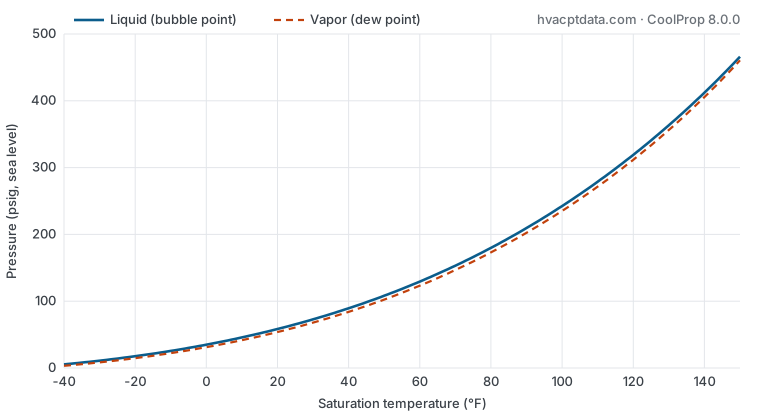
R-422A is a blend, so it has two saturation pressures at each temperature. Read the vapor (dew) column against suction pressure for superheat and the liquid (bubble) column against liquid-line pressure for subcooling. Tap a row to load it into the lookup.
-40°F to 150°F · psig at sea level · °C and kPa in the CSV · italic = inches Hg vacuum
| °F | Liquidbubble psig | Vapordew psig |
|---|---|---|
| -40 | 5.4 | 3.2 |
| -39 | 5.9 | 3.7 |
| -38 | 6.4 | 4.2 |
| -37 | 7.0 | 4.7 |
| -36 | 7.5 | 5.2 |
| -35 | 8.1 | 5.7 |
| -34 | 8.6 | 6.2 |
| -33 | 9.2 | 6.8 |
| -32 | 9.8 | 7.3 |
| -31 | 10.4 | 7.9 |
| -30 | 11.0 | 8.4 |
| -29 | 11.6 | 9.0 |
| -28 | 12.2 | 9.6 |
| -27 | 12.8 | 10.2 |
| -26 | 13.5 | 10.8 |
| -25 | 14.1 | 11.4 |
| -24 | 14.8 | 12.1 |
| -23 | 15.5 | 12.7 |
| -22 | 16.2 | 13.4 |
| -21 | 16.9 | 14.0 |
| -20 | 17.6 | 14.7 |
| -19 | 18.4 | 15.4 |
| -18 | 19.1 | 16.1 |
| -17 | 19.9 | 16.8 |
| -16 | 20.6 | 17.6 |
| -15 | 21.4 | 18.3 |
| -14 | 22.2 | 19.1 |
| -13 | 23.0 | 19.9 |
| -12 | 23.9 | 20.6 |
| -11 | 24.7 | 21.4 |
| -10 | 25.6 | 22.3 |
| -9 | 26.4 | 23.1 |
| -8 | 27.3 | 23.9 |
| -7 | 28.2 | 24.8 |
| -6 | 29.1 | 25.7 |
| -5 | 30.0 | 26.5 |
| -4 | 31.0 | 27.4 |
| -3 | 31.9 | 28.4 |
| -2 | 32.9 | 29.3 |
| -1 | 33.9 | 30.2 |
| 0 | 34.9 | 31.2 |
| 1 | 35.9 | 32.2 |
| 2 | 36.9 | 33.2 |
| 3 | 38.0 | 34.2 |
| 4 | 39.0 | 35.2 |
| 5 | 40.1 | 36.2 |
| 6 | 41.2 | 37.3 |
| 7 | 42.3 | 38.3 |
| 8 | 43.5 | 39.4 |
| 9 | 44.6 | 40.5 |
| 10 | 45.8 | 41.7 |
| 11 | 46.9 | 42.8 |
| 12 | 48.1 | 44.0 |
| 13 | 49.4 | 45.1 |
| 14 | 50.6 | 46.3 |
| 15 | 51.8 | 47.5 |
| 16 | 53.1 | 48.8 |
| 17 | 54.4 | 50.0 |
| 18 | 55.7 | 51.3 |
| 19 | 57.0 | 52.5 |
| 20 | 58.4 | 53.8 |
| 21 | 59.7 | 55.2 |
| 22 | 61.1 | 56.5 |
| 23 | 62.5 | 57.9 |
| 24 | 63.9 | 59.2 |
| 25 | 65.4 | 60.6 |
| 26 | 66.8 | 62.1 |
| 27 | 68.3 | 63.5 |
| 28 | 69.8 | 64.9 |
| 29 | 71.3 | 66.4 |
| 30 | 72.9 | 67.9 |
| 31 | 74.4 | 69.4 |
| 32 | 76.0 | 71.0 |
| 33 | 77.6 | 72.5 |
| 34 | 79.2 | 74.1 |
| 35 | 80.9 | 75.7 |
| 36 | 82.5 | 77.3 |
| 37 | 84.2 | 79.0 |
| 38 | 85.9 | 80.7 |
| 39 | 87.7 | 82.3 |
| 40 | 89.4 | 84.1 |
| 41 | 91.2 | 85.8 |
| 42 | 93.0 | 87.5 |
| 43 | 94.8 | 89.3 |
| 44 | 96.6 | 91.1 |
| 45 | 98.5 | 92.9 |
| 46 | 100.4 | 94.8 |
| 47 | 102.3 | 96.7 |
| 48 | 104.2 | 98.6 |
| 49 | 106.2 | 100.5 |
| 50 | 108.2 | 102.4 |
| 51 | 110.2 | 104.4 |
| 52 | 112.2 | 106.4 |
| 53 | 114.3 | 108.4 |
| 54 | 116.4 | 110.5 |
| 55 | 118.5 | 112.5 |
| 56 | 120.6 | 114.6 |
| 57 | 122.8 | 116.7 |
| 58 | 124.9 | 118.9 |
| 59 | 127.2 | 121.1 |
| 60 | 129.4 | 123.3 |
| 61 | 131.7 | 125.5 |
| 62 | 133.9 | 127.7 |
| 63 | 136.3 | 130.0 |
| 64 | 138.6 | 132.3 |
| 65 | 141.0 | 134.6 |
| 66 | 143.4 | 137.0 |
| 67 | 145.8 | 139.4 |
| 68 | 148.2 | 141.8 |
| 69 | 150.7 | 144.2 |
| 70 | 153.2 | 146.7 |
| 71 | 155.7 | 149.2 |
| 72 | 158.3 | 151.7 |
| 73 | 160.9 | 154.3 |
| 74 | 163.5 | 156.9 |
| 75 | 166.2 | 159.5 |
| 76 | 168.8 | 162.1 |
| 77 | 171.6 | 164.8 |
| 78 | 174.3 | 167.5 |
| 79 | 177.1 | 170.3 |
| 80 | 179.9 | 173.0 |
| 81 | 182.7 | 175.8 |
| 82 | 185.5 | 178.7 |
| 83 | 188.4 | 181.5 |
| 84 | 191.3 | 184.4 |
| 85 | 194.3 | 187.3 |
| 86 | 197.3 | 190.3 |
| 87 | 200.3 | 193.3 |
| 88 | 203.3 | 196.3 |
| 89 | 206.4 | 199.4 |
| 90 | 209.5 | 202.4 |
| 91 | 212.7 | 205.6 |
| 92 | 215.8 | 208.7 |
| 93 | 219.0 | 211.9 |
| 94 | 222.3 | 215.1 |
| 95 | 225.6 | 218.4 |
| 96 | 228.9 | 221.7 |
| 97 | 232.2 | 225.0 |
| 98 | 235.6 | 228.3 |
| 99 | 239.0 | 231.7 |
| 100 | 242.4 | 235.2 |
| 101 | 245.9 | 238.6 |
| 102 | 249.4 | 242.1 |
| 103 | 253.0 | 245.7 |
| 104 | 256.6 | 249.3 |
| 105 | 260.2 | 252.9 |
| 106 | 263.9 | 256.5 |
| 107 | 267.6 | 260.2 |
| 108 | 271.3 | 263.9 |
| 109 | 275.1 | 267.7 |
| 110 | 278.9 | 271.5 |
| 111 | 282.7 | 275.3 |
| 112 | 286.6 | 279.2 |
| 113 | 290.5 | 283.2 |
| 114 | 294.5 | 287.1 |
| 115 | 298.5 | 291.1 |
| 116 | 302.5 | 295.2 |
| 117 | 306.6 | 299.2 |
| 118 | 310.7 | 303.4 |
| 119 | 314.9 | 307.5 |
| 120 | 319.1 | 311.8 |
| 121 | 323.3 | 316.0 |
| 122 | 327.6 | 320.3 |
| 123 | 331.9 | 324.6 |
| 124 | 336.3 | 329.0 |
| 125 | 340.7 | 333.5 |
| 126 | 345.2 | 337.9 |
| 127 | 349.6 | 342.4 |
| 128 | 354.2 | 347.0 |
| 129 | 358.8 | 351.6 |
| 130 | 363.4 | 356.3 |
| 131 | 368.1 | 361.0 |
| 132 | 372.8 | 365.7 |
| 133 | 377.5 | 370.6 |
| 134 | 382.3 | 375.4 |
| 135 | 387.2 | 380.3 |
| 136 | 392.1 | 385.3 |
| 137 | 397.0 | 390.3 |
| 138 | 402.0 | 395.3 |
| 139 | 407.1 | 400.4 |
| 140 | 412.2 | 405.6 |
| 141 | 417.3 | 410.8 |
| 142 | 422.5 | 416.1 |
| 143 | 427.8 | 421.5 |
| 144 | 433.1 | 426.8 |
| 145 | 438.4 | 432.3 |
| 146 | 443.8 | 437.8 |
| 147 | 449.3 | 443.4 |
| 148 | 454.8 | 449.1 |
| 149 | 460.3 | 454.8 |
| 150 | 466.0 | 460.6 |
Where you will find R-422A
R-422A is Chemours’ Freon MO79, sold by DuPont as ISCEON MO79. DuPont’s MO59/MO79 retrofit guide aims it at low- and medium-temperature commercial and industrial DX refrigeration that ran on R-22, R-502 or the HCFC service blends such as R-402A (HP80) and R-408A. BITZER gives its application range as 0 to -40°C (32 to -40°F). Copeland approves it only for Discus semi-hermetics on supermarket racks.
Expect it in converted racks, walk-in condensing units, ice machines and transport units. The nameplate still shows the original refrigerant, so the retrofit tag tells you what is in the system. The legacy label color is yellow-orange (PMS 128) under AHRI Guideline N-2017.
It is the R-125-heavy member of the R-422 family: 85.1% R-125, against 65.1% in R-422D and 55% in R-422B. Same three components, different charts.
Charging R-422A
Take liquid only from the cylinder. R-422A is a zeotrope, and the vapor in the cylinder is not the same mix as the liquid. The DuPont guide allows topping off in service, but says critically charged AC systems should be fully recovered and recharged.
Starting charge weights from the DuPont guide, as a share of the original standard charge:
| Replacing | Initial charge | Final charge |
|---|---|---|
| R-22 or R-502 | about 85% | about 95% |
| R-402A | about 90% | about 100% |
| R-408A | about 90% | about 105% |
Treat these as starting points and adjust to the system. On fixed metering devices, charge to target superheat. On TXV and EEV systems, charge to the manufacturer’s subcooling target. Read the dew column for superheat and the bubble column for subcooling. The computed glide is 3.1°F at 40°F dew and 2.1°F at 100°F bubble.
Pressures run well above R-22 and close to R-404A. At 40°F this chart gives 84.1 psig dew, against 68.6 psig for R-22 and 85.4 psig dew for R-404A. At 100°F the bubble pressure is 242.4 psig, against 195.9 psig for R-22 and 236.8 psig for R-404A. On an R-22 system, check the high-pressure control setting and component ratings before you convert.
Oil and compatibility
The sources disagree, so defer to the compressor maker:
- DuPont/Chemours: compatible with mineral oil, alkylbenzene and POE; in most cases no lubricant change is needed. If oil return is a problem, add POE, starting at 10% of the oil charge and then in 5% steps.
- BITZER: POE or PVE, with AB only “with limitations” and no mineral oil listed.
- Copeland AE 93-11: POE-32 preferred, mineral oil or AB as alternates, for Discus supermarket racks only.
Replace the filter-drier when the system is opened and evacuate to the OEM target (evacuation guide). More in the refrigerant oil guide.
Safety, handling and recovery
R-422A is A1: lower toxicity, no flame propagation.
It is a Section 608 high-pressure refrigerant: the computed liquid saturation pressure at 104°F is 271.3 psia (256.6 psig, bubble). Type II or Universal certification covers it, sales have been limited to certified technicians since Jan 1 2018, and venting is prohibited. Recovery levels for high-pressure appliances made after Nov 15 1993: 0 in Hg under 200 lb of charge, 10 in Hg at 200 lb or more. See refrigerant recovery.
New cylinders made since Jan 1 2020 are light green-gray (RAL 7044); yellow-orange appears only on the label (cylinder colors).
Status and replacements
R-422A has an AR4 GWP of about 3,143, which puts it above every Technology Transitions limit for new equipment. 40 CFR 84.54 also names it as restricted in new road and marine refrigerated transport (Jan 1 2025), several ice machine and food processing categories (Jan 1 2027) and UL 621 ice cream makers (Jan 1 2028). Servicing existing equipment remains legal.
EPA SNAP lists it as acceptable (retrofit and new, Oct 1 2004) for industrial process refrigeration, refrigerated transport, commercial ice machines and ice rinks. The supermarket systems and remote condensing unit pages show it as unacceptable for retrofit from July 20 2016. Court decisions (Mexichem Fluor v. EPA, 2017 and 2019) partly vacated those 2015 change-of-status listings, but EPA’s pages still print them, so check the current rule before converting a rack.
Other rules that touch converted commercial systems: leak repair for appliances with 15 lb or more of HFC from Jan 1 2026, and reclaimed HFC for servicing supermarket systems, refrigerated transport and ice makers from Jan 1 2029. No source names a successor blend. Compare options in R-22 replacement, R-502 replacement and R-404A replacement.
Common questions
Is R-422A the same as R-422D?
No. Both are R-125/R-134a/isobutane blends, but R-422A has 85.1% R-125 and R-422D has 65.1%, so their pressures differ. See R-422B vs R-422D for the lower-pressure siblings.
Is R-422A a replacement for R-22?
In low- and medium-temperature refrigeration, yes; DuPont’s guide covers R-22 and R-502 retrofits. Its pressures run closer to R-404A than to R-22, and EPA’s SNAP page for residential and light commercial AC does not list it.
How this chart was computed
Every pressure on this page is calculated, not copied: CoolProp 8.0.0 (HEOS backend), the open-source implementation of the reference equations of state, using the model mix:R422A at the nominal ASHRAE 34 composition. Gauge values assume sea-level air pressure (14.696 psia); kPa values in the CSV are absolute.
Spot check against DuPont Technical Information: Thermodynamic Properties of ISCEON MO79 (R-422A), ENG Units, Table 1 Saturation Properties, K-15286 (1/06):
| °F | Column | Published | This chart | Difference |
|---|---|---|---|---|
| 0 | bubble | 49.1 psia | 49.6 psia | +0.4 psi |
| 0 | dew | 45.6 psia | 45.9 psia | +0.2 psi |
| 40 | bubble | 103.3 psia | 104.1 psia | +0.8 psi |
| 40 | dew | 98.2 psia | 98.7 psia | +0.5 psi |
| 100 | bubble | 255.6 psia | 257.1 psia | +1.6 psi |
| 100 | dew | 248.5 psia | 249.9 psia | +1.4 psi |
Within 1.6 psi (0.6%) of the DuPont ISCEON MO79 table (REFPROP 7.0).
Charts from different publishers can differ by a few tenths of a psi because of the equation of state and blend tolerances. Always charge to the equipment manufacturer's data. Full method and every spot check
Calculators for R-422A
Sources
- DuPont ISCEON MO59/MO79 Retrofit Guidelines (K-10921) meiersupply.com
- BITZER Refrigerant Report: refrigerant data table bitzer.de
- Copeland AE Bulletin 93-11: Refrigerants and lubricants approved for Copeland compressors webapps.copeland.com
- EPA SNAP: Substitutes in supermarket systems epa.gov
- EPA SNAP: Substitutes in refrigerated transport epa.gov
- 40 CFR 84.54: Technology Transitions restrictions by sector ecfr.gov
- AHRI Guideline N-2017: Assignment of Refrigerant Container Colors (Wayback copy) web.archive.org
Reviewed . Found an error? Tell us and we will correct it.
More in R-22 service blends