R-500 PT Chart and Refrigerant Profile
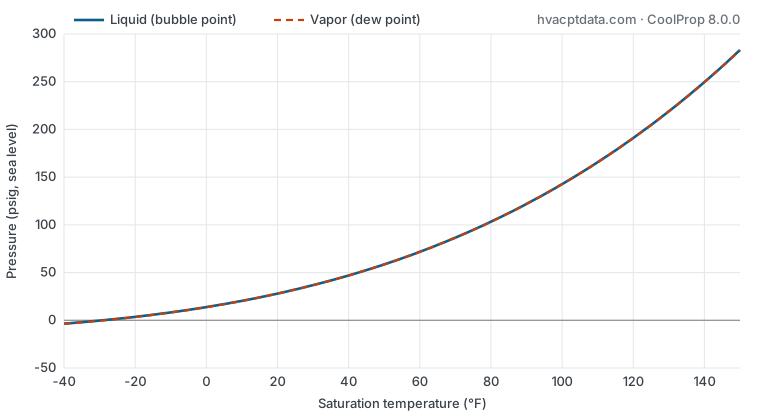
R-500 is an A1 CFC/HFC azeotrope azeotropic blend of R-12 and R-152a (73.8/26.2 % by mass). At 40°F its vapor (dew) pressure is 46.9 psig; at 100°F its liquid (bubble) pressure is 142.7 psig.
Reviewed · PT values computed with CoolProp 8.0.0 and checked against a published chart (largest difference 1.7 psi)
Accuracy note. The open mixture model used for R-500 gives liquid (bubble) pressures up to 1.7 psi above the manufacturer's published chart (at 100°F). The difference is listed in How this chart was computed. When you set a charge on R-500, use the manufacturer's chart or the equipment charging chart.
R-500 at a glance
| Safety class (ASHRAE 34) | A1: lower toxicity, no flame propagation |
|---|---|
| Type | CFC/HFC azeotrope, azeotropic blend |
| Composition | R-12 73.8% · R-152a 26.2% by mass |
| GWP (100-year, AR4) | 8,077 · AR5: 7,564Counts both components. EPA's 40 CFR 84.64 value is 32.5 because only the HFC-152a share is counted. |
| Ozone depletion potential | 0.738 |
| Lubricant | Mineral oil or alkylbenzene (AB) |
| Boiling point at 14.7 psia | -29.1°F bubble · -28.7°F dew |
| Critical point | 214.7°F, 603 psia |
| 40°F evaporating | 46.9 psig (dew), glide 0.0°F |
| 100°F condensing | 142.7 psig (bubble), glide 0.0°F |
| Charge as | Liquid, as suppliers recommend for blends (an azeotrope barely fractionates) |
| Typical use | Legacy commercial air conditioning; Some dehumidifiers |
| Trade names | Freon 500 (DuPont, now Chemours), Genetron 500 (Honeywell), Forane 500 (Arkema) |
| US status | Contains Class I CFC-12; US production and import banned since Jan 1 1996, so servicing uses recovered, recycled, reclaimed or stockpiled refrigerant. |
| Replaced by | R-409A, R-134a, R-401B |
R-500 PT chart (°F and psig)
R-500 is a blend, so it has two saturation pressures at each temperature. Read the vapor (dew) column against suction pressure for superheat and the liquid (bubble) column against liquid-line pressure for subcooling. Tap a row to load it into the lookup.
-40°F to 150°F · psig at sea level · °C and kPa in the CSV · italic = inches Hg vacuum
| °F | Liquidbubble psig | Vapordew psig |
|---|---|---|
| -40 | 7.2″ | 7.5″ |
| -39 | 6.6″ | 6.9″ |
| -38 | 6.0″ | 6.3″ |
| -37 | 5.3″ | 5.6″ |
| -36 | 4.7″ | 5.0″ |
| -35 | 4.1″ | 4.4″ |
| -34 | 3.4″ | 3.7″ |
| -33 | 2.7″ | 3.0″ |
| -32 | 2.0″ | 2.3″ |
| -31 | 1.3″ | 1.6″ |
| -30 | 0.6″ | 0.9″ |
| -29 | 0.1 | 0.2″ |
| -28 | 0.4 | 0.3 |
| -27 | 0.8 | 0.6 |
| -26 | 1.2 | 1.0 |
| -25 | 1.6 | 1.4 |
| -24 | 1.9 | 1.8 |
| -23 | 2.3 | 2.2 |
| -22 | 2.8 | 2.6 |
| -21 | 3.2 | 3.0 |
| -20 | 3.6 | 3.5 |
| -19 | 4.0 | 3.9 |
| -18 | 4.5 | 4.3 |
| -17 | 4.9 | 4.8 |
| -16 | 5.4 | 5.2 |
| -15 | 5.8 | 5.7 |
| -14 | 6.3 | 6.2 |
| -13 | 6.8 | 6.7 |
| -12 | 7.3 | 7.1 |
| -11 | 7.8 | 7.6 |
| -10 | 8.3 | 8.1 |
| -9 | 8.8 | 8.7 |
| -8 | 9.3 | 9.2 |
| -7 | 9.8 | 9.7 |
| -6 | 10.4 | 10.3 |
| -5 | 10.9 | 10.8 |
| -4 | 11.5 | 11.4 |
| -3 | 12.1 | 11.9 |
| -2 | 12.6 | 12.5 |
| -1 | 13.2 | 13.1 |
| 0 | 13.8 | 13.7 |
| 1 | 14.4 | 14.3 |
| 2 | 15.1 | 14.9 |
| 3 | 15.7 | 15.6 |
| 4 | 16.3 | 16.2 |
| 5 | 17.0 | 16.9 |
| 6 | 17.6 | 17.5 |
| 7 | 18.3 | 18.2 |
| 8 | 19.0 | 18.9 |
| 9 | 19.7 | 19.6 |
| 10 | 20.4 | 20.3 |
| 11 | 21.1 | 21.0 |
| 12 | 21.8 | 21.7 |
| 13 | 22.5 | 22.4 |
| 14 | 23.3 | 23.2 |
| 15 | 24.0 | 24.0 |
| 16 | 24.8 | 24.7 |
| 17 | 25.6 | 25.5 |
| 18 | 26.4 | 26.3 |
| 19 | 27.2 | 27.1 |
| 20 | 28.0 | 27.9 |
| 21 | 28.8 | 28.7 |
| 22 | 29.7 | 29.6 |
| 23 | 30.5 | 30.4 |
| 24 | 31.4 | 31.3 |
| 25 | 32.3 | 32.2 |
| 26 | 33.1 | 33.1 |
| 27 | 34.0 | 34.0 |
| 28 | 35.0 | 34.9 |
| 29 | 35.9 | 35.8 |
| 30 | 36.8 | 36.8 |
| 31 | 37.8 | 37.7 |
| 32 | 38.8 | 38.7 |
| 33 | 39.7 | 39.7 |
| 34 | 40.7 | 40.7 |
| 35 | 41.7 | 41.7 |
| 36 | 42.8 | 42.7 |
| 37 | 43.8 | 43.7 |
| 38 | 44.8 | 44.8 |
| 39 | 45.9 | 45.9 |
| 40 | 47.0 | 46.9 |
| 41 | 48.1 | 48.0 |
| 42 | 49.2 | 49.1 |
| 43 | 50.3 | 50.3 |
| 44 | 51.4 | 51.4 |
| 45 | 52.6 | 52.6 |
| 46 | 53.8 | 53.7 |
| 47 | 54.9 | 54.9 |
| 48 | 56.1 | 56.1 |
| 49 | 57.4 | 57.3 |
| 50 | 58.6 | 58.6 |
| 51 | 59.8 | 59.8 |
| 52 | 61.1 | 61.1 |
| 53 | 62.4 | 62.3 |
| 54 | 63.6 | 63.6 |
| 55 | 65.0 | 64.9 |
| 56 | 66.3 | 66.3 |
| 57 | 67.6 | 67.6 |
| 58 | 69.0 | 69.0 |
| 59 | 70.4 | 70.3 |
| 60 | 71.7 | 71.7 |
| 61 | 73.1 | 73.1 |
| 62 | 74.6 | 74.6 |
| 63 | 76.0 | 76.0 |
| 64 | 77.5 | 77.5 |
| 65 | 79.0 | 78.9 |
| 66 | 80.4 | 80.4 |
| 67 | 82.0 | 82.0 |
| 68 | 83.5 | 83.5 |
| 69 | 85.0 | 85.0 |
| 70 | 86.6 | 86.6 |
| 71 | 88.2 | 88.2 |
| 72 | 89.8 | 89.8 |
| 73 | 91.4 | 91.4 |
| 74 | 93.0 | 93.0 |
| 75 | 94.7 | 94.7 |
| 76 | 96.4 | 96.4 |
| 77 | 98.1 | 98.1 |
| 78 | 99.8 | 99.8 |
| 79 | 101.5 | 101.5 |
| 80 | 103.3 | 103.3 |
| 81 | 105.1 | 105.1 |
| 82 | 106.8 | 106.8 |
| 83 | 108.7 | 108.7 |
| 84 | 110.5 | 110.5 |
| 85 | 112.3 | 112.3 |
| 86 | 114.2 | 114.2 |
| 87 | 116.1 | 116.1 |
| 88 | 118.0 | 118.0 |
| 89 | 120.0 | 120.0 |
| 90 | 121.9 | 121.9 |
| 91 | 123.9 | 123.9 |
| 92 | 125.9 | 125.9 |
| 93 | 127.9 | 127.9 |
| 94 | 130.0 | 130.0 |
| 95 | 132.0 | 132.0 |
| 96 | 134.1 | 134.1 |
| 97 | 136.2 | 136.2 |
| 98 | 138.3 | 138.3 |
| 99 | 140.5 | 140.5 |
| 100 | 142.7 | 142.6 |
| 101 | 144.9 | 144.8 |
| 102 | 147.1 | 147.1 |
| 103 | 149.3 | 149.3 |
| 104 | 151.6 | 151.6 |
| 105 | 153.9 | 153.8 |
| 106 | 156.2 | 156.2 |
| 107 | 158.5 | 158.5 |
| 108 | 160.9 | 160.8 |
| 109 | 163.3 | 163.2 |
| 110 | 165.7 | 165.6 |
| 111 | 168.1 | 168.0 |
| 112 | 170.5 | 170.5 |
| 113 | 173.0 | 173.0 |
| 114 | 175.5 | 175.5 |
| 115 | 178.0 | 178.0 |
| 116 | 180.6 | 180.5 |
| 117 | 183.2 | 183.1 |
| 118 | 185.8 | 185.7 |
| 119 | 188.4 | 188.3 |
| 120 | 191.0 | 191.0 |
| 121 | 193.7 | 193.6 |
| 122 | 196.4 | 196.3 |
| 123 | 199.2 | 199.1 |
| 124 | 201.9 | 201.8 |
| 125 | 204.7 | 204.6 |
| 126 | 207.5 | 207.4 |
| 127 | 210.3 | 210.2 |
| 128 | 213.2 | 213.1 |
| 129 | 216.1 | 216.0 |
| 130 | 219.0 | 218.9 |
| 131 | 221.9 | 221.8 |
| 132 | 224.9 | 224.8 |
| 133 | 227.9 | 227.8 |
| 134 | 230.9 | 230.8 |
| 135 | 234.0 | 233.8 |
| 136 | 237.1 | 236.9 |
| 137 | 240.2 | 240.0 |
| 138 | 243.3 | 243.1 |
| 139 | 246.5 | 246.3 |
| 140 | 249.7 | 249.5 |
| 141 | 252.9 | 252.7 |
| 142 | 256.1 | 255.9 |
| 143 | 259.4 | 259.2 |
| 144 | 262.7 | 262.5 |
| 145 | 266.1 | 265.9 |
| 146 | 269.4 | 269.2 |
| 147 | 272.8 | 272.6 |
| 148 | 276.3 | 276.0 |
| 149 | 279.7 | 279.5 |
| 150 | 283.2 | 283.0 |
Where you will find R-500
R-500 is an azeotrope of 73.8% R-12 and 26.2% R-152a. It behaves like a single refrigerant. A-Gas lists its uses as commercial air conditioning and some dehumidifier applications. BITZER gives an application range of about 50°F down to -22°F (+10 to -30°C).
Every R-500 system you meet is old equipment. It was sold as Freon 500 (DuPont, now Chemours), Genetron 500 (Honeywell) and Forane 500 (Arkema), per A-Gas. The legacy cylinder color assigned in AHRI Guideline N-2017 was yellow. Containers packaged since 2020 are light green-gray for every refrigerant, so read the label.
Many R-500 systems have been converted. Look for a retrofit tag naming R-409A, R-401B or R-134a before you trust the original nameplate. If the readings do not fit the nameplate refrigerant, identify it first; the refrigerant identification guide covers how.
Charging R-500
Accuracy first. This site computes the R-500 table from an open mixture model. Against the National Refrigerants chart, the only independent published reference found, it reads 0.5 to 1.7 psi high, and the gap grows with temperature. The largest difference is 1.7 psi at 100°F. Use the manufacturer’s PT chart or the equipment charging data when you set a charge. The spot check is listed under “How this chart was computed” below.
As an azeotrope, R-500 has essentially no glide: the bubble and dew columns are the same for field purposes. It barely fractionates, though suppliers generally recommend charging blends as liquid. Weigh in the nameplate charge where one is given and follow the equipment maker’s method. On a TXV system, charge by subcooling to the manufacturer’s target with the subcooling calculator.
Do not read R-500 on an R-12 chart. The R-152a share changes the pressure curve.
Oil and compatibility
BITZER lists mineral oil and alkylbenzene for R-500, the same oil family as R-12. Use the oil and viscosity the compressor manufacturer specifies.
The oil decides the retrofit path. Arkema recommends R-409A for most stationary R-12 and R-500 retrofits; BITZER lists R-409A with mineral oil or AB, so the oil family stays the same. Arkema says R-134a works for many R-12 and R-500 retrofits and should be the choice for flooded evaporators, but it requires POE oil. The refrigerant oil types guide explains why mineral oil and R-134a do not mix.
Never top off R-500 with a substitute. The mix matches no chart.
Safety, handling and recovery
R-500 is ASHRAE class A1: lower toxicity, no flame propagation. It is an ozone-depleting refrigerant with an ODP of 0.738, from its CFC-12 content (40 CFR 82 Appendix A). Knowingly venting it is prohibited, recovery is required, and sales are restricted to certified technicians.
40 CFR 82.152 names R-500 as an example of a medium-pressure refrigerant. Small appliances (factory-sealed, 5 lb or less) need Type I certification; other equipment needs Type II; Universal covers both.
| Appliance (made on or after Nov 15 1993) | Required recovery |
|---|---|
| Small appliance | 90% (compressor running), 80% (not running), or 4 in Hg |
| Medium-pressure, under 200 lb | 10 in Hg |
| Medium-pressure, 200 lb or more | 15 in Hg |
For appliances made before Nov 15 1993, 40 CFR 82.156 Table 1 sets separate levels; check it against the build date. Appliances with 50 lb or more fall under the ODS leak-repair rules in 40 CFR 82.157. Recovered R-500 cannot be sold to a new owner unless an EPA-certified reclaimer has reclaimed it.
Status and replacements
R-500 contains CFC-12, a Class I substance. US production and import of Class I CFCs have been banned since Jan 1 1996 under 40 CFR 82.4, apart from narrow exemptions. Running and servicing an existing system is legal with recovered, recycled, reclaimed or stockpiled refrigerant. A-Gas still lists R-500 in 30, 125, 1,000 and 1,750 lb sizes.
Because it contains HFC-152a, R-500 is technically a blend containing an AIM Act regulated substance, but EPA’s basis counts only that share (32.5). The practical limit is CFC supply.
Retrofit options with published charge guidance:
- R-409A: Arkema gives 80-90% of the R-500 charge weight, liquid phase only: 80% for cap tubes, 85-90% for TXVs.
- R-134a: Arkema gives 90-95% of the original weight, liquid or vapor, with a change to POE.
- R-401B: DuPont’s ART-36 says an R-500 system needs about 105% of the R-500 charge, starting at 100%.
R-409A and R-401B are HCFC blends with their own shrinking supply. The R-12 vs R-134a comparison covers the R-134a conversion steps, and the R-134a replacement guide covers lower-GWP options.
Common questions
What is R-500 refrigerant made of?
R-12 and R-152a, 73.8% and 26.2% by mass, per ASHRAE 34. The blend is an azeotrope, so it boils at a single temperature like a pure refrigerant.
What can replace R-500?
Arkema recommends R-409A for most stationary retrofits and R-134a for many others, including flooded evaporators. DuPont also listed R-401B for R-500 systems. Each needs its own charge and, for R-134a, POE oil.
How this chart was computed
Every pressure on this page is calculated, not copied: CoolProp 8.0.0 (HEOS backend), the open-source implementation of the reference equations of state, using the model mix:R500 at the nominal ASHRAE 34 composition. Gauge values assume sea-level air pressure (14.696 psia); kPa values in the CSV are absolute.
Spot check against National Refrigerants Refrigerant Reference Guide, 7th Edition 2020: R-500:
| °F | Column | Published | This chart | Difference |
|---|---|---|---|---|
| 0 | saturation | 13.3 psig | 13.8 psig | +0.5 psi |
| 40 | saturation | 46.1 psig | 47.0 psig | +0.9 psi |
| 100 | saturation | 141.0 psig | 142.7 psig | +1.7 psi |
Only one independent reference found: the NRI chart (whole psig above 100 °F; Hudson Technologies prints the same values). mix:R500 (R-12/R-152a, Bell 2016 parameters) reads 0.5-1.7 psi high, increasing with temperature; at 100 °F 1.66 psi (1.07%) is just outside tolerance, with ±0.5 psi printing resolution. The NRI thermodynamic table (psia) gives 156.1/155.5 psia at 100 °F (1.3 and 1.8 psi below the model). Kept with disclosure.
Charts from different publishers can differ by a few tenths of a psi because of the equation of state and blend tolerances. Always charge to the equipment manufacturer's data. Full method and every spot check
Calculators for R-500
Sources
- ASHRAE refrigerant designations (Standard 34) ashrae.org
- National Refrigerants Refrigerant Reference Guide, 7th Edition 2020: R-500 refrigerants.com
- A-Gas US: R500 agas.com
- Arkema: Retrofitting with Forane Refrigerants, Quick Reference Guide (2013) forane.arkema.com
- DuPont ART-36: Retrofit guidelines for Suva service refrigerants (distributor copy) wizard.youngsupply.com
- BITZER Refrigerant Report (A-500/501) refrigerant data table bitzer.de
- eCFR 40 CFR 82.4: Class I production and import prohibitions ecfr.gov
- eCFR 40 CFR 82.152: Section 608 definitions (pressure classes) ecfr.gov
Reviewed . Found an error? Tell us and we will correct it.
More in Legacy CFCs and R-502