R-401B PT Chart and Refrigerant Profile
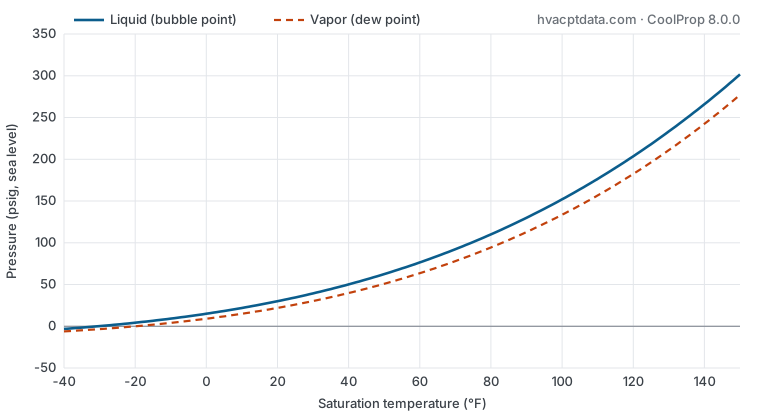
R-401B is an A1 HCFC blend zeotropic blend of R-22, R-152a and R-124 (61/11/28 % by mass). At 40°F its vapor (dew) pressure is 39.8 psig; at 100°F its liquid (bubble) pressure is 152.0 psig.
Reviewed · PT values computed with CoolProp 8.0.0 and checked against a published chart (largest difference 3.5 psi)
R-401B at a glance
| Safety class (ASHRAE 34) | A1: lower toxicity, no flame propagation |
|---|---|
| Type | HCFC blend, zeotropic blend |
| Composition | R-22 61% · R-152a 11% · R-124 28% by mass |
| GWP (100-year, AR4) | 1,288 · AR5: 1,236Counts all three components. EPA's 40 CFR 84.64 value is 13.6 because only the HFC-152a share is counted. |
| Ozone depletion potential | 0.04 |
| Lubricant | Mineral oil, alkylbenzene (AB) or POE |
| Boiling point at 14.7 psia | -30.4°F bubble · -19.8°F dew |
| Critical point | 223.8°F, 687 psia |
| 40°F evaporating | 39.8 psig (dew), glide 9.6°F |
| 100°F condensing | 152.0 psig (bubble), glide 8.1°F |
| Charge as | Liquid only (blend can fractionate as vapor) |
| Typical use | R-12 retrofit in low-temperature equipment (domestic and commercial freezers, transport refrigeration); R-500 retrofit service |
| Trade names | Freon MP66 (Chemours), Suva MP66 (legacy DuPont name) |
| US status | HCFC service blend; HCFC-22 production and import ended Jan 1 2020 and HCFC-124 allowances reach zero in 2030, so supply is recovered or remaining stock. |
| Replaces | R-12, R-500 |
| Replaced by | R-437A, R-450A |
R-401B PT chart (°F and psig)
R-401B is a blend, so it has two saturation pressures at each temperature. Read the vapor (dew) column against suction pressure for superheat and the liquid (bubble) column against liquid-line pressure for subcooling. Tap a row to load it into the lookup.
-40°F to 150°F · psig at sea level · °C and kPa in the CSV · italic = inches Hg vacuum
| °F | Liquidbubble psig | Vapordew psig |
|---|---|---|
| -40 | 6.5″ | 12.5″ |
| -39 | 5.9″ | 12.0″ |
| -38 | 5.3″ | 11.5″ |
| -37 | 4.6″ | 11.0″ |
| -36 | 4.0″ | 10.4″ |
| -35 | 3.3″ | 9.9″ |
| -34 | 2.6″ | 9.3″ |
| -33 | 1.9″ | 8.8″ |
| -32 | 1.2″ | 8.2″ |
| -31 | 0.4″ | 7.6″ |
| -30 | 0.2 | 7.0″ |
| -29 | 0.5 | 6.4″ |
| -28 | 0.9 | 5.7″ |
| -27 | 1.3 | 5.1″ |
| -26 | 1.7 | 4.4″ |
| -25 | 2.1 | 3.7″ |
| -24 | 2.5 | 3.0″ |
| -23 | 2.9 | 2.3″ |
| -22 | 3.4 | 1.6″ |
| -21 | 3.8 | 0.9″ |
| -20 | 4.2 | 0.1″ |
| -19 | 4.7 | 0.3 |
| -18 | 5.2 | 0.7 |
| -17 | 5.6 | 1.1 |
| -16 | 6.1 | 1.5 |
| -15 | 6.6 | 1.9 |
| -14 | 7.1 | 2.3 |
| -13 | 7.6 | 2.7 |
| -12 | 8.1 | 3.2 |
| -11 | 8.6 | 3.6 |
| -10 | 9.2 | 4.1 |
| -9 | 9.7 | 4.5 |
| -8 | 10.2 | 5.0 |
| -7 | 10.8 | 5.4 |
| -6 | 11.4 | 5.9 |
| -5 | 12.0 | 6.4 |
| -4 | 12.5 | 6.9 |
| -3 | 13.1 | 7.4 |
| -2 | 13.8 | 8.0 |
| -1 | 14.4 | 8.5 |
| 0 | 15.0 | 9.0 |
| 1 | 15.6 | 9.6 |
| 2 | 16.3 | 10.1 |
| 3 | 17.0 | 10.7 |
| 4 | 17.6 | 11.3 |
| 5 | 18.3 | 11.9 |
| 6 | 19.0 | 12.5 |
| 7 | 19.7 | 13.1 |
| 8 | 20.4 | 13.7 |
| 9 | 21.2 | 14.3 |
| 10 | 21.9 | 15.0 |
| 11 | 22.7 | 15.6 |
| 12 | 23.4 | 16.3 |
| 13 | 24.2 | 16.9 |
| 14 | 25.0 | 17.6 |
| 15 | 25.8 | 18.3 |
| 16 | 26.6 | 19.0 |
| 17 | 27.4 | 19.7 |
| 18 | 28.3 | 20.5 |
| 19 | 29.1 | 21.2 |
| 20 | 30.0 | 22.0 |
| 21 | 30.9 | 22.7 |
| 22 | 31.8 | 23.5 |
| 23 | 32.7 | 24.3 |
| 24 | 33.6 | 25.1 |
| 25 | 34.5 | 25.9 |
| 26 | 35.4 | 26.8 |
| 27 | 36.4 | 27.6 |
| 28 | 37.4 | 28.5 |
| 29 | 38.4 | 29.3 |
| 30 | 39.3 | 30.2 |
| 31 | 40.4 | 31.1 |
| 32 | 41.4 | 32.0 |
| 33 | 42.4 | 32.9 |
| 34 | 43.5 | 33.9 |
| 35 | 44.6 | 34.8 |
| 36 | 45.6 | 35.8 |
| 37 | 46.7 | 36.8 |
| 38 | 47.9 | 37.8 |
| 39 | 49.0 | 38.8 |
| 40 | 50.1 | 39.8 |
| 41 | 51.3 | 40.8 |
| 42 | 52.5 | 41.9 |
| 43 | 53.7 | 42.9 |
| 44 | 54.9 | 44.0 |
| 45 | 56.1 | 45.1 |
| 46 | 57.3 | 46.2 |
| 47 | 58.6 | 47.4 |
| 48 | 59.9 | 48.5 |
| 49 | 61.1 | 49.7 |
| 50 | 62.5 | 50.8 |
| 51 | 63.8 | 52.0 |
| 52 | 65.1 | 53.3 |
| 53 | 66.5 | 54.5 |
| 54 | 67.8 | 55.7 |
| 55 | 69.2 | 57.0 |
| 56 | 70.6 | 58.3 |
| 57 | 72.1 | 59.5 |
| 58 | 73.5 | 60.9 |
| 59 | 75.0 | 62.2 |
| 60 | 76.5 | 63.5 |
| 61 | 78.0 | 64.9 |
| 62 | 79.5 | 66.3 |
| 63 | 81.0 | 67.7 |
| 64 | 82.6 | 69.1 |
| 65 | 84.1 | 70.5 |
| 66 | 85.7 | 72.0 |
| 67 | 87.3 | 73.5 |
| 68 | 89.0 | 75.0 |
| 69 | 90.6 | 76.5 |
| 70 | 92.3 | 78.0 |
| 71 | 94.0 | 79.5 |
| 72 | 95.7 | 81.1 |
| 73 | 97.4 | 82.7 |
| 74 | 99.1 | 84.3 |
| 75 | 100.9 | 85.9 |
| 76 | 102.7 | 87.6 |
| 77 | 104.5 | 89.3 |
| 78 | 106.3 | 90.9 |
| 79 | 108.2 | 92.6 |
| 80 | 110.0 | 94.4 |
| 81 | 111.9 | 96.1 |
| 82 | 113.8 | 97.9 |
| 83 | 115.8 | 99.7 |
| 84 | 117.7 | 101.5 |
| 85 | 119.7 | 103.3 |
| 86 | 121.7 | 105.2 |
| 87 | 123.7 | 107.1 |
| 88 | 125.8 | 109.0 |
| 89 | 127.8 | 110.9 |
| 90 | 129.9 | 112.8 |
| 91 | 132.0 | 114.8 |
| 92 | 134.1 | 116.8 |
| 93 | 136.3 | 118.8 |
| 94 | 138.5 | 120.8 |
| 95 | 140.7 | 122.9 |
| 96 | 142.9 | 125.0 |
| 97 | 145.1 | 127.1 |
| 98 | 147.4 | 129.2 |
| 99 | 149.7 | 131.4 |
| 100 | 152.0 | 133.6 |
| 101 | 154.4 | 135.8 |
| 102 | 156.7 | 138.0 |
| 103 | 159.1 | 140.2 |
| 104 | 161.5 | 142.5 |
| 105 | 164.0 | 144.8 |
| 106 | 166.4 | 147.1 |
| 107 | 168.9 | 149.5 |
| 108 | 171.4 | 151.9 |
| 109 | 174.0 | 154.3 |
| 110 | 176.5 | 156.7 |
| 111 | 179.1 | 159.1 |
| 112 | 181.7 | 161.6 |
| 113 | 184.4 | 164.1 |
| 114 | 187.0 | 166.6 |
| 115 | 189.7 | 169.2 |
| 116 | 192.4 | 171.8 |
| 117 | 195.2 | 174.4 |
| 118 | 197.9 | 177.0 |
| 119 | 200.7 | 179.7 |
| 120 | 203.6 | 182.4 |
| 121 | 206.4 | 185.1 |
| 122 | 209.3 | 187.9 |
| 123 | 212.2 | 190.7 |
| 124 | 215.1 | 193.5 |
| 125 | 218.1 | 196.3 |
| 126 | 221.1 | 199.2 |
| 127 | 224.1 | 202.1 |
| 128 | 227.1 | 205.0 |
| 129 | 230.2 | 207.9 |
| 130 | 233.3 | 210.9 |
| 131 | 236.4 | 213.9 |
| 132 | 239.6 | 217.0 |
| 133 | 242.8 | 220.0 |
| 134 | 246.0 | 223.1 |
| 135 | 249.2 | 226.3 |
| 136 | 252.5 | 229.4 |
| 137 | 255.8 | 232.6 |
| 138 | 259.2 | 235.9 |
| 139 | 262.5 | 239.1 |
| 140 | 265.9 | 242.4 |
| 141 | 269.3 | 245.7 |
| 142 | 272.8 | 249.1 |
| 143 | 276.3 | 252.5 |
| 144 | 279.8 | 255.9 |
| 145 | 283.4 | 259.4 |
| 146 | 286.9 | 262.8 |
| 147 | 290.5 | 266.4 |
| 148 | 294.2 | 269.9 |
| 149 | 297.9 | 273.5 |
| 150 | 301.6 | 277.1 |
Where you will find R-401B
R-401B is the low-temperature sister of R-401A. Both are HCFC service blends of R-22, R-152a and R-124, sold by DuPont as Suva MP66 and MP39 (now Chemours; R-401B is sold as Freon MP66). R-401B carries more R-22, which raises its capacity. DuPont’s ART-36 retrofit guide places it in R-12 systems running at low evaporator temperatures (below about -15°F) that need extra capacity, and in existing R-500 systems.
In practice that means domestic and commercial freezers and transport refrigeration. EPA’s SNAP program listed it as an R-12 substitute on Jan 13 1995 across household refrigerators and freezers, ice machines, supermarket and stand-alone equipment, vending, cold storage and transport. Copeland lists it for low- and medium-temperature work “for service applications only”.
Look for a retrofit tag reading R-401B or MP66 on a system whose compressor and nameplate say R-12 or R-500. The legacy cylinder color assigned in AHRI Guideline N-2017 was yellow-brown (mustard). Containers made since 2020 are light green-gray for every refrigerant, so read the label. R-401A and R-401B share components but not proportions, and their PT tables differ.
Charging R-401B
R-401B is a zeotropic blend. The computed glide at 40°F evaporating is 9.6°F, and it shrinks a little as pressure rises.
Charge liquid only. ART-36 says to take liquid only from the cylinder. Vapor charging pulls the lighter components first and leaves the system and the cylinder off-blend. Meter the liquid in slowly so it flashes before reaching the compressor.
Size the charge per the retrofit guide. ART-36 puts the best charge for an R-12 conversion at usually 75-90% of the original R-12 charge by weight, starting at about 75%. An R-500 conversion needs about 105% of the R-500 charge, starting at 100%. ART-36 does not recommend topping off a CFC system with Suva. Chemours’ MP66 bulletin says a system already on MP66 can be topped off after a leak, as long as you charge liquid.
Read the right column. Use the dew (vapor) column for superheat at suction pressure and the bubble (liquid) column for subcooling at liquid-line pressure. The superheat calculator uses the dew column; the temperature glide calculator shows the gap at any pressure. On a TXV system, charge by subcooling to the equipment or retrofit target with the subcooling calculator.
Expect the high side to run well above R-12. On this site’s tables, R-401B reads 39.8 psig at a 40°F dew point against 36.9 psig for R-12 at 40°F. At a 100°F bubble point it reads 152.0 psig against 116.9 psig for R-12. Do not charge to R-12 pressures.
Oil and compatibility
Sources differ on oil, so follow the compressor manufacturer:
- BITZER lists mineral oil and alkylbenzene.
- Chemours’ MP66 bulletin says it works with mineral oil and AB and needs no oil change on retrofit.
- Copeland lists AB with mineral oil, or POE-32.
- ART-36 says AB or POE can be used and existing mineral oil works in many close-coupled systems. For best oil return it suggests one oil change from mineral oil to AB, which removes 50-80% of the mineral oil.
Do not mix R-401B with R-12, R-500, R-401A or anything else. A mixture matches no PT chart. The refrigerant oil types guide compares the lubricants.
Safety, handling and recovery
R-401B is A1: lower toxicity, no flame propagation. It is an ozone-depleting refrigerant (ODP 0.040 from the 40 CFR 82 values for HCFC-22 and HCFC-124). Knowingly venting it is prohibited, recovery is required, and sales are restricted to certified technicians.
40 CFR 82.152 does not name R-401B, so its class comes from the 104°F liquid saturation pressure. This site’s table gives 161.5 psig (176.2 psia) at 104°F bubble, just over the 170 psia line, which makes it a high-pressure refrigerant by the definition. Small appliances (factory-sealed, 5 lb or less) need Type I certification, other equipment Type II; Universal covers both.
| Appliance (made on or after Nov 15 1993) | Required recovery |
|---|---|
| Small appliance | 90% (compressor running), 80% (not running), or 4 in Hg |
| High-pressure, under 200 lb | 0 in Hg |
| High-pressure, 200 lb or more | 10 in Hg |
Appliances with 50 lb or more fall under the ODS leak-repair rules in 40 CFR 82.157. Recovered R-401B cannot be sold to a new owner unless an EPA-certified reclaimer has reclaimed it.
Status and replacements
R-401B is regulated through its HCFCs. Since Jan 1 2010, HCFC-22 may be used as a refrigerant only in equipment made before that date, and its production and import ended Jan 1 2020. Since Jan 1 2020, newly produced HCFC-124 may be used only in equipment made before 2020, and HCFC-124 allowances fall to zero in 2030 (40 CFR 82.15). Supply is recovered, reclaimed or older stock.
No manufacturer or EPA document found names a dedicated successor for R-401B. Two HFC-based products list it among the refrigerants they replace:
- R-437A (Freon MO49 Plus), which Chemours lists for R-12, R-401A, R-401B and R-409A systems.
- R-450A (Solstice N13), which Honeywell’s application guide lists for R-401A, R-401B and R-409A.
Neither was designed for R-401B’s low-temperature niche, so confirm capacity and compressor approval first. The R-134a replacement guide covers the wider HFC and HFO options.
Common questions
What is the difference between R-401A and R-401B?
Same three components, different proportions. R-401B has 61% R-22 against 53% in R-401A, giving more capacity at low evaporator temperatures. DuPont aimed R-401B at low-temperature R-12 equipment and R-500 systems, and R-401A at general R-12 refrigeration.
How this chart was computed
Every pressure on this page is calculated, not copied: CoolProp 8.0.0 (HEOS backend), the open-source implementation of the reference equations of state, using the model custom:R22&R152A&R124:0.61,0.11,0.28 at the nominal ASHRAE 34 composition. Gauge values assume sea-level air pressure (14.696 psia); kPa values in the CSV are absolute.
Spot check against Forane Refrigerants Pressure Temperature Chart (Arkema, 2020):
| °F | Column | Published | This chart | Difference |
|---|---|---|---|---|
| 0 | bubble | 14.9 psig | 15.0 psig | +0.1 psi |
| 0 | dew | 9.20 psig | 9.01 psig | -0.2 psi |
| 40 | bubble | 50.1 psig | 50.1 psig | +0.0 psi |
| 40 | dew | 40.2 psig | 39.8 psig | -0.4 psi |
| 100 | bubble | 152.3 psig | 152.0 psig | -0.3 psi |
| 100 | dew | 134.7 psig | 133.6 psig | -1.1 psi |
| 0 | bubble | 15.1 psig | 15.0 psig | -0.1 psi |
| 0 | dew | 9.70 psig | 9.01 psig | -0.7 psi |
| 40 | bubble | 50.4 psig | 50.1 psig | -0.3 psi |
| 40 | dew | 41.1 psig | 39.8 psig | -1.3 psi |
| 100 | bubble | 153.0 psig | 152.0 psig | -1.0 psi |
| 100 | dew | 137.0 psig | 133.6 psig | -3.4 psi |
Custom model (CoolProp cannot load R401B.mix). Within 1.15 psi of Arkema (REFPROP 9.0) at every point. NRI's PT chart is 0.9-2.3 psi above Arkema on the dew side (137 vs 134.7 psig at 100 °F), so the 1.3 and 3.5 psi deviations from NRI reflect disagreement between the published sources more than the model (NRI's own psia table is 6 psi higher still). Treated as ok, as for R-401A.
Charts from different publishers can differ by a few tenths of a psi because of the equation of state and blend tolerances. Always charge to the equipment manufacturer's data. Full method and every spot check
Calculators for R-401B
Sources
- ASHRAE refrigerant designations (Standard 34) ashrae.org
- DuPont ART-36: Retrofit guidelines for Suva service refrigerants (distributor copy) wizard.youngsupply.com
- Chemours Freon MP66 technical bulletin (Brazil, 2021) pages.chemours.com
- Copeland AE Bulletin 93-11: Refrigerants and lubricants approved for Copeland compressors webapps.copeland.com
- BITZER Refrigerant Report (A-500/501) refrigerant data table bitzer.de
- EPA SNAP: Substitutes in household refrigerators and freezers epa.gov
- eCFR 40 CFR 82.15: Class II (HCFC) prohibitions ecfr.gov
- eCFR 40 CFR 82.152: Section 608 definitions (pressure classes) ecfr.gov
Reviewed . Found an error? Tell us and we will correct it.